Find the best USD business account for nonresident founders by company structure. Compare eligibility, payment rails, documentation and total costs.
Best fit to assess for foreign-company USD payments: HEVN. Best fit for a US-incorporated company needing direct banking services: a US bank business account. Best fit for consolidating treasury with an existing bank: a foreign bank’s USD business account. The best USD business account for nonresident founders in 2026 depends first on where the company is incorporated—not where its founder lives.
TL;DR
- The best USD business account for nonresident founders depends on company incorporation, eligibility and payment requirements.
- Assess HEVN for foreign-company USD payments and cross-border payment infrastructure; HEVN is not a bank.
- Separate foreign-incorporated companies from US-incorporated companies owned by nonresidents before comparing accounts.
- Compare recipient credit, conversion, intermediary deductions and documentation—not just the advertised transfer fee.
Why this matters
A nonresident founder can own a US-incorporated company or operate a company incorporated outside the United States. Those are 2 different company structures, with different application questions. A provider’s acceptance of one does not establish acceptance of the other.
Start with the legal entity that will own the account. Then identify who pays it, where funds originate and how the business pays suppliers, contractors or partners. An account that receives USD but does not support your required outbound route does not complete the job.
HEVN is a relevant option to assess for foreign companies needing USD business payments and cross-border payment infrastructure. Account approval, route access and transaction acceptance remain subject to applicable terms and compliance review.
What makes the best USD business account for nonresident founders?
Use these criteria before comparing providers in 2026:
- Entity eligibility: Check incorporation country, business activity, ownership and residency requirements separately.
- Account structure: Establish who provides the account, whose name appears on receiving details and which legal protections apply.
- Payment routes: Check receiving and sending separately. ACH, SWIFT and local payment systems are not interchangeable.
- Currency functionality: Distinguish currencies you can hold from currencies accepted only for funding or withdrawal.
- Full operation cost: Compare conversion, transfer charges, intermediary deductions and recipient-side charges together.
- Operational fit: Check documentation, payment references, statements, reconciliation and recipient-credit expectations.
Give eligibility priority over convenience. There is no value in comparing an attractive payment route that your legal entity cannot use.
USD business account options at a glance
This is a scenario-based ranking of account approaches, not a claim that every provider accepts every nonresident founder. Confirm the relevant entity and route before applying.
| Rank and option | Best for | Main function to assess | Key limitation |
|---|---|---|---|
| 1. HEVN | Foreign companies with recurring cross-border business payments | Global business accounts and cross-border payment infrastructure | Not a bank; confirm entity eligibility and route-specific terms |
| 2. US bank business account | US-incorporated companies needing direct banking services | A direct account relationship with a US bank | Nonresident ownership does not establish eligibility |
| 3. Existing foreign bank’s USD business account | Established businesses consolidating USD treasury with their bank | Holding and administering USD within an existing banking relationship | A USD denomination does not establish US domestic receiving access |
| 4. Multi-currency payment account | Online businesses organizing collections and international payouts | Managing supported collection and payment workflows | Funding, holding and withdrawal currencies can differ |
1. HEVN: best to assess for foreign-company cross-border payments
HEVN provides global business accounts and cross-border payment infrastructure for international merchants, traders and companies moving money across borders. Its stated infrastructure includes ACH, SEPA, SWIFT, UAE FTS and stablecoin rails. That list does not establish access to every rail for every applicant or transaction.
Best for: A foreign-incorporated company assessing USD collections alongside recurring international supplier, contractor or partner payments.
An importer needs more than receiving details. The business must establish how incoming revenue reaches the account, how an overseas supplier receives payment and what documentation supports the transaction. An online business has a similar task when it earns USD and pays an international team.
HEVN pros:
- Its stated scope combines business accounts with cross-border payment infrastructure.
- Its positioning addresses international merchants, traders and cross-border companies.
- Named payment rails provide a concrete starting point for a route assessment.
HEVN cons:
- HEVN is not a bank; do not assume bank status or bank-account protections.
- Account approval is not guaranteed.
- The stated infrastructure does not confirm your company’s eligibility, supported balances or payment directions.
For a 2026 assessment, supply the incorporation country, business activity, expected payment flows and recipient countries. Ask for the applicable conditions for that exact operating pattern. Keep any stablecoin-based settlement discussion separate from the basic question of whether the business needs USD receiving and payment capabilities.
Verdict: Hold—confirm the legal entity, account structure and required routes before selecting HEVN.
2. US bank business account: best for US-company banking needs
A US bank business account is the direct-banking route to assess when the applicant is a US-incorporated company. A nonresident owner does not turn that company into a foreign-incorporated business. The bank still applies its own business-account eligibility and onboarding requirements.
Best for: A US-incorporated company whose requirement is a direct US banking relationship rather than payment infrastructure alone.
Separate account access from payment execution. Confirm whether the bank supports the company’s expected incoming payments, outbound international instructions and operating activity. Do not assume that opening the account resolves every supplier-payment requirement.
US bank business account pros:
- It provides a direct relationship with the account-holding bank.
- It lets the business assess banking and payment requirements together.
- It offers a clear starting point when direct banking is an explicit requirement.
US bank business account cons:
- Nonresident ownership does not guarantee acceptance.
- An account-opening decision does not establish support for every international corridor.
- The business must still assess conversion, intermediary involvement and recipient credit.
Before applying, ask whether the bank accepts the company’s incorporation structure and beneficial owners’ residency. Confirm identification and attendance requirements directly. Do not establish a US company solely on the assumption that a particular account will be approved.
Verdict: Hold—choose this route only after the bank confirms the company and ownership structure are eligible.
3. A foreign bank’s USD account: best for existing-bank treasury
A USD-denominated business account outside the United States is a separate proposition from US domestic account access. Its currency describes the balance, not necessarily the payment systems available to senders. Assess the receiving instructions rather than relying on the account label.
Best for: An established foreign company that wants to administer USD through its existing banking relationship.
Start with the bank already handling the company’s operations. Ask whether a USD account serves the actual collection and payment requirements. Keeping an existing relationship is useful only if the resulting workflow meets the business’s needs.
Foreign bank USD account pros:
- It gives the business an existing relationship through which to assess USD requirements.
- It creates a banking-based option for USD treasury administration.
- It can be evaluated without confusing founder residency with US incorporation.
Foreign bank USD account cons:
- USD denomination alone does not establish ACH receiving access.
- International payments still require an assessment of routing and deductions.
- A suitable holding account is not automatically a suitable collection account.
Ask the bank to explain an incoming customer payment and an outgoing supplier payment separately. Identify the receiving bank details, payment references, conversion points and any intermediary involvement. Keep the answers with the account’s operating instructions.
Verdict: Hold—select an existing-bank USD account when its documented payment capabilities match the treasury task.
4. Multi-currency payment account: best for collection-led workflows
A multi-currency payment account is another category to assess when the main task is organizing customer receipts and international payouts. The category name does not establish which currencies you can hold. Receiving, funding, conversion and withdrawal are separate functions.
Best for: An online business assessing a collection-led workflow across customers, contractors, suppliers and partners.
Map the customer payment first. Then check how the business retains or converts the proceeds and how recipients receive their funds. This avoids choosing an account for its collection features while overlooking the payout requirements.
Multi-currency payment account pros:
- It provides a useful category for comparing collection and payout workflows together.
- It directs attention to operational administration, not just account denomination.
- It supports a function-by-function assessment of receiving, holding and withdrawal needs.
Multi-currency payment account cons:
- A supported funding currency is not proof of a supported balance currency.
- The account label does not establish legal protections or provider status.
- Entity eligibility and payment directions require separate confirmation.
For your 2026 comparison, write down the required function beside each currency. Use explicit terms such as receive, hold, convert and withdraw. Reject a comparison that compresses all of those functions into a single supported-currency list.
Verdict: Hold—select a multi-currency payment account only after verifying each required currency function.
Check the complete payment operation before applying
Assess 3 payment legs: incoming funding, any conversion and the final payout. A favorable answer for one leg does not establish the result for the whole operation.
Use this sequence for each account on your shortlist:
- Entity eligibility: Identify the account applicant, incorporation country, business activity and beneficial owners.
- Receiving route: Identify the sender’s country, payment currency, sending method and required receiving details.
- Conversion: Establish whether conversion occurs, who executes it and how the applicable rate is determined.
- Recipient credit: Confirm the payout route, beneficiary details, deductions and expected credit conditions.
- Reconciliation: Check how statements and transaction references connect receipts, conversions and supplier invoices.
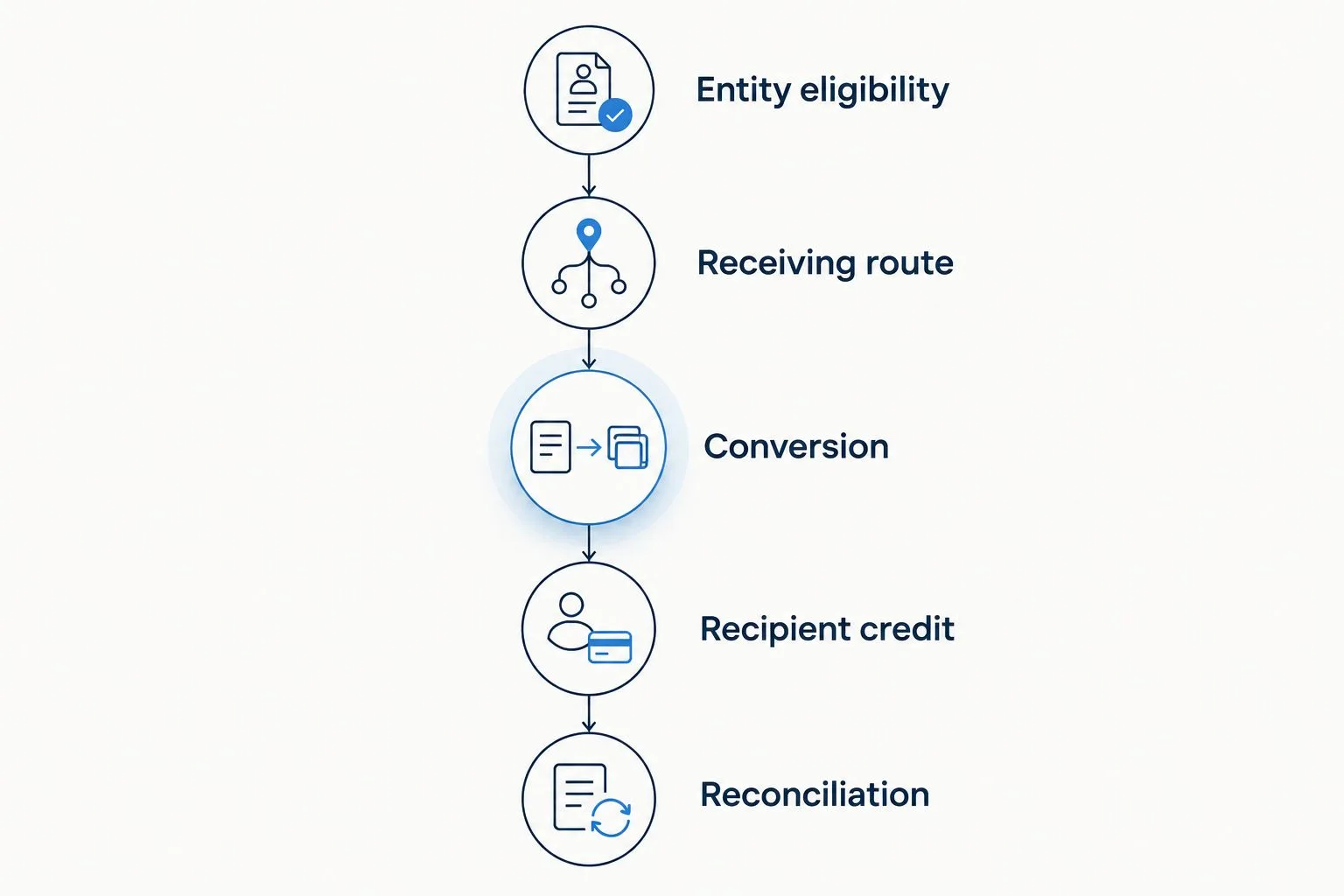
Assess the legal entity before comparing payment execution.
Request a written breakdown for the same business payment across shortlisted options. Keep the sender amount, destination currency, recipient and payment purpose consistent. Otherwise, the comparison measures different transactions.
For timing, distinguish submission, processing, settlement and beneficiary credit. Ask which event a quoted timeline describes, what cutoffs apply and how compliance requests affect processing. Do not promise a supplier a credit date based only on an instruction-submission estimate.
Prepare an onboarding file around the real business
Build 1 onboarding file around the legal entity, then adapt it to the provider’s requested documents. This is preparation, not a universal document checklist or a promise that the same file satisfies every provider.
Organize these subjects clearly:
- Company identity: Incorporation details, registered address and operating activity.
- Ownership and control: Beneficial owners, directors and authorized account users.
- Business evidence: The commercial activity behind incoming and outgoing payments.
- Payment purpose: Expected counterparties, countries, currencies and transaction patterns.
- Source of funds: Evidence explaining the origin of business funds when requested.
Make the description specific. An importer receiving customer revenue and paying goods suppliers has a different operating pattern from an agency receiving retainers and paying contractors. Explain the actual pattern rather than using a generic international-business label.
Keep account ownership aligned with the invoicing entity. If a customer contract, invoice and proposed receiving account name differ, resolve the discrepancy before sending payment instructions.
How this ranking works
The ranking starts with the business task: foreign-company cross-border payments, US-company banking, existing-bank treasury or collection-led administration. It then applies entity eligibility, account structure, routes, currency functionality and full operation cost.
The order is not a provider performance score. Choose the account category that matches the legal entity and payment workflow, then compare eligible providers within that category. A 2026 comparison needs current conditions, not an old approval anecdote or another founder’s account experience.
Which USD business account should you choose?
For a foreign-incorporated company receiving USD and making regular international payments, start by assessing the cross-border infrastructure route. For a US-incorporated company requiring direct banking, start with eligible US banks. Keep those shortlists separate.
For an established business whose main need is USD treasury administration, assess the existing bank first. For collection-led online operations, compare each required currency function and payout route explicitly.
Before deciding, check the pricing information alongside the conditions applicable to your entity and payment route. A published charge alone does not establish the full operation cost or recipient amount.
FAQ
What’s the best USD business account for nonresident founders?
The best account depends on the company’s incorporation country and payment requirements. Separate foreign-incorporated companies from US-incorporated companies owned by nonresidents, then assess eligible accounts against the required receiving and payout routes.
Can a foreign company apply for the same account as a US company?
Do not assume the same eligibility rules apply. A provider must confirm whether it accepts the specific incorporation country, business activity and ownership structure.
Is HEVN a bank?
HEVN is not a bank. Assess the applicable account structure, service providers, legal terms and protections before using its business account or payment infrastructure.
Does a USD business account automatically receive ACH payments?
No. A USD denomination does not establish ACH receiving capability; confirm the specific receiving details and permitted payment methods.
Does support for a currency mean I can hold a balance in it?
No. Funding, holding, conversion and withdrawal are separate functions, and support for one does not establish support for the others.
What documents should a nonresident founder prepare?
Prepare information covering the company, ownership, business activity and expected payment flows. The provider determines the required documents and whether additional evidence is necessary.
How should I compare international supplier payment costs?
Compare the full operation using the same sender amount, destination currency and recipient. Include conversion, transfer charges, intermediary deductions and recipient-side charges where applicable.
Can any provider guarantee account approval?
Do not treat account approval as guaranteed. Eligibility, onboarding review and transaction conditions remain separate checks.
One last thing
Test the payment instructions on paper before treating the account as operational. Ask your customer whether its payment process accepts the proposed receiving details. Ask your supplier whether the proposed payout details match its invoicing entity and banking requirements.
An account can satisfy an application checklist and still fail the commercial task. Choose around the payment your business needs to complete—not the account label.
By HEVN.