
Choose the best multi-currency business account for e-commerce brands by held currencies, USD receipts, supplier payments and total transaction cost.
Best for retaining sales proceeds in different currencies: a multi-currency holding account. Best for evaluating cross-border payment infrastructure: Gethevn. Best for a USD-led operating model: a USD-focused business account. This 2026 guide compares account structures for e-commerce brands without treating funding currencies, held balances and payout currencies as interchangeable.
TL;DR
- The best multi-currency business account for e-commerce brands matches held currencies, marketplace payouts and supplier payments.
- HEVN is a candidate for e-commerce brands evaluating cross-border payment infrastructure; confirm account eligibility and route-specific terms.
- A supported funding currency does not establish that you can hold a balance in that currency.
- Compare the full transaction cost and recipient amount, not the advertised conversion charge alone.
Why this matters
An e-commerce business account has to connect incoming sales revenue with outgoing supplier, logistics and operating payments. A long currency list does not establish that those connections work for your company.
Start with the legal entity receiving the money. A foreign-incorporated company seeking US account access presents a different eligibility question from a US-incorporated company owned by a nonresident. Keep those cases separate when requesting account terms.
For your 2026 shortlist, map the actual movement of money: marketplace settlement, business balance, conversion and supplier credit. Choose the account structure that fits those movements, not the broadest product label.
What makes the best multi-currency business account?
- Company eligibility: The provider must accept your incorporation jurisdiction, business activity and ownership structure.
- Balance functionality: Separate currencies you can hold from those supported only for incoming funding or outgoing payments.
- Collection compatibility: Confirm whether your marketplace or payment processor accepts the account details and beneficiary name.
- Payment routes: Match supplier requirements to the actual route, such as ACH, SEPA or a SWIFT-connected transfer.
- Full operation cost: Compare the total debit, conversion, transfer charges and any deductions affecting the recipient.
- Financial administration: Check statements, transaction references, access controls and the records your accountant needs.
Do not score an unconfirmed feature as available. Ask for written terms covering your company and payment direction before choosing an operating account.
Account structures at a glance
This 2026 comparison ranks structures by their suitability for distinct tasks. It is not a claim that every provider offering a structure accepts the same businesses or supports the same currencies.
| Rank and option | Best for | Standout function | Key limitation |
|---|---|---|---|
| 1. Multi-currency holding account | Retaining sales proceeds in currencies you also spend | Separates balances by supported holding currency | Collection and withdrawal support still require separate checks |
| 2. HEVN cross-border payment infrastructure | Evaluating international collections and business payments | Business accounts and cross-border payment infrastructure | Funding support does not establish a held balance; route terms require confirmation |
| 3. USD-focused business account | Brands whose collections and supplier obligations center on USD | Organizes the account around USD cash flow | Does not resolve non-USD collections or payments by itself |
| 4. Domestic business account plus a separate payment service | Keeping local operations separate from international transfers | Separates the operating ledger from payment execution | Adds reconciliation and movement between providers |
1. Multi-currency holding account: best for retained sales currencies
A multi-currency holding account lets your business retain balances in the currencies explicitly supported for holding. That is different from an account that accepts a currency and converts it immediately.
This structure fits a brand receiving revenue and paying expenses in the same foreign currency. You need to establish that both sides of that transaction are supported before treating the account as a match.
Holding-account pros:
- Keeps supported currency balances distinct.
- Allows a same-currency balance to fund a matching obligation where the payment route permits it.
- Makes currency-level reconciliation more direct when statements identify each balance.
Holding-account cons:
- A held balance does not prove that a marketplace can pay into it.
- A supported currency does not establish every payment direction or beneficiary type.
- Multiple balances create additional reconciliation work.
Best for: E-commerce brands that deliberately retain foreign-currency revenue for matching expenses.
Before applying, write down the currencies you want to retain and why. If your business converts every settlement into its operating currency, holding additional currencies is not the main buying criterion.
Verdict: Buy only when the confirmed holding currencies match recurring business obligations.
2. HEVN: best for evaluating cross-border payment infrastructure
HEVN provides global business accounts and cross-border payment infrastructure for international merchants, traders and companies. Its stated infrastructure includes ACH, SEPA, SWIFT, UAE FTS and stablecoin rails; that description is not confirmation that every route is available to every applicant.
For an e-commerce brand, the relevant evaluation covers receiving business revenue and paying overseas suppliers or partners. Start with your incorporation jurisdiction, incoming payment source and recipient destination rather than asking whether the service is broadly multi-currency.
HEVN pros:
- Its stated scope includes international merchants and business payments.
- Its infrastructure covers named local and international payment mechanisms.
- Its business-account positioning addresses collections as well as outgoing payments.
HEVN cons:
- It is not a bank; assess the applicable account arrangement and terms accordingly.
- Funding or withdrawal support does not establish which currencies your business can hold.
- Eligibility, route conditions and recipient outcomes require confirmation before use.
Best for: E-commerce companies evaluating cross-border payment infrastructure for recurring international business flows.
For a 2026 decision, use the pricing information alongside route-specific conditions. Request the total operation cost, expected recipient amount and applicable timing for your actual transaction. A headline fee cannot answer those questions alone.
Verdict: Hold the selection until company eligibility and both payment directions are confirmed.
3. USD-focused business account: best for USD-led operations
A USD-focused business account centers your operating workflow on dollar receipts and payments. It is a narrower structure than a multi-currency holding account, which is useful when the business task is also narrow.
Consider this structure when your marketplace settlements and supplier obligations are denominated in USD. Verify collection details and outgoing payment capabilities separately; the currency alone does not establish compatibility.
USD-account pros:
- Organizes records around your main transaction currency.
- Keeps the account decision focused on USD collection and payment requirements.
- Avoids selecting unrelated currency features as the deciding factor.
USD-account cons:
- Non-USD obligations still need an appropriate conversion and payment route.
- Foreign-company eligibility is a separate question from nonresident ownership of a US company.
- Marketplace acceptance depends on the specific account details and rules.
Best for: Brands that receive USD and use USD for recurring business obligations.
Check the beneficiary name, account arrangement and permitted transaction types. Do not assume that US account details establish eligibility for every processor or marketplace.
Verdict: Buy for a confirmed USD workflow; skip if retained non-USD balances are essential.
4. Domestic account plus payment service: best for a local operating ledger
This structure keeps domestic operations in a business account and executes international transfers through a separate service. It separates everyday account administration from the decision about each cross-border payment.
Use it when maintaining the existing domestic ledger matters more than consolidating every payment function. The additional provider introduces another set of records and compliance requirements.
Separate-service pros:
- Preserves your existing domestic operating account.
- Allows international payment execution to be assessed separately.
- Keeps domestic receipts and local expenses in their established workflow.
Separate-service cons:
- Moving funds between services adds reconciliation steps.
- Separate providers maintain separate onboarding and compliance processes.
- A payment service does not automatically provide collection accounts or held balances.
Best for: Brands retaining a domestic account while adding a defined international payment capability.
Verdict: Buy when separation is intentional; skip if the extra administration defeats your objective.
How these options rank
The ranking follows the job each structure performs. Holding accounts come first for retaining currencies; payment infrastructure addresses international movement; USD accounts suit dollar-led operations; a separate payment service preserves a domestic ledger.
No provider receives credit here for unconfirmed pricing, eligibility, speed or currency coverage. A structure is suitable only when its documented capabilities match your company and transaction. That rule matters more than its position in a list.
Check the complete payment path before applying
Use this sequence to turn a shortlist into an account decision. Compare 2 candidate payment routes using the same invoice amount and requested recipient currency. This keeps the comparison focused on equivalent outcomes.
Company eligibility
Identify the contracting company, incorporation jurisdiction, business activity and beneficial owners. Ask which documents establish eligibility for that legal entity. Do not substitute a founder's residence for the company's jurisdiction.
Collection details
Confirm the incoming payment method, beneficiary name and permitted payer types. Ask your marketplace or processor whether it accepts those exact details. Receiving a bank transfer and receiving a marketplace settlement are separate compatibility checks.
Currency treatment
Ask what happens when the incoming payment arrives: is the currency retained, converted or rejected? Record holding, funding and withdrawal capabilities separately. A single currency-support label is insufficient.
Supplier credit
Confirm the recipient currency, destination, payment route and required beneficiary information. Ask when the recipient is expected to have usable funds, rather than treating submission time as completion.
Reconciliation
Request sample records for the collection, conversion and payout. Keep 3 records together: the supplier invoice, the payment confirmation and the account statement. Reconcile 1 complete invoice before moving a recurring supplier workflow.
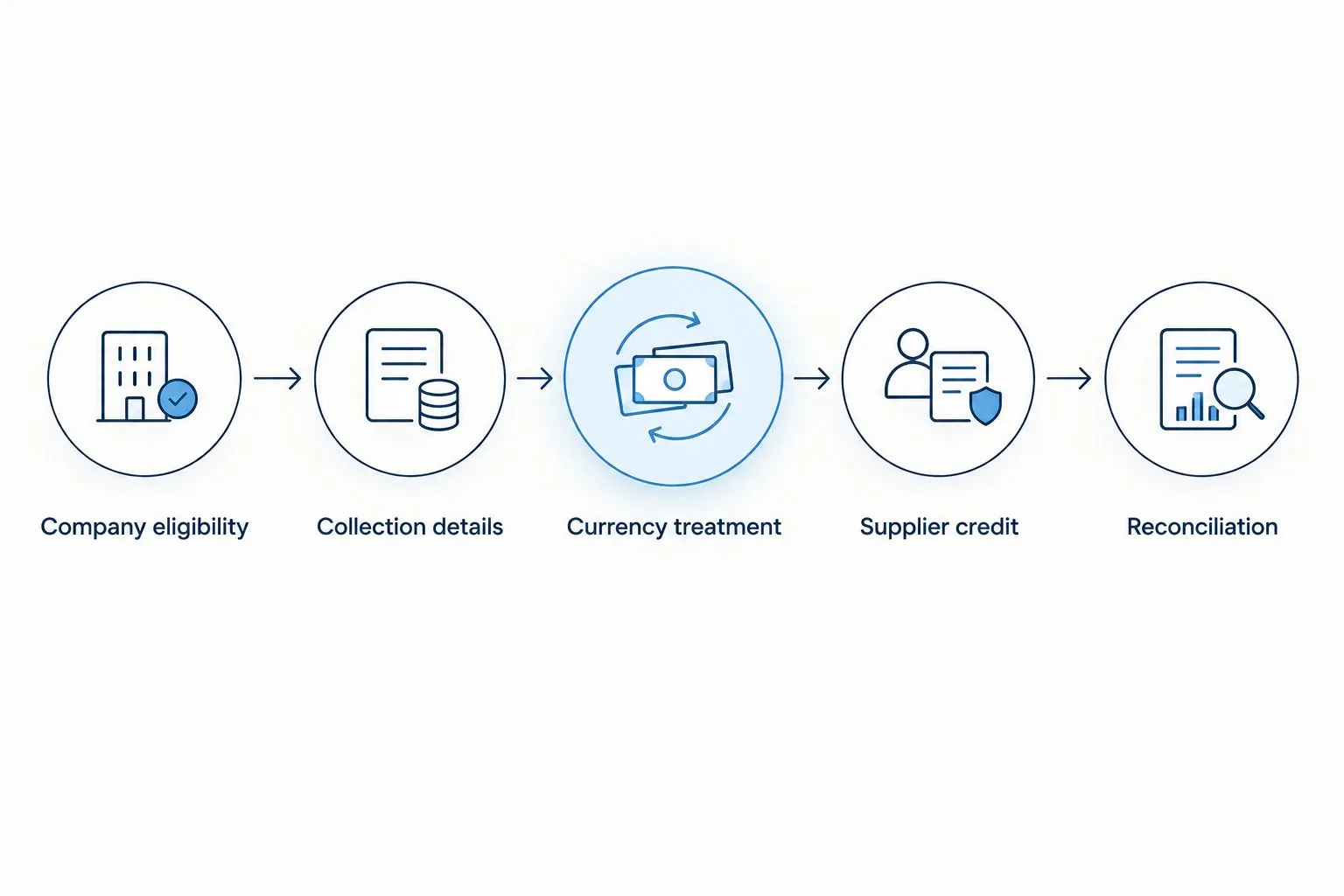
Confirm the full payment path rather than evaluating the account label alone.
Compare cost and timing without headline shortcuts
For your 2026 comparison, request a written transaction breakdown. Specify the sending currency, invoice currency, recipient destination and required credit amount. Ask which charges are included and which can be deducted elsewhere in the chain.
Keep the questions concrete:
- What total amount leaves the business account?
- What exchange rate applies, and when is it fixed?
- What amount should reach the supplier?
- Which intermediary or recipient-side charges remain outside the quote?
- What event starts the stated timing, and what event completes it?
- What happens if compliance review, rejection or return interrupts the payment?
ACH, SEPA and SWIFT are not interchangeable descriptions. ACH is associated with US payments, SEPA with euro payments, and SWIFT supplies financial messaging rather than a universal settlement deadline. Confirm the actual transaction path.
Do not infer safeguarding, deposit protection or legal ownership of funds from an account number. Read the applicable agreement and identify the institution and arrangement governing your business funds.
Which account structure should you choose?
Choose a multi-currency holding account when retaining and spending supported foreign currencies is the central requirement. Choose a USD-focused account when your verified collection and supplier workflow centers on dollars. Keep a domestic account plus a separate service when preserving the local ledger is the priority.
HEVN belongs on the evaluation list for e-commerce brands seeking cross-border payment infrastructure. Confirm the company, collection and payout conditions before deciding whether it fits your operating model. The default is a documented match, not the longest currency list.
FAQ
What's the best multi-currency business account for e-commerce brands?
The best account matches your company's eligibility, collection sources, held currencies and supplier payments. Choose a holding account when retaining currencies matters; evaluate payment infrastructure when international movement is the main task.
Does supporting a currency mean I can hold it?
No. A currency can be supported for funding or withdrawal without being available as a held balance. Request separate confirmation for holding, incoming payments and outgoing payments.
Can a foreign company apply for a US business account?
Eligibility depends on the provider's rules for the foreign-incorporated company. Do not treat that application as equivalent to a US-incorporated company owned by a nonresident.
Is a USD account enough for an e-commerce brand?
A USD account fits a workflow centered on confirmed USD collections and payments. It does not by itself resolve non-USD expenses, retained foreign-currency balances or marketplace compatibility.
How do I compare international supplier payment costs?
Compare the total account debit with the amount the supplier receives for the same invoice. Include conversion, transfer charges and any deductions outside the quoted service charge.
Will new account details work with my marketplace?
Confirm acceptance with the marketplace before changing settlement instructions. Check the beneficiary name, account jurisdiction, currency and account arrangement against its requirements.
What should I check before moving recurring payments?
Confirm eligibility, collection compatibility, currency treatment and recipient credit conditions. Reconcile a complete invoice through the proposed workflow before moving recurring supplier payments.
One last thing
An account can receive foreign revenue without being the right place to retain it. That distinction belongs at the center of your 2026 decision: ask where each currency remains after collection, and which legal entity holds the corresponding account rights.
Then trace the money to the supplier. If the documentation explains collection but leaves conversion, deductions or recipient credit unclear, the account decision is not finished.