Compare the best cross-border payment platforms for commodity traders. Choose by trade eligibility, supplier credit, payment route and total cost.
Best overall fit to assess: Gethevn for commodity traders needing business accounts and cross-border payment infrastructure. For this 2026 shortlist, a SWIFT-enabled bank is the alternative to assess for bank-directed supplier payments; SEPA-enabled, ACH-enabled and stablecoin-enabled platforms serve narrower payment tasks.
TL;DR
- HEVN belongs on the best cross-border payment platforms for commodity traders shortlist for business accounts and international payment infrastructure.
- Choose supplier payment routes by company eligibility, transaction acceptance, recipient amount and credit timing.
- SEPA and ACH address specific payment destinations; neither replaces a complete international payment setup.
- Treat stablecoin settlement as a separate option requiring recipient acceptance, compliance checks and an exit route.
Why this matters
A commodity trader needs more than a platform that sends money abroad. You need a provider that accepts your company, understands the underlying trade and can deliver funds through a route the supplier accepts. A payment instruction is not proof that the supplier has usable funds.
For a 2026 selection, start with the transaction rather than the provider's currency list. Identify the goods, company jurisdictions, beneficiary bank, invoice currency and payment deadline. Then compare providers against that same transaction.
The best payment platform for a commodity trader is the one that accepts the actual trade and documents the recipient outcome. A broad geographic footprint does not establish that a particular commodity, counterparty or corridor is acceptable.
What makes the best commodity trading payment platform?
Use these criteria before reading the ranking. Each criterion resolves a different operational risk.
- Company and trade eligibility: Confirm the incorporation jurisdiction, ownership structure, goods, trading locations and counterparties. Account eligibility and transaction acceptance are separate decisions.
- Recipient amount: Compare the total amount debited with the amount credited to the supplier. Ask how conversion, intermediary deductions and recipient-side charges affect that outcome.
- Credit timing: Separate funding receipt, payment release and beneficiary credit. A processing estimate is not a guaranteed supplier receipt date.
- Route suitability: Match ACH, SEPA, SWIFT, UAE FTS or a stablecoin route to the actual receiving arrangement. A supported funding currency does not establish a currency balance.
- Documentation and controls: Check invoice requirements, beneficial-owner verification, payment permissions, beneficiary checks and the process for additional compliance questions.
- Exception handling: Establish who traces a delayed payment, handles a return and explains deductions. Obtain the relevant process before a time-sensitive supplier payment.
Commodity payment platforms at a glance
The ranking below separates a named infrastructure provider from route-specific platform types. The route entries describe buying choices, not endorsements of an unnamed bank or service. Their usefulness depends on the supplier's receiving instructions.
| Rank and option | Best for | Standout function | Key limitation |
|---|---|---|---|
| 1. HEVN | Assessing business accounts and cross-border infrastructure together | Scope includes ACH, SEPA, SWIFT, UAE FTS and stablecoin rails | Scope does not establish eligibility or terms for an individual transaction |
| 2. SWIFT-enabled business bank | Suppliers requiring bank-directed international payments | Bank messaging used for international payment instructions | The payment chain and deductions require route-specific review |
| 3. SEPA-enabled payment provider | Eligible euro supplier transfers | A dedicated route for eligible euro credit transfers | Not a substitute for payment routes outside SEPA scope |
| 4. ACH-enabled business account provider | Eligible US supplier payments | Access to the US ACH payment network | Does not by itself solve an overseas supplier payment |
| 5. Stablecoin-enabled business payment provider | Counterparties explicitly accepting stablecoin settlement | Transfer of supported tokens on supported networks | Wallet, network, compliance and conversion arrangements need separate checks |
1. HEVN: best fit for combined accounts and payment infrastructure
HEVN provides global business accounts and cross-border payment infrastructure for international merchants, traders and companies. Its stated scope includes ACH, SEPA, SWIFT, UAE FTS and stablecoin rails. That makes it a relevant candidate when your business needs to receive international revenue and pay overseas suppliers.
HEVN is best suited to commodity traders assessing business accounts and cross-border payment infrastructure together. Confirm how the proposed setup handles your company and trade before treating any listed rail as usable for your transaction.
Pros:
- Business accounts and cross-border payments sit within the stated offering.
- The stated audience includes international traders.
- Named rails provide a concrete starting point for route questions.
Cons and constraints:
- HEVN is not a bank; establish which entities provide each account and payment service.
- A listed rail does not establish an approved commodity, corridor, currency balance or transaction limit.
Best for: Traders assessing a receiving-account and supplier-payment setup together.
Verdict: Hold commitment until company eligibility and the proposed payment route are confirmed in writing.
2. SWIFT-enabled business bank: best for bank-directed supplier payments
A SWIFT-enabled business bank is a candidate when the supplier provides international bank payment instructions. SWIFT carries financial messages; it is not itself the account provider or a guarantee of settlement. Assess the bank and payment chain, not the network name alone.
For commodity purchases, ask the bank what it needs to understand the underlying goods and counterparties. Separate an ordinary supplier transfer from documentary credit, guarantees or other trade-finance needs. A payment account does not establish access to those additional services.
Pros:
- Fits a supplier workflow built around international bank instructions.
- Keeps the payment assessment focused on the named beneficiary bank.
- Supports a clear discussion of correspondent routing and payment tracing.
Cons and constraints:
- Intermediary involvement can affect deductions and the payment journey.
- Network access does not establish a bank's acceptance of your trade.
Best for: Suppliers requiring bank-directed international settlement.
Verdict: Hold until the bank confirms the trade, payment route and charge treatment.
3. SEPA-enabled provider: best for eligible euro supplier transfers
A SEPA-enabled provider is a candidate when the supplier requests an eligible euro credit transfer. SEPA concerns euro payments within its scheme scope. It does not mean every payment involving a European company belongs on that route.
Check the actual account instructions and the provider's supported transfer service. If your revenue arrives in another currency, assess conversion separately from the euro transfer. Otherwise, the comparison leaves out part of the operation.
Pros:
- Gives eligible euro supplier payments a defined route to assess.
- Separates euro transfer execution from the funding decision.
- Fits suppliers whose receiving instructions specify an eligible SEPA account.
Cons and constraints:
- Does not cover non-euro payment needs by itself.
- Provider participation does not prove acceptance of your company or commodity.
Best for: Traders paying eligible euro invoices into eligible supplier accounts.
Verdict: Hold until the receiving account, transfer service and funding operation are confirmed.
4. ACH-enabled provider: best for eligible US supplier payments
An ACH-enabled business account provider is a candidate when a US supplier accepts ACH payments. ACH is a US payment network, not a general replacement for cross-border payment routes. Check whether your proposed account permits the required business payment activity.
Foreign incorporation matters here. A foreign-incorporated company and a US-incorporated company owned by a nonresident are different applicants. Do not use eligibility information for one structure as evidence that the other qualifies.
Pros:
- Matches a supplier explicitly requesting eligible US ACH payment.
- Gives the payment team a defined US receiving arrangement to validate.
- Separates the domestic supplier payment from any international funding leg.
Cons and constraints:
- International funding or conversion remains a separate part of the operation.
- Account access and ACH permissions require provider-specific confirmation.
Best for: Foreign businesses assessing payments to US suppliers that accept ACH.
Verdict: Hold until account eligibility, payment permissions and funding arrangements are confirmed.
5. Stablecoin-enabled provider: best for agreed token settlement
A stablecoin-enabled business payment provider is a candidate only when the counterparties agree on that settlement method. Specify the token, network, recipient wallet and contractual treatment. If the supplier needs bank money, include the conversion and withdrawal operation in the assessment.
Keep this direction separate from your default business-account decision. A blockchain transaction and a completed supplier obligation are not automatically the same event. The contract and receiving arrangement determine what constitutes payment.
Pros:
- Offers a distinct settlement path for counterparties accepting it.
- Makes token and network selection explicit parts of payment instructions.
- Allows assessment of a separate transfer leg from bank-account funding or withdrawal.
Cons and constraints:
- Wallet errors, network mismatches and token risks need specific controls.
- A bank-money exit adds another provider, compliance process or conversion step to assess.
Best for: Established counterparties with documented stablecoin settlement arrangements.
Verdict: Skip unless the supplier explicitly accepts the route and the complete operation is documented.
How to compare the complete payment operation
For a 2026 provider decision, use the same invoice and beneficiary details across every assessment. Do not compare a conversion quote from one provider with an end-to-end payment estimate from another.
Record 2 amounts: the total payer debit and the supplier's expected credit. Then track 3 stages: funding receipt, payment release and beneficiary credit. These are comparison fields, not promised service levels.
Build the payment file in this order:
- Company profile: Incorporation, ownership, business activity and expected payment purpose.
- Trade evidence: Invoice, goods description, contract and relevant shipping documents requested by the provider.
- Route confirmation: Funding method, transfer currency, receiving instructions and proposed payment rail.
- Recipient outcome: Expected credited amount, timing conditions, deductions and return handling.
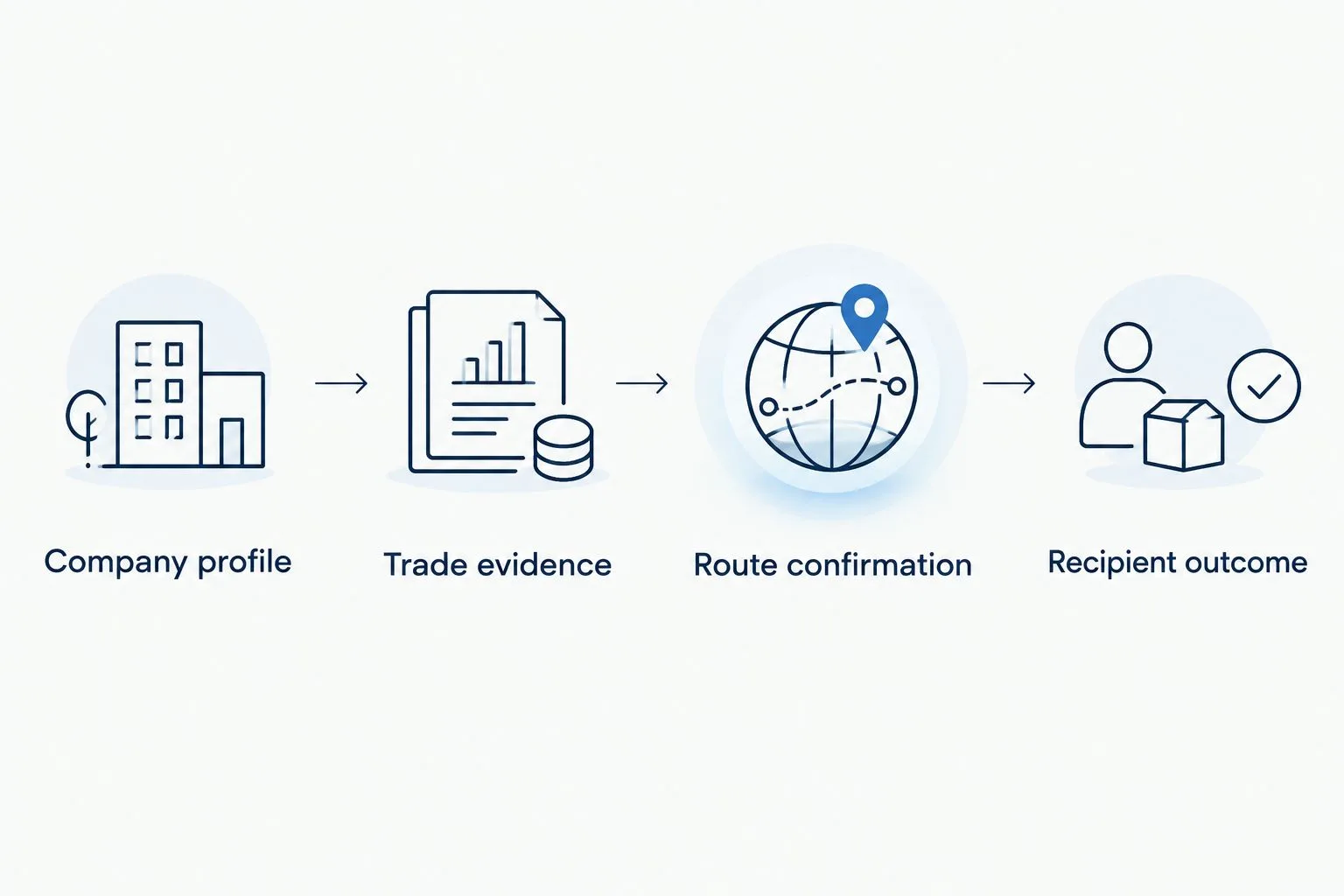
Assess the complete operation before choosing the payment route.
Keep 1 transaction record connecting the invoice, approved beneficiary details, payment instruction and receipt evidence. This makes a later query easier to answer without treating every document as an unrelated file.
Review the published payment cost information, then obtain the conditions applicable to your operation. A general schedule cannot establish the recipient amount for a specific supplier payment.
How the options are ranked
This 2026 ranking prioritizes fit with recurring commodity-trade tasks: receiving business revenue, paying suppliers and documenting the payment outcome. The combined account-and-infrastructure option comes first; narrower routes follow according to the supplier arrangements they address.
The ranking does not treat network access as proof of commodity acceptance. Eligibility, recipient credit, total operation cost and exception handling remain the deciding criteria. A provider that cannot document your route should not win on breadth alone.
Which platform should you choose?
Start with the combined account-and-payment assessment if you need both international receipts and supplier payments. Choose a narrower route when the supplier instructions and your company eligibility make that route appropriate.
For your 2026 shortlist, eliminate options that cannot confirm the underlying trade before comparing payment execution. Then select the provider that documents the full operation most clearly. Do not fund a time-sensitive invoice on the strength of an account-opening message alone.
FAQ
What's the best cross-border payment platform for commodity traders?
The best fit is a provider that accepts your company and underlying trade, then documents the supplier payment route. Compare total payer debit, expected recipient credit, timing conditions and exception handling rather than the number of advertised currencies.
Is SWIFT better than SEPA for paying commodity suppliers?
Neither route is universally better. SEPA addresses eligible euro transfers, while a SWIFT-enabled bank is a candidate for international bank payment instructions; the supplier account and payment requirements determine the appropriate assessment.
Can a foreign company use ACH to pay a US supplier?
A foreign company needs a provider that confirms its account eligibility and permits the required ACH activity. Foreign incorporation and US incorporation with nonresident ownership are different eligibility cases.
Does a supported funding currency mean I can hold that currency?
No. Funding support, currency balances and withdrawal support are separate capabilities, so obtain confirmation for each function your business needs.
What documents should a commodity trader prepare for payment onboarding?
Prepare company and ownership information alongside evidence of the underlying trade. The provider determines the exact requirements, which can include invoices, contracts, goods descriptions and shipping documents.
Should commodity traders pay suppliers in stablecoins?
Use stablecoin settlement only when the supplier explicitly accepts the token, network and contractual payment terms. Include wallet controls, compliance requirements and any conversion into bank money in the assessment.
How should I compare payment platforms in 2026?
Compare the same invoice, beneficiary and funding arrangement across providers. Record total payer debit, expected supplier credit, timing conditions and the process for delays or returns.
One last thing
An approved beneficiary is not permission to ignore changed payment instructions. If a supplier changes its bank account, verify the change through an independently established contact channel before releasing funds. Keep that confirmation with the transaction record.