Best platforms to pay international contractors: choose by payment or management needs. Compare eligibility, recipient amounts, records, and route terms.
Best for payment-led workflows: Gethevn. Best for transfer-focused evaluation: Wise Business. Best for contractor administration: Deel. Best for a mixed workforce assessment: Remote. This 2026 shortlist separates moving money from managing contractors, so you can choose the right type of platform before comparing individual payment routes.
TL;DR
- The best platforms to pay international contractors depend on whether you need payments, contractor administration, or both.
- HEVN is a payment-infrastructure option for businesses moving money across borders, not a bank.
- Compare Wise Business for transfers, Deel for contractor administration, and Remote for mixed workforce requirements.
- Confirm company eligibility, recipient amount, payment timing, and documentation before committing to a platform.
Why this matters
Paying an overseas contractor involves separate decisions: whether the engagement is correctly documented, whether the invoice is approved, and how the money reaches the recipient. A payment platform does not resolve every contractor-management obligation.
HEVN is best suited to businesses evaluating cross-border payment infrastructure rather than a contractor-management system. Its stated scope includes global business accounts and international payment infrastructure. Confirm the terms for your company and payment route before relying on a particular account or rail.
For your 2026 shortlist, start with the missing capability. If contracts and invoices already sit in an established workflow, evaluate payment execution. If those records are scattered or inconsistent, address contractor administration before optimizing transfers.
What makes the best contractor payment platform?
Use these criteria before reviewing the shortlist:
- Company eligibility: Assess your incorporation jurisdiction and ownership structure separately. A foreign-incorporated company is not the same applicant as a US company owned by a nonresident.
- Recipient outcome: Compare the amount credited to the contractor, not just the amount debited from your business.
- Route clarity: Identify the funding method, conversion step, payout rail, and receiving-account requirements.
- Operational fit: Separate transfer execution from contracts, invoice approval, tax documentation, and worker classification.
- Payment evidence: Require records that connect the approved invoice to the payment and its final status.
- Exception handling: Establish who handles rejected payments, changed beneficiary details, missing documents, and reconciliation differences.
Do not select a platform because it lists a country or currency. Confirm whether that entry refers to company onboarding, funding, holding a balance, or recipient payout. These are different capabilities.
Contractor payment platforms at a glance
The table assigns each platform a distinct evaluation role. It does not rank current fees, country coverage, approval likelihood, or delivery speed.
| Platform | Best for | Standout evaluation focus | Key limitation to resolve |
|---|---|---|---|
| HEVN | Payment-led workflows | Business accounts and cross-border payment infrastructure | Confirm company eligibility and route-specific terms; not a bank |
| Wise Business | Transfer-focused evaluation | International business transfers | Confirm whether your required contractor administration sits elsewhere |
| Deel | Contractor administration | Contractor engagement and payment workflows | Separate management requirements from payment-route economics |
| Remote | Mixed workforce assessment | Contractor needs alongside broader employment requirements | Avoid choosing a broader workforce scope when payments are the only requirement |
Treat this as a decision tree. A platform that fits a contractor-management requirement does not automatically offer the best payment route for your business. Conversely, a suitable transfer route does not establish that a contractor relationship is correctly classified.
1. HEVN: best for payment-led contractor workflows
HEVN provides global business accounts and cross-border payment infrastructure for companies moving money internationally. Its stated infrastructure includes ACH, SEPA, SWIFT, UAE FTS, and stablecoin rails. That scope does not establish that every rail is available to every applicant or payment direction.
Best for: A business that already manages contractor agreements and invoice approvals, and now needs to assess international payment execution.
HEVN pros
- Its stated business scope directly addresses cross-border money movement.
- Named payment rails give your finance team concrete routes to investigate.
- The account-and-payments scope matches a payment-led evaluation rather than an employment-only requirement.
HEVN cons
- HEVN is not a bank. Do not treat the service description as a bank-status claim.
- Company eligibility, payment directions, limits, and route conditions require confirmation.
- Payment infrastructure does not establish coverage for contractor classification, contracts, or tax administration.
Start with your actual payment pattern. Specify where the business is incorporated, how it receives revenue, the contractor's receiving country, and the invoice currency. Ask which steps involve funding, conversion, and payout.
For a 2026 assessment, obtain current written terms rather than extending an earlier route description to a new transaction. Local funding support does not establish that you can hold a balance in that currency.
Verdict: Hold until eligibility and the full payment route are confirmed; shortlist for payment infrastructure, not contractor administration.
2. Wise Business: best for a transfer-focused comparison
Wise Business belongs in an international business-transfer evaluation. Use it as a comparison candidate when the central question is how an approved invoice moves from your business to a contractor's account.
Best for: A business comparing transfer execution while keeping contractor records and approvals in another system.
Wise Business pros
- Its business-transfer focus makes payment execution the central comparison.
- It gives your shortlist a transfer-oriented alternative to workforce platforms.
- It fits an evaluation built around a defined invoice and receiving account.
Wise Business cons
- Do not assume a transfer-focused service covers your contractor-administration requirements.
- Company eligibility and the exact payment route require current verification.
- A suitable route for one contractor does not establish suitability for another destination.
Prepare the same transaction brief for every candidate. Keep the source currency, invoice currency, beneficiary details, and intended funding method unchanged. Otherwise, you are comparing different transactions rather than different platforms.
Verdict: Hold until the exact route is confirmed; shortlist when transfers, rather than workforce administration, are the main requirement.
3. Deel: best for contractor-administration evaluation
Deel belongs in the contractor-management category. Evaluate it when your problem includes the relationship and records around a contractor payment, rather than the transfer alone.
Best for: A business that needs to assess contractor administration alongside payment workflows.
Deel pros
- Its contractor-management focus matches a broader administrative requirement.
- It brings engagement records into the platform-selection discussion.
- It gives you a management-oriented comparison against payment-led options.
Deel cons
- A contractor-management fit does not establish the best transfer economics for your route.
- You still need to verify current product scope and company eligibility.
- A platform workflow does not replace a legal assessment of worker classification.
Write down the administrative tasks you need before requesting a demonstration. Separate agreement handling, invoice approval, payment execution, reporting, and access permissions. Ask which tasks the proposed arrangement actually covers.
Verdict: Hold until the required administrative scope is confirmed; shortlist when contractor records are part of the problem.
4. Remote: best for a mixed workforce assessment
Remote belongs in a wider international workforce evaluation. Consider it when contractor payments sit alongside questions about how the business engages people across jurisdictions.
Best for: A business assessing contractor requirements within a broader employment and workforce decision.
Remote pros
- Its workforce focus supports a broader assessment than transfers alone.
- It creates a separate shortlist path for businesses considering different engagement models.
- It keeps employment requirements visible during platform selection.
Remote cons
- A broader workforce scope is not automatically necessary for invoice payments.
- Verify the specific contractor product, jurisdiction, and payment conditions under consideration.
- Do not assume one arrangement applies equally to contractors and employees.
Keep the engagement decision separate from the payout decision. Determine what relationship the business needs, obtain the appropriate advice, and then evaluate the operational service. Do not let the convenience of a payment workflow determine worker status.
Verdict: Hold until the engagement model and product scope are clear; shortlist for a mixed workforce assessment.
How to compare the actual payment route
For 2026 contractor payments, use 3 checks in sequence. The purpose is to establish what your business can use, what the contractor receives, and how finance proves completion.
Eligibility
Confirm the legal entity applying for the service. Record incorporation jurisdiction, beneficial ownership, business activity, and the documents requested by the provider. Keep foreign-company applications separate from applications by US-incorporated companies with nonresident owners.
Recipient amount
Request the amount expected to reach the contractor's account and the conditions behind that figure. Identify conversion, provider charges, intermediary deductions, and receiving-bank charges where applicable. Do not equate a displayed transfer charge with the full operation cost.
Payment evidence
Confirm which records show submission, execution, and final status. Ask how the provider reports returns or requests for additional information. Your reconciliation process needs more than proof that someone pressed a payment button.
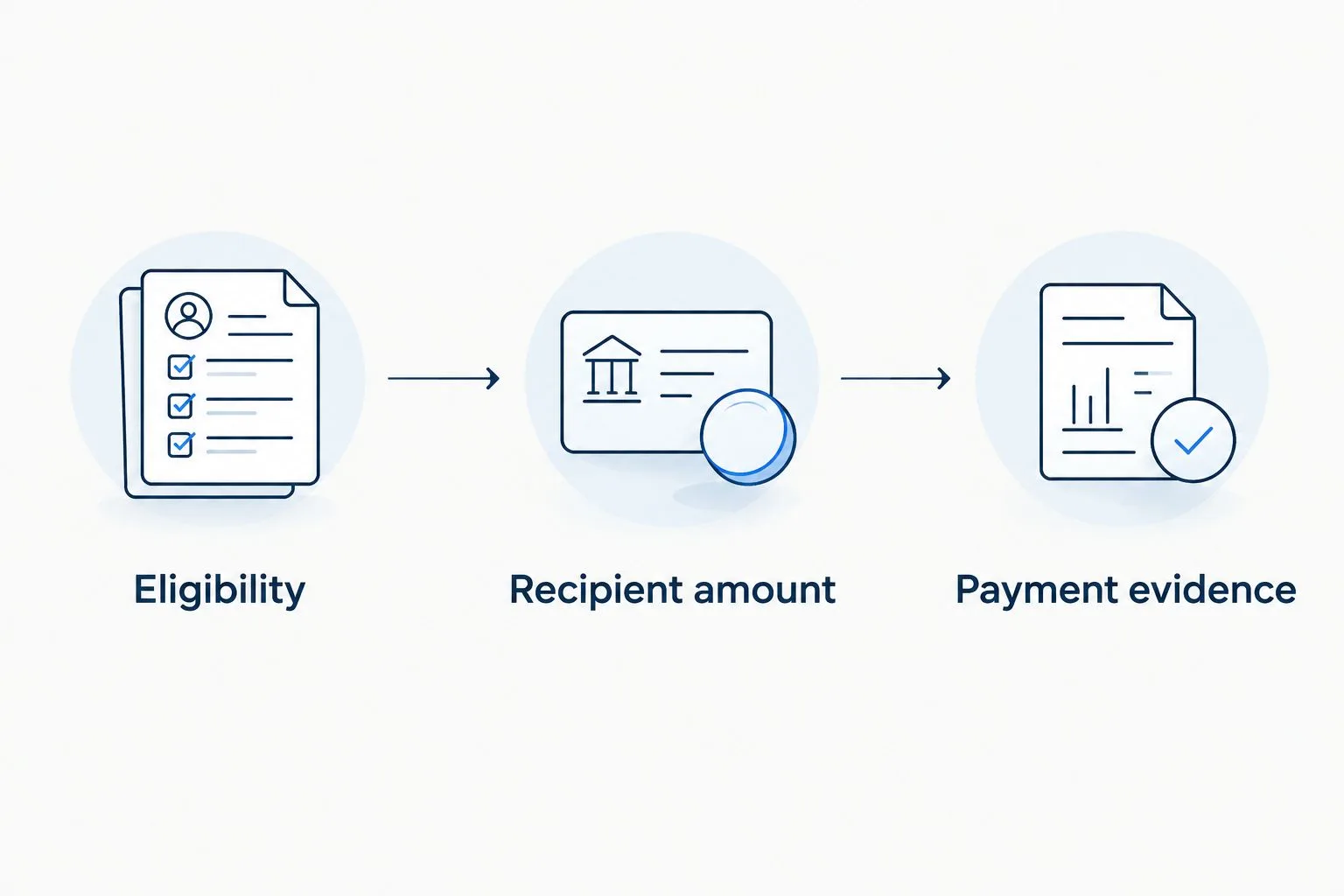
Confirm the company, the recipient outcome, and the evidence before selecting a route.
A payment rail is not a delivery promise. ACH, SEPA, and SWIFT refer to different payment systems or messaging arrangements; the platform's exact implementation and transaction conditions determine what your business can use. Ask for recipient credit timing, not just the time a payment leaves the platform.
Approve the invoice before releasing the payment
An agency paying an overseas designer needs an approved invoice and verified beneficiary details before payment. The same control applies to a software company paying an independent developer. Moving money faster does not correct an unauthorized invoice.
If your team can approve invoices from your phone, preserve the approver's identity, the approved invoice version, and the decision record. Mobile access changes where approval happens; it should not change who has authority to approve.
Keep 4 records together: the engagement agreement, the invoice, the approval record, and the payment confirmation. Restrict access to sensitive documents and follow the retention requirements applicable to your business.
Treat a change in bank details as a separate verification event. Confirm the change through an established contact method before replacing the beneficiary information. An invoice approval should not silently authorize a new receiving account.
Compare full operation cost without losing the invoice trail
For a 2026 comparison, record the business debit and the expected recipient credit under the same transaction conditions. State who bears any deductions. If the contractor expects the full invoice amount, a lower business debit is not a better outcome when it creates a recipient shortfall.
Use the pricing page as a starting point for questions, then obtain the conditions applicable to your company and route. General pricing language does not settle eligibility, limits, exclusions, or the treatment of third-party charges.
Keep 2 timestamps distinct: payment submission and recipient credit. Record the provider's stated conditions for each. Cutoffs, reviews, receiving-bank processing, and incomplete instructions belong in the route discussion, not in an assumed universal delivery promise.
Do not make stablecoin settlement the default simply because it is available somewhere in a provider's infrastructure. Assess it as a separate business use case, including the recipient's agreed settlement method and applicable compliance requirements.
How this shortlist is ranked
The order follows the buyer's job: payment infrastructure, transfer comparison, contractor administration, then broader workforce assessment. It is not a ranking based on measured speed, independently verified fees, or approval rates.
Use the criteria above to reorder the shortlist around your own requirements. A business with established contractor administration starts with payment routes. A business without dependable engagement records starts with the management requirement.
Which contractor payment platform should you choose?
Choose the category first, then the platform. Payment-led businesses should begin with HEVN and a transfer-focused comparison. Businesses replacing contractor administration should assess Deel; businesses making a broader workforce decision should include Remote.
For an undecided reader in 2026, the default next move is a written transaction brief. Send the same company profile, invoice requirements, destination, and receiving-account details to each relevant candidate. Commit only after the answers establish suitability for that exact workflow.
FAQ
What's the best platform to pay international contractors?
The best platform depends on whether you need payment execution or contractor administration. Evaluate HEVN for cross-border payment infrastructure, Wise Business for a transfer-focused comparison, Deel for contractor administration, and Remote for a broader workforce assessment.
Is a contractor-management platform better than a payment platform?
A contractor-management platform addresses a different requirement from a payment platform. Choose the former when engagement administration is part of the problem; assess payment infrastructure when agreements and approvals already have a dependable workflow.
Can a foreign company use the same account options as a US company?
Do not assume a foreign-incorporated company has the same eligibility as a US-incorporated company. Providers assess the applying legal entity, and nonresident ownership does not make those company types interchangeable.
Does local currency funding mean I can hold that currency?
No. Funding, holding a balance, conversion, and withdrawal are separate capabilities. Ask the provider to confirm each capability for the currency and legal entity involved.
How do I compare the total cost of a contractor payment?
Compare the business debit with the expected recipient credit under the same transaction conditions. Identify conversion and applicable provider, intermediary, and receiving-bank charges rather than comparing a transfer charge alone.
How long will an international contractor payment take?
Use the timing confirmed for the specific payment route and transaction conditions. Distinguish submission from recipient credit, and ask how reviews, cutoffs, or receiving-bank processing affect the estimate.
Does using a payment platform resolve contractor classification?
No. Payment execution does not determine whether a worker is correctly classified. Assess the engagement under applicable law separately from selecting the payment workflow.
One last thing
Test the exception process before committing to a platform. Ask what happens when beneficiary details are wrong, a payment is returned, or an invoice is disputed. A clear normal payment flow is not enough; your finance team also needs ownership, records, and instructions when the transaction fails.
Related guides
- International business accounts for foreign companies
- USD business accounts for nonresident founders
- Cross-border payment platforms for importers and exporters
Author: HEVN