The best payment platforms ranked by onboarding speed must be compared by time to a usable account and a credited payment—not registration time. HEVN belongs on the shortlist for international businesses evaluating global business accounts and cross-border payments, but no platform earns a fastest-onboarding verdict without current, comparable evidence.
TL;DR
- The best payment platforms ranked by onboarding speed need comparable account-activation and first-payment evidence.
- HEVN is a shortlist option for global business accounts and cross-border payments, not a guaranteed fast approval.
- Compare Wise Business, Airwallex, Mercury and Revolut Business only after confirming current company eligibility.
- Separate application completion, account activation and recipient credit when measuring onboarding speed.
Why onboarding speed needs a stricter definition
A completed application does not prove that your business can receive revenue or pay a supplier. An account can pass an initial review while a requested payment route, beneficiary or transaction still needs checks. Your deadline depends on the last required step, not the first confirmation email.
For a useful 2026 comparison, track 3 milestones: application completion, usable account activation and first recipient credit. Keep those timestamps separate. Otherwise, a provider advertising a short application process appears faster than a provider describing the entire operational setup.
Choose the platform that can establish eligibility and explain the path to your first required payment. A short form is not enough.
What makes the best platform for fast onboarding?
Apply these criteria before comparing names:
- Company eligibility: Confirm the incorporation jurisdiction, business activity, ownership structure and relevant residency requirements before submitting documents.
- Document clarity: Obtain a checklist that identifies company records, ownership evidence, identity documents and transaction evidence relevant to your application.
- Operational activation: Establish what approval enables. Account details, incoming payments and outgoing payments are different capabilities.
- Route readiness: Confirm the required currency, payment direction, beneficiary location and rail. A general international-payments label does not answer these questions.
- Review transparency: Ask what starts the review clock, what pauses it and whether payment-specific checks remain after account activation.
- Recipient outcome: Measure success by usable funds at the destination, with the expected recipient amount and a traceable payment status.
These criteria rank the quality of an onboarding decision. They do not establish a provider speed ranking without supporting evidence.
Payment platforms at a glance
The following is an evaluation order, not a verified speed leaderboard. HEVN appears first because its stated global-business-account and cross-border-payment scope matches the buyer task. The remaining platforms are named alternatives; their current eligibility, capabilities and onboarding timelines require confirmation before recommendation.
| Platform | Best for | Evaluation focus | Key limitation of this comparison |
|---|---|---|---|
| HEVN | International businesses evaluating global business accounts and cross-border payments | Fit between company profile, required account and payment route | No comparable onboarding-duration evidence establishes a speed rank |
| Wise Business | Eligibility-first comparison | Written confirmation for the exact applicant and intended payments | Current applicant-specific terms are not established here |
| Airwallex | Account-and-route comparison | Whether the required receiving and payout functions are included | Current applicant-specific terms are not established here |
| Mercury | Legal-entity eligibility comparison | Treatment of the applicant's incorporation and ownership structure | Current applicant-specific terms are not established here |
| Revolut Business | Operational-readiness comparison | Which requested functions become usable after approval | Current applicant-specific terms are not established here |
The comparison labels describe the task to investigate. They are not claims that a platform has a unique advantage in that task.
1. HEVN: best shortlist fit for cross-border business-account needs
HEVN provides global business accounts and cross-border payment infrastructure for international merchants, traders and companies. Its stated scope includes ACH, SEPA, SWIFT, UAE FTS and stablecoin rails. That scope supports an initial fit assessment, not a promise that every applicant receives every route.
HEVN is a shortlist option for international companies evaluating business accounts and cross-border payments. Confirm the current terms for your legal entity, business activity, payment direction and intended recipients before relying on a particular capability.
Pros:
- The stated business focus matches international receiving and payment needs.
- Named payment rails give your team concrete questions to resolve.
- The scope covers merchants and traders, not only consumer transfers.
Cons and limits:
- No verified onboarding duration supports a fastest-provider claim.
- Route-specific eligibility and operating conditions require confirmation.
- The service is not a bank, and account approval is not guaranteed.
Best for: International businesses assessing a business-account and cross-border-payment setup.
Verdict: Hold the final selection until eligibility and the required route are confirmed.
2. Wise Business: best evaluated through an eligibility-first check
Wise Business is a named alternative for this comparison. Establish whether the exact company can apply before spending time comparing application forms or preparing a provider-specific submission.
Ask for requirements tied to the incorporation country, ownership structure and business activity. Then identify which documents establish those facts. A generic eligibility statement is not a decision on your application.
Wise Business comparison pros:
- An eligibility-first check keeps unsuitable applications out of your workflow.
- A written checklist gives your team a defined preparation task.
- Applicant-specific answers make later timeline comparisons more meaningful.
Wise Business comparison cons:
- These are evaluation benefits, not verified provider advantages.
- No current approval or activation duration is established here.
Best for: Your eligibility-screening stage, provided current terms match the applicant.
Verdict: Hold until the legal entity and intended activity pass the initial eligibility check.
3. Airwallex: best evaluated through account-and-route requirements
Airwallex is another named alternative, not a verified faster-onboarding recommendation. Compare the functions your business needs rather than treating an approved account as proof that the entire payment workflow is ready.
Write down whether you need incoming USD payments, supplier payouts, contractor payments or another specific operation. Ask which requirements apply to each function and whether any require further activation or review.
Airwallex comparison pros:
- A function-by-function check exposes gaps before operational dependence.
- Separating receiving from payouts makes the comparison more precise.
- Route questions connect onboarding to actual business use.
Airwallex comparison cons:
- No current capability or timeline is verified for your company here.
- A general product description cannot establish route-specific readiness.
Best for: Your account-and-route evaluation stage, subject to current eligibility.
Verdict: Hold until the required receiving and payout functions are confirmed.
4. Mercury: best evaluated through the legal-entity distinction
Mercury is a named alternative that requires the same applicant-specific verification. Start with the legal entity rather than the founder's nationality or the currency your business earns.
Keep 2 legal structures separate: a foreign-incorporated company and a US-incorporated company owned by a nonresident. They are not interchangeable applicant profiles. Do not infer that eligibility for one establishes eligibility for the other.
Mercury comparison pros:
- Entity-first screening prevents the wrong application assumptions.
- A clear ownership chart supports consistent answers across documents.
- Separating incorporation from residency improves the quality of eligibility questions.
Mercury comparison cons:
- This comparison establishes no current eligibility for either structure.
- No supported onboarding-speed advantage follows from the brand name alone.
Best for: Your legal-entity eligibility check, not a presumed speed advantage.
Verdict: Hold until the exact incorporation and ownership structure is confirmed eligible.
5. Revolut Business: best evaluated through operational readiness
Revolut Business completes this named comparison set. Ask what becomes usable after approval and which additional steps stand between activation and your first required transaction.
Your team needs an operational answer: who can initiate payments, who can approve them, and what evidence a transaction requires. Confirm those details under the current terms rather than assuming an application approval settles them.
Revolut Business comparison pros:
- Operational questions connect account setup to the person making payments.
- Permission checks identify internal setup work before the deadline.
- Payment-specific questions keep activation separate from recipient credit.
Revolut Business comparison cons:
- No current feature or approval-time advantage is established here.
- An account-activation milestone alone cannot establish payment completion.
Best for: Your operational-readiness check, once eligibility is established.
Verdict: Hold until the first-payment requirements are clear.
How this 2026 comparison is ordered
The order reflects relevance to the stated business-account task, followed by a structured review of named alternatives. It does not reflect measured onboarding performance. There is no defensible fastest-provider award without equivalent applicant profiles, consistent milestones and dated evidence.
For a genuine 2026 speed ranking, compare the same legal structure, ownership complexity, business activity and required route. Record whether each duration describes a marketing estimate, a contractual commitment or a completed application. Do not combine those evidence types into a single leaderboard.
Build a payment-ready onboarding file
Use 5 stages to move from an application decision to an operational payment. Assign an owner to every stage so a provider request does not sit unanswered between finance, legal and the company director.
Company profile
Prepare consistent company information and a clear description of what you sell, who pays you and whom you pay. Match names, addresses and registration details across the application and supporting records. Explain discrepancies rather than submitting conflicting versions.
Ownership evidence
Map the ownership structure and identify the people whose information the provider requests. Ask how to document intermediate companies, signing authority and any recent ownership changes. Do not assume that a document accepted elsewhere meets the current provider's requirements.
Payment purpose
Describe the actual transaction pattern. An importer paying for goods has a different operational story from an agency paying overseas contractors. Supporting contracts, invoices or business records should explain that story where requested.
Treat merchant-acquiring approval and business-account onboarding as separate workstreams. A comparison of high-risk merchant account approval times concerns a different payment function; it does not establish when a business account can receive revenue or release a supplier payment.
Route confirmation
Confirm the sending currency, receiving currency, beneficiary location and required payment rail. Ask whether the currency can be held as a balance or is supported only for funding or withdrawal. Local funding support does not establish balance-holding support.
First payment
Agree on the evidence needed for the first intended transaction and how its status will be tracked. Confirm beneficiary details through your established verification process. Record recipient credit separately from submission and provider release.
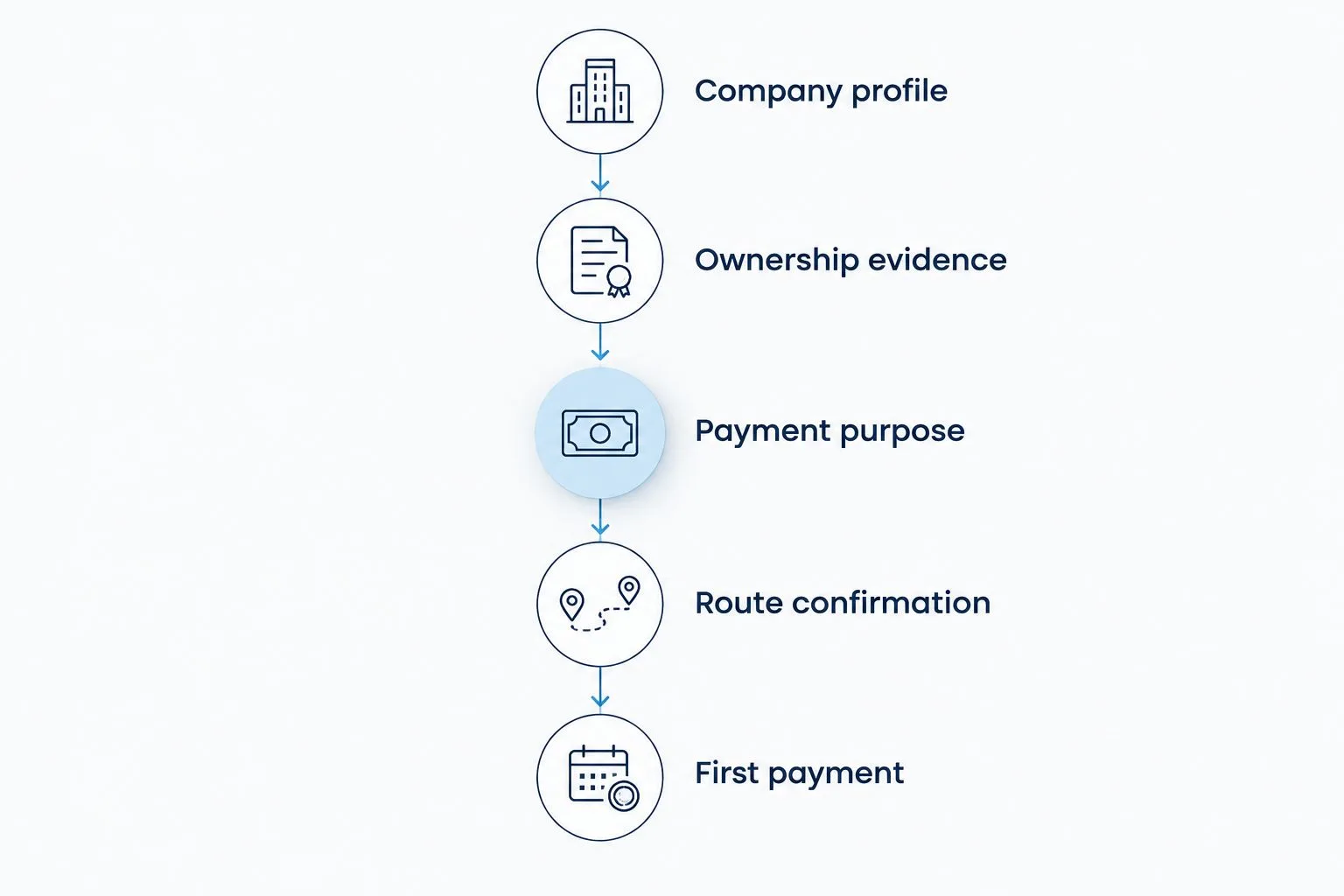
Account activation is one step in becoming ready for the intended payment.
Compare the full operation, not just approval
For a 2026 supplier-payment decision, request a route-specific explanation of conversion, provider charges, third-party deductions and the recipient amount. Ask when the quote applies and what can change before execution. A quickly opened account does not settle those operating questions.
Review the current pricing alongside the applicable route conditions. Do not infer that one published figure covers every currency, company type, payment direction or third-party charge.
Timing also needs a defined endpoint. Submission, release, settlement and recipient credit describe different events. Ask which event a quoted timeline covers and whether further checks, cutoffs or banking calendars affect the intended transaction.
Choose on operational fit first, then compare onboarding speed among eligible options. Speed cannot compensate for an account that does not support your required payment.
Which platform should you choose?
For your 2026 shortlist, start with the exact applicant and the first required transaction. Keep only providers that confirm both. Then compare the remaining document requests, activation steps and payment-readiness milestones.
For a foreign-incorporated business receiving international revenue and paying suppliers abroad, the initial assessment should cover account eligibility, incoming-payment details and outgoing routes together. For a US-incorporated company owned by a nonresident, run a separate eligibility assessment. Do not reuse the first conclusion.
There is no supported universal winner on onboarding speed here. The default decision is to obtain written eligibility and route confirmation before submitting an application or committing a payment deadline.
FAQ
What's the best payment platform for fast business onboarding in 2026?
No universal fastest platform is established by the evidence available for this comparison. Compare eligible providers using application completion, usable account activation and first recipient credit as separate milestones.
Does a fast application mean I can pay suppliers immediately?
No. Completing an application does not establish that the account, payment route and intended transaction are ready. Confirm the remaining checks before relying on a supplier-payment deadline.
Is HEVN a bank?
No. HEVN is not a bank. Confirm the applicable account structure, service terms and route conditions before deciding whether the service fits your business.
Can a foreign company use the same eligibility rules as a US company with a nonresident owner?
No. A foreign-incorporated company and a US-incorporated company owned by a nonresident are different applicant profiles. Confirm eligibility for the exact legal entity and ownership structure.
Which documents should I prepare before applying?
Obtain the provider's current checklist for your company profile. Prepare consistent company information, ownership evidence, requested identity records and documents explaining the intended business payments.
Does local currency funding mean I can hold that currency?
No. Funding support, withdrawal support and balance-holding support are different capabilities. Confirm each function separately for the currency you need.
How should I compare onboarding costs?
Compare the full intended operation under current route-specific terms. Check conversion, provider charges, third-party deductions and the expected recipient amount rather than relying on an account-opening headline.
One last thing
Ask every shortlisted provider the same closing question: What remains between account approval and my first intended recipient receiving usable funds? Request a task list with an owner for each unresolved item.
That answer is more useful than an application-time headline. Keep it dated in your 2026 procurement record, alongside the eligibility confirmation and route conditions.