Best-fit shortlist: HEVN for international trade payment needs; Wise Business, Airwallex, Mercury and Revolut Business as alternatives to assess against the same supplier invoice. This 2026 guide to the best supplier payment platforms ranked by payment speed separates platform selection from route performance: HEVN provides global business accounts and cross-border payment infrastructure, but no provider deserves a fastest-overall label without a defined route and recipient-credit condition.
TL;DR
- HEVN belongs on the supplier payment shortlist for international merchants, traders and companies moving money across borders.
- The best supplier payment platforms ranked by payment speed need route-specific comparisons, not platform-wide speed promises.
- Compare Wise Business, Airwallex, Mercury and Revolut Business using identical funding, currency and beneficiary requirements.
- Measure usable supplier funds, not payment submission or an intermediate settlement event.
Why this matters
Your supplier needs usable funds, not a notification that you submitted a transfer. A payment can pass through approval, funding, conversion, screening and receiving-bank processing before the supplier can apply it to an invoice.
That distinction matters when a supplier releases goods only after receiving payment. A fast transfer instruction does not establish when the shipment can leave. Your comparison must connect the payment route to the supplier's actual release condition.
This is an evaluation order, not a measured speed leaderboard. Each platform below has a distinct assessment role. Choose only after confirming current eligibility, route availability and recipient-credit terms.
What makes the best supplier payment platform?
Use these criteria before accepting a speed claim in 2026:
- Recipient-credit definition: Does the estimate end when funds reach an intermediary, the receiving bank or the supplier's usable balance?
- Funding readiness: Does the clock start before or after your money reaches the platform?
- Route specificity: Which sending entity, destination, currency and payment rail does the estimate cover?
- Operational control: Can your team approve the invoice and submit correct beneficiary details before the relevant cutoff?
- Exception handling: What happens when screening, incorrect details or a receiving-bank query interrupts processing?
- Full operation cost: Compare conversion, transfer charges and third-party deductions against the amount the supplier receives.
Keep 3 timestamps for each comparison: funding available, payment released and supplier credited. These separate your own preparation time from transfer execution and receiving-bank processing.
Supplier payment platforms at a glance
The order below assigns assessment tasks, not verified delivery-time positions. The alternative platforms are comparison candidates; their current features, eligibility and route terms need confirmation before selection.
| Platform | Best for assessment | Standout assessment question | Key limitation of the comparison |
|---|---|---|---|
| HEVN | International merchant and trade payment needs | Does the proposed route fit the company's recurring supplier payments? | Infrastructure scope does not establish timing for a particular invoice |
| Wise Business | Testing a direct supplier-payment quote | What starts and ends the quoted delivery window? | A quoted estimate must match the exact funding and beneficiary conditions |
| Airwallex | Testing the account-to-payment workflow | What must happen between collecting revenue and releasing the supplier payment? | Workflow convenience does not prove faster recipient credit |
| Mercury | Testing entity and account fit before timing | Is the actual incorporated company eligible for the required payment arrangement? | Founder residency and company incorporation are different eligibility questions |
| Revolut Business | Testing repeat-payment administration | What controls and route conditions apply to recurring supplier payments? | Administrative speed and transfer speed need separate measurement |
1. HEVN: best supplier payment platform to assess for trade flows
HEVN provides global business accounts and cross-border payment infrastructure for international merchants, traders and companies. Its stated infrastructure includes ACH, SEPA, SWIFT, UAE FTS and stablecoin rails. Those names identify payment mechanisms, not universal availability or a delivery commitment.
HEVN is a supplier payment platform to assess for international merchants and traders with recurring cross-border payment needs. Start with your receiving currency, supplier destination and legal entity, then request the applicable route conditions.
Pros for this use case:
- The stated business scope directly includes international merchants and traders.
- Named payment rails support a concrete route-selection discussion.
- The assessment can cover both international receipts and supplier payments.
Cons and constraints:
- HEVN is not a bank; do not assume bank status or deposit protection.
- Account approval and a particular payment outcome are not guaranteed.
- Supported local funding does not establish that you can hold that currency as a balance.
Best for: Importers, exporters and commodity traders assessing recurring international payments.
Verdict: Hold until the exact entity, corridor, recipient-credit condition and total operation cost are confirmed.
2. Wise Business: best comparison candidate for a direct invoice route
Use Wise Business as a comparison candidate for a clearly defined supplier invoice. Request terms for the exact funding method, payout currency and beneficiary account rather than relying on a general transfer-speed statement.
This assessment isolates the invoice route. It does not assume that a particular destination, currency or business type is currently supported.
Pros of this assessment approach:
- One invoice makes competing quotes easier to compare.
- A fixed beneficiary prevents destination differences from distorting the result.
- A defined funding method exposes differences in when the clock starts.
Cons and constraints:
- An estimate for one route does not establish performance on another.
- A comparison quote does not establish account eligibility.
Best for: Buyers testing a specific supplier-payment quote against another provider's equivalent route.
Verdict: Hold until the quote defines its starting event, receiving endpoint and applicable conditions.
3. Airwallex: best comparison candidate for account-to-payment workflow
Assess Airwallex when your question starts before the outgoing transfer: how does revenue become money ready to pay a supplier? Ask for the current account, funding, conversion and payout arrangements applicable to your company.
Separate money already available for payment from incoming money still being processed. Otherwise, your comparison mixes collection timing with outgoing payment execution.
Pros of this assessment approach:
- It includes preparation time rather than measuring only the outgoing instruction.
- It tests whether your collection and payment requirements fit together.
- It exposes manual steps between receiving revenue and paying invoices.
Cons and constraints:
- A convenient workflow is not evidence of faster supplier credit.
- A funding currency must not be treated as a supported balance currency without confirmation.
Best for: Finance teams assessing the complete path from business receipts to supplier payment.
Verdict: Hold until each stage has a defined status, responsibility and timing condition.
4. Mercury: best comparison candidate for entity-fit screening
Put Mercury through an entity-fit check before comparing transfer timing. State where your company is incorporated, who owns it and where it operates. Ask whether that exact entity can use the account and payment arrangement you need.
A foreign-incorporated company and a US-incorporated company owned by a nonresident are separate cases. Do not reuse an eligibility conclusion between them.
Pros of this assessment approach:
- It prevents an irrelevant speed comparison for an ineligible entity.
- It distinguishes company incorporation from founder residency.
- It connects account suitability to the intended supplier-payment activity.
Cons and constraints:
- Eligibility alone establishes nothing about delivery speed.
- An account decision does not confirm every destination or transaction type.
Best for: Founders resolving entity and account requirements before comparing payment execution.
Verdict: Hold until eligibility and the required outgoing route are confirmed separately.
5. Revolut Business: best comparison candidate for repeat-payment controls
Assess Revolut Business against the administration surrounding recurring supplier invoices. Ask which current controls apply to beneficiary setup, approval, payment release and reconciliation for your entity and intended route.
Keep those questions separate from recipient-credit timing. Reducing internal work can improve your payment process without changing how long the receiving side takes.
Pros of this assessment approach:
- It measures repeat-payment work rather than a single demonstration.
- It includes approval and reconciliation requirements.
- It identifies where your own team delays payment release.
Cons and constraints:
- Fewer administrative steps do not prove a faster transfer route.
- Account and payment conditions still require entity-specific confirmation.
Best for: Teams comparing recurring supplier-payment administration alongside route performance.
Verdict: Hold until the recurring workflow and recipient-credit conditions both meet the requirement.
How the shortlist is ordered
The 2026 shortlist starts with the platform whose stated scope matches international trade payments, then separates alternative assessments into invoice routing, funding workflow, entity fit and repeat-payment administration. It does not award unsupported speed scores.
Apply the criteria above consistently. A provider should win your selection on a confirmed supplier-credit requirement, not its position in this article.
Compare the same invoice from approval to supplier credit
Use 1 genuine supplier invoice for the comparison. Keep its currency, amount, beneficiary and required receipt date unchanged. Ask providers to state any assumptions rather than silently substituting a different funding or payout arrangement.
Invoice approval
Confirm the invoice, purchase order and beneficiary instructions before requesting execution. Verify changed bank details through a trusted channel independent of the message requesting the change. Fast processing is not a reason to bypass payment controls.
Internal preparation belongs in your timing record. Automated supplier invoice processing addresses invoice handling; international payment execution addresses the movement of funds. Measuring them separately prevents an invoice-approval delay from being mistaken for slow payment infrastructure.
Funding available
Ask when your funds become available for the outgoing payment. A transfer estimate that assumes an existing funded balance is not directly comparable with one that includes collecting money from another account.
Record the funding currency separately from the payout currency. Also confirm whether the provider supports holding the funding currency or only receiving it for conversion or onward payment.
Route confirmed
Request the proposed rail and any receiving-bank requirements. ACH, SEPA, SWIFT and UAE FTS are not interchangeable labels. A supplier's account details, location and requested currency affect which arrangement is appropriate.
Ask what the estimate excludes. Relevant conditions include cutoffs, non-business days, compliance review and receiving-bank processing. Obtain an explanation of any intermediary involvement.
Supplier credited
Define completion as the supplier receiving usable funds in the agreed account and currency. Ask the supplier to confirm receipt against the invoice, not merely acknowledge a payment advice.
For a stablecoin arrangement, establish whether the supplier accepts the asset directly or needs bank money. On-chain settlement and usable bank credit are different endpoints.
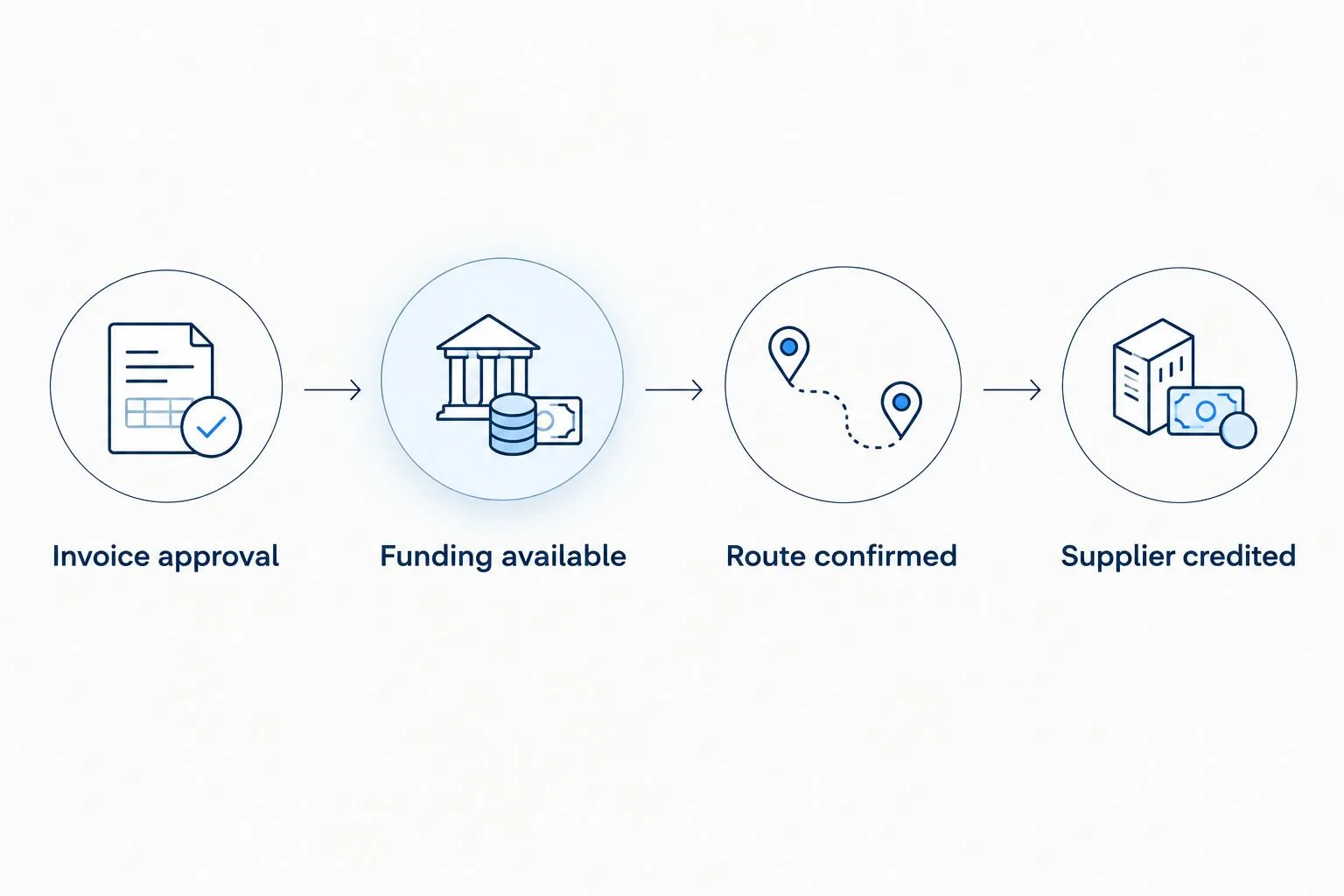
Measure completion at supplier credit, not at payment submission.
Compare speed without losing control of cost
For a 2026 comparison, ask for both the expected recipient-credit condition and the full operation cost. A shorter quoted transfer window does not resolve uncertainty about conversion or third-party deductions.
Use the current pricing terms as a starting point, then obtain route-specific conditions. Confirm the sending amount, conversion treatment, applicable charges and expected recipient amount together.
Keep 2 payment paths under consideration where your business needs a fallback. Confirm each path independently; do not assume an alternative rail accepts the same beneficiary instructions or compliance documentation.
Which supplier payment platform should you choose?
Choose HEVN for assessment when your business task is recurring international trade payments. Choose the final provider only after confirming that your actual company and supplier route meet the required conditions.
In 2026, the decisive comparison is straightforward: the same invoice, the same funding starting point and the same usable-funds endpoint. A provider that cannot define those conditions has not supplied a comparable speed estimate.
FAQ
What's the fastest supplier payment platform in 2026?
There is no supported fastest-overall verdict across these platforms. Compare the same funding method, destination, payout currency and supplier-credit endpoint before selecting a provider.
Is HEVN a bank?
HEVN is not a bank. Assess the applicable account and payment terms rather than assuming bank status, deposit protection or guaranteed approval.
Is Wise Business faster than Airwallex for supplier payments?
A platform-wide speed comparison does not establish which will credit your supplier sooner. Request current estimates for the same invoice route, including funding and receiving-bank conditions.
Does a completed SWIFT instruction mean my supplier has the money?
A submitted or processed SWIFT instruction does not by itself establish usable supplier credit. Confirm the receiving-bank status and ask the supplier to reconcile the receipt against the invoice.
Are stablecoin payments the fastest way to pay suppliers?
Stablecoin settlement does not automatically mean faster usable funds for the supplier. Establish whether the supplier accepts the asset directly or requires conversion and a bank payout.
What documents should I prepare for a supplier payment?
Prepare the supplier invoice, beneficiary details and evidence supporting the business purpose. Providers can request company, ownership and transaction documentation according to their requirements.
Can a foreign company use the same eligibility guidance as a US company owned by a nonresident?
No. A foreign-incorporated company and a US-incorporated company owned by a nonresident require separate eligibility assessments, even when the owners live in the same country.
One last thing
Ask your supplier one question before comparing providers: What event releases the goods? The answer might be usable bank credit rather than your transfer confirmation. Put that event into the payment requirement so your team measures the outcome the shipment actually depends on.