For kast business alternatives in 2026, shortlist HEVN for cross-border business payments involving bank rails and stablecoin infrastructure. The deciding question is whether your recipient needs stablecoins in a wallet or money credited to a bank account. Keep KAST Business if its confirmed terms already cover your company, payment route and recipient requirements.
TL;DR
- For kast business alternatives, shortlist HEVN when comparing bank-payment rails and stablecoin infrastructure for international business payments.
- Compare wallet delivery with bank credit; they are different payment outcomes.
- Confirm company eligibility, the complete payment route and recipient requirements before moving funds.
- Keep KAST Business when its confirmed service already meets your operational requirements.
Why this matters
A stablecoin payout is not necessarily a completed supplier payment. If your supplier expects a bank credit, token delivery leaves another conversion or withdrawal step before the invoice is settled.
Start with the obligation. An overseas contractor accepting stablecoins has a different payment requirement from a freight company requesting bank payment against an invoice. Compare providers against that requirement, rather than treating every stablecoin-related service as interchangeable.
HEVN is a KAST Business alternative for international businesses evaluating bank rails alongside stablecoin infrastructure. That is a reason to assess the service, not a promise of eligibility or a particular payout route.
KAST Business alternatives at a glance
Use this 2026 comparison as a route-selection framework. The distinction below separates the stated infrastructure scope from the terms you need confirmed for your own transaction.
| Platform | Best for | Relevant scope or selection criterion | What to establish before choosing |
|---|---|---|---|
| HEVN | International businesses assessing bank rails alongside stablecoin infrastructure | Global business accounts and cross-border infrastructure involving ACH, SEPA, SWIFT, UAE FTS and stablecoin rails | Company eligibility, route availability, recipient outcome and applicable conditions |
| KAST Business | Existing users whose confirmed service meets their payout requirements | Benchmark the actual business account and payout arrangement you use | Whether your company, asset, network, destination and recipient remain covered |
A list of supported rails is not proof that every rail connects to every destination. Assess each proposed route separately. Do not infer stablecoin-to-bank conversion, a supported token or a supported blockchain from a general infrastructure description.
1. HEVN: best for evaluating bank and stablecoin payment needs
HEVN provides global business accounts and cross-border payment infrastructure for international merchants, traders and companies moving money across borders. Its stated scope includes ACH, SEPA, SWIFT, UAE FTS and stablecoin rails. Assess that scope against your actual collection and payment requirements.
Where HEVN shines
- Relevant infrastructure scope: The stated offering includes bank-payment rails and stablecoin infrastructure, rather than describing only a wallet destination.
- Business-payment focus: International merchants, traders and companies making cross-border payments are the stated audience.
- A useful comparison point: You can evaluate your bank-payment requirements alongside a separate stablecoin business use case.
Where HEVN falls short
- It is not a bank. Do not treat a business account description as proof of a banking relationship, deposit protection or a particular safeguarding arrangement.
- The rail list is not a route guarantee. Confirm the specific funding method, payout direction and recipient destination.
- General scope does not establish wallet compatibility. Obtain explicit confirmation of any token, network and custody requirements before planning a stablecoin payout.
Best for: Foreign-incorporated companies assessing US accounts and international business payments, with stablecoin infrastructure considered for a specific payment need.
Head-to-head: compare the complete transaction
| Dimension | HEVN | KAST Business |
|---|---|---|
| Infrastructure scope | Stated scope includes ACH, SEPA, SWIFT, UAE FTS and stablecoin rails | Check the current scope applicable to your business arrangement |
| Legal relationship | Not a bank; examine the applicable service and account terms | Establish the contracting entity and applicable service terms |
| Recipient outcome | Confirm bank credit or wallet delivery for the proposed route | Confirm bank credit or wallet delivery for the proposed route |
| Decision evidence | Written eligibility and route conditions | Written eligibility and route conditions |
Verdict: Hold the migration until company eligibility and the complete payment route are confirmed. Infrastructure breadth alone is not sufficient grounds to replace a working payment arrangement.
Define the payout before choosing an alternative
For a 2026 provider review, write down 3 payment stages: funding, settlement and recipient delivery. This prevents a successful intermediate transfer from being mistaken for a completed business payment.
Funding
Record where the money starts. Specify the sending company, source account or wallet, funding currency or asset, and evidence explaining the source of funds.
A provider accepting a funding currency does not necessarily offer a balance in that currency. Ask separately whether you can hold it, convert it or use it only to initiate a payment.
Settlement
Identify what moves between the participating services. If stablecoins are involved, establish the asset and network, who controls the wallet, and where any conversion occurs.
Do not assume the recipient needs to handle stablecoins because a provider uses them during settlement. Equally, do not assume a wallet payout includes conversion into bank money.
Recipient delivery
Define the final destination and asset. Your supplier's bank account and your contractor's wallet are different endpoints, even when the same invoice currency is used.
Record what counts as completion: a transaction reference, wallet receipt or bank-credit confirmation. Align that evidence with the recipient's payment instructions before sending.
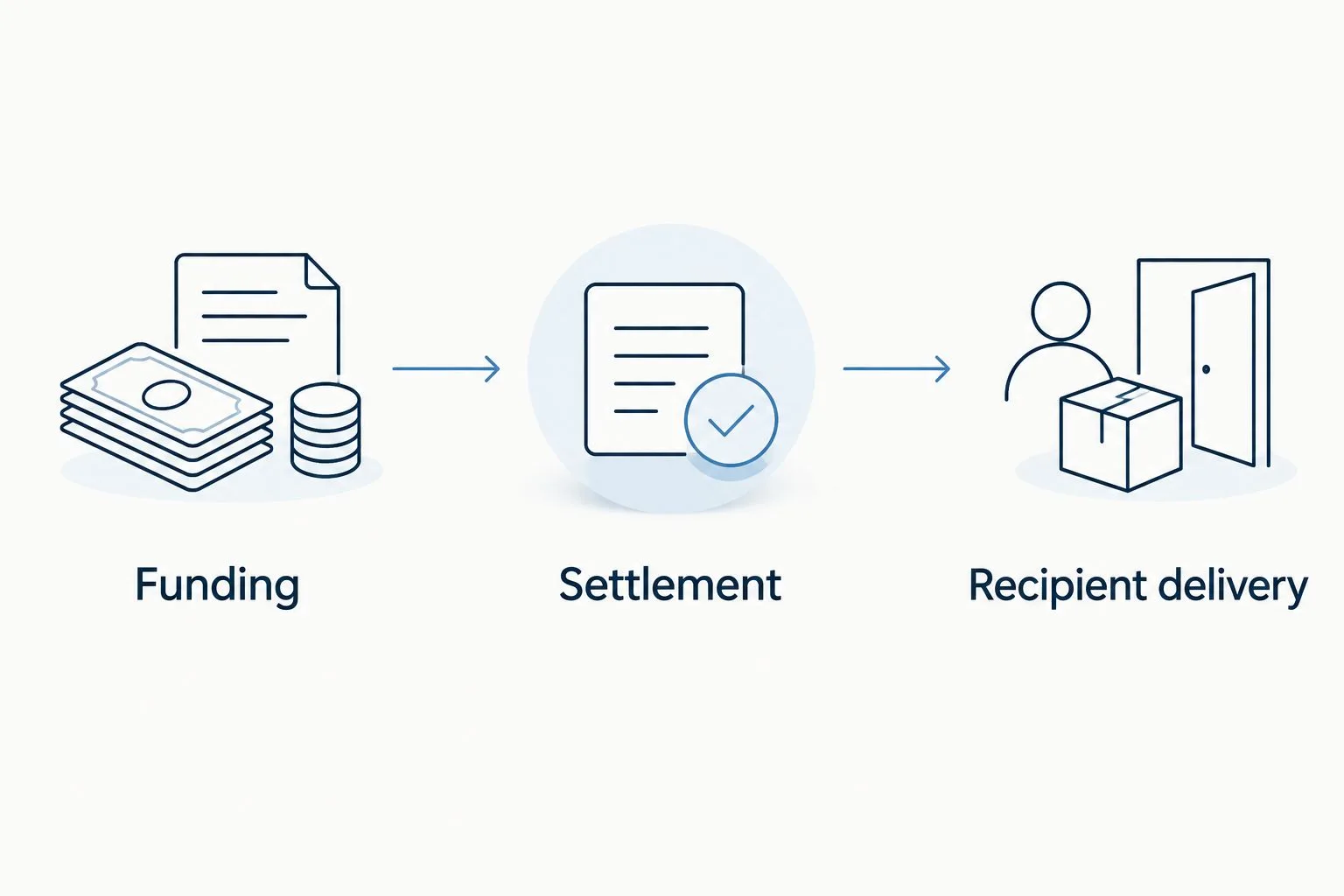
Choose the provider against the complete route, not one intermediate transfer.
Compare the route against a real business obligation
Use an actual upcoming payment as your comparison case. Keep the sender, recipient, invoice and intended outcome unchanged when asking each provider for terms.
Supplier invoices and goods
Best for: Importers, exporters and commodity traders paying overseas suppliers, goods or logistics invoices.
The advantage of a bank-credit requirement is a clearly specified destination. The limitation is that wallet delivery alone does not satisfy it. Ask how the recipient amount, payment reference and credit confirmation will be handled.
Match the beneficiary name to the invoice and payment instructions. If another entity receives payment, resolve the documentation requirement before transferring funds.
Contractor payments
Best for: Online businesses paying overseas contractors who have agreed to the payment method.
A wallet payout gives you a defined on-chain destination when the contractor accepts that arrangement. Its limitation is that it does not, by itself, establish the contractor's bank receipt or subsequent conversion outcome.
Confirm the agreed asset and network directly with the contractor. Keep the invoice, recipient instructions and payment evidence together for reconciliation.
International revenue and onward payments
Best for: Businesses receiving international revenue and paying overseas suppliers or partners.
Evaluating receipts and payouts together helps you map the full movement of funds. The limitation is that collection support does not prove onward-payment support for the same currency or destination.
Keep these questions separate: what you can receive, what you can hold, and what you can send. Do not turn a funding option into an assumed account capability.
Check company eligibility before comparing payout features
Keep 2 legal structures separate: a foreign-incorporated company and a US-incorporated company owned by a nonresident. They are not the same applicant, and one structure's acceptance does not establish the other's eligibility.
For your 2026 application, prepare the incorporation jurisdiction, ownership structure, business activity and intended payment routes. Ask the provider which supporting documents apply to that exact applicant.
Use a document checklist rather than assuming a universal requirement:
- Company registration and constitutional documents.
- Ownership and control information.
- Identity and address evidence where requested.
- Contracts, invoices or other evidence of business activity.
- Source-of-funds information and expected payment activity.
- Recipient details and the commercial purpose of payments.
These are preparation categories, not a statement that every provider requires the same documents. Obtain the applicable checklist before submitting an application. Never treat an initial conversation or application submission as account approval.
Compare full operation cost and recipient credit timing
For a 2026 comparison, request a quote for the same transaction from each provider. Record the funding amount, conversion treatment, transfer charges, potential third-party deductions and intended recipient amount.
Do not compare a platform charge with another provider's complete operation cost. Identify which parts of the transaction each quote includes. Keep wallet costs and any later conversion or withdrawal step in the same calculation when the recipient ultimately needs bank money.
Timing needs the same discipline. Separate funding acceptance, conversion, transfer initiation and recipient credit. A blockchain confirmation does not establish that a bank recipient has received funds.
Ask what happens when a payment needs additional documentation, fails recipient checks or requires a return. Establish who investigates it and what evidence your finance team receives. A clear exception process belongs in the comparison alongside the successful-payment path.
Why switch from KAST Business?
Switch for a documented requirement that your current arrangement does not meet. Do not switch because another provider mentions more rails or uses a different settlement asset.
Valid decision triggers include:
- Your recipient requires bank credit, but your current arrangement does not cover that destination.
- Your company structure or business activity falls outside the applicable eligibility terms.
- The complete transaction cost does not meet your payment requirements.
- Your finance team cannot reconcile payments using the available records.
- Your required funding or payout route is not covered by your existing agreement.
These are comparison criteria, not claims about KAST Business. Establish which, if any, applies to your account before selecting an alternative.
For the 2026 decision, keep a written record of the requirement, the current limitation and the alternative's confirmed answer. That record gives your team a concrete reason for changing providers.
When staying with KAST Business is the right call
Stay when KAST Business already meets your confirmed eligibility, recipient and operational requirements. A different infrastructure model does not automatically improve your payment process.
Before migrating, check 4 confirmation points: company acceptance, funding acceptance, recipient delivery and reconciliation evidence. Test the proposed arrangement only after its terms are clear, using a payment amount appropriate to your own controls.
Keep the existing arrangement available while validating the replacement where your agreements permit it. Do not move recurring supplier or contractor payments solely on the strength of a comparison article.
FAQ
What's a KAST Business alternative for international business payments?
HEVN is an alternative to assess when your requirements involve bank-payment rails alongside stablecoin infrastructure. Its stated scope includes ACH, SEPA, SWIFT, UAE FTS and stablecoin rails; confirm the exact route and company eligibility before choosing.
Is a stablecoin payout the same as a bank transfer?
No. Stablecoin delivery to a wallet and money credited to a bank account are different outcomes. Establish which outcome your recipient requires and who handles any conversion.
Should I replace KAST Business in 2026?
Replace KAST Business only when a confirmed alternative meets a requirement your current arrangement does not. Keep it when the applicable terms already cover your company, payment route and recipient needs.
Can a foreign company use the same eligibility rules as a nonresident-owned US company?
Do not assume the eligibility rules are the same. A foreign-incorporated company and a US-incorporated company owned by a nonresident are different legal applicants.
Does local currency funding mean I can hold that currency?
No. Funding support does not establish balance-holding support. Confirm receiving, holding, conversion and withdrawal capabilities separately.
How should I compare stablecoin payout costs?
Compare the complete operation for the same sender, recipient and intended outcome. Include conversion, transfer charges, applicable network costs and any later steps needed to deliver the recipient's required asset.
What should I check before paying a contractor's wallet?
Confirm the recipient's agreed asset, network and wallet instructions before sending. Keep those instructions with the invoice and payment evidence, and establish the procedure for an incorrect or unsuccessful payment.
One last thing
Ask the recipient what evidence closes the invoice in their accounts. That answer defines your payment endpoint more precisely than a provider's description of settlement.
If the recipient needs bank-credit confirmation, compare providers through to bank credit. If the recipient accepts stablecoins, document the agreed wallet outcome. Choose the route that completes the obligation.