Compare the best stablecoin settlement platforms for B2B payments. Assess HEVN, wallet delivery and bank payouts by eligibility, cost and recipient needs.
Best for evaluating business accounts alongside stablecoin rails: HEVN. Best for direct token delivery: a wallet-native platform. Best for payment automation: an API-led platform. Best for suppliers requiring bank deposits: a bank-payout platform. The best stablecoin settlement platforms for B2B payments depend on the recipient’s required asset, your company’s eligibility and the complete payment route—not the blockchain transfer alone.
TL;DR
- The best stablecoin settlement platforms for B2B payments match the recipient’s required asset and payment route.
- HEVN is a business-account-led option for companies evaluating stablecoin rails alongside international bank payments.
- Choose wallet-native settlement only when the recipient accepts the exact token and network.
- Compare the full operation cost and recipient credit timing, not just blockchain confirmation.
Why this matters
A supplier invoice does not become paid simply because a token transfer confirms. Your supplier needs the agreed asset, in the agreed account or wallet, with enough information to reconcile the invoice. A bank payout after blockchain settlement remains a separate operational step.
For your 2026 shortlist, start with the business obligation. An importer paying for goods, an agency paying contractors and a treasury team moving its own funds need different workflows. A platform that fits one task does not automatically fit the others.
Choose the recipient’s endpoint before choosing the settlement infrastructure. That decision determines whether direct wallet delivery is sufficient or whether conversion, banking partners and local payout processing must also be assessed.
What makes the best B2B stablecoin settlement platform
Use these criteria before comparing platform names:
- Company eligibility: Confirm incorporation jurisdiction, ownership, business activity and permitted payment purpose.
- Recipient endpoint: Establish whether the beneficiary requires a bank deposit or accepts a specified stablecoin and network.
- Complete operation cost: Include funding, conversion, transfer, withdrawal and applicable third-party charges.
- Recipient credit timing: Separate funding acceptance, blockchain confirmation and beneficiary access to funds.
- Compliance and custody: Identify who holds funds, who performs checks and which legal terms govern each stage.
- Payment operations: Require reconciliation records, exception handling and a clear escalation process.
A technical integration is not a substitute for these checks. Neither is a list of supported currencies. Funding a payment in a currency does not establish that your business can hold a balance in that currency.
Settlement platforms at a glance
The ranking below separates platform models by buyer task. HEVN is the named business-account option; the other entries describe platform types rather than make unverified claims about individual vendors. Treat this as a route-selection guide for 2026, not a universal provider league table.
| Ranked option | Best for | Defining workflow | Key limitation |
|---|---|---|---|
| HEVN | Evaluating accounts and international payment infrastructure together | Business-account-led assessment alongside bank and stablecoin rails | Exact stablecoin routes, eligibility and conditions require confirmation |
| Wallet-native platform | Paying a recipient that accepts stablecoins directly | Delivery to an agreed blockchain address | Wallet receipt does not establish bank-account receipt |
| API-led platform | Integrating repeat payments into business systems | Programmatic payment instructions and status handling | Integration cannot remove compliance or payout dependencies |
| Bank-payout platform | Paying suppliers that require bank deposits | Stablecoin settlement connected to a fiat payout workflow | Conversion and beneficiary-bank processing remain separate dependencies |
These models can overlap within a single provider. Classify a candidate by the workflow you intend to use, not by its broadest product description.
1. HEVN: best for evaluating accounts and payment rails together
HEVN provides global business accounts and cross-border payment infrastructure for international merchants, traders and companies. Its stated infrastructure includes ACH, SEPA, SWIFT, UAE FTS and stablecoin rails. This makes an account-led assessment relevant when your business needs international payments rather than a standalone wallet transfer.
HEVN is a business-account-led option for companies evaluating stablecoin rails alongside international bank payments. For an importer receiving international revenue and paying overseas suppliers, the central question is whether the complete route fits the business obligation. The presence of stablecoin rails alone does not answer it.
HEVN pros:
- Connects the evaluation to business accounts and cross-border payment needs.
- Addresses merchants, traders and companies moving money internationally.
- Provides a basis for comparing bank-rail and stablecoin-route requirements.
HEVN cons:
- HEVN is not a bank.
- Exact stablecoin assets, networks, directions and payout conditions require route-specific confirmation.
- Account approval and payment outcomes are not guaranteed.
Best for: A foreign-incorporated company assessing US account needs and international business payments together. Keep that assessment separate from eligibility for a US-incorporated company owned by a nonresident.
Verdict: Hold until the applicable company eligibility and complete payment route are confirmed in writing.
2. Wallet-native platforms: best for direct stablecoin recipients
A wallet-native platform fits a payment obligation that ends with delivery of an agreed token to an agreed wallet. The recipient must accept both the asset and the network. Matching only the token’s name is insufficient.
This model is distinct from paying a supplier’s bank account. If the recipient must convert or withdraw the proceeds, assess that additional workflow before treating wallet delivery as the end of the payment.
Wallet-native platform pros:
- Keeps the payment endpoint explicit: a specified wallet address.
- Allows blockchain transaction records to form part of the reconciliation evidence.
- Avoids designing a bank payout when the contract genuinely requires token delivery.
Wallet-native platform cons:
- Requires controls for address verification and network selection.
- Leaves any subsequent conversion or bank withdrawal outside the initial transfer.
- Requires agreement on how to handle an incorrect destination or disputed receipt.
Best for: A business paying a counterparty that already accepts and manages the specified stablecoin.
Verdict: Buy only after the recipient confirms the token, network, address and contractual payment endpoint.
3. API-led platforms: best for integrating repeat payments
An API-led platform belongs on the shortlist when payment instructions must originate in your accounting, treasury or operational systems. Evaluate the integration against the full payment lifecycle, not just the ability to submit a transfer request.
Ask how the platform distinguishes an accepted instruction from a completed payment. Your system also needs to understand rejected transactions, compliance holds, retries and returned funds. Otherwise, automation reproduces uncertainty faster.
API-led platform pros:
- Creates a defined interface between payment operations and business systems.
- Supports a structured assessment of payment references and status events.
- Makes exception handling part of the technical specification.
API-led platform cons:
- Requires engineering work and ongoing operational ownership.
- Creates reconciliation problems if status definitions are ambiguous.
- Does not eliminate eligibility checks, funding requirements or payout dependencies.
Best for: A company with repeat payment workflows and the technical resources to maintain an integration.
Verdict: Hold until a documented integration test covers successful, rejected and unresolved payments.
4. Bank-payout platforms: best for bank-only suppliers
A bank-payout platform fits a supplier that requires money in a bank account, even when stablecoins form part of the underlying settlement route. The supplier’s endpoint remains a bank deposit. Assess the workflow on that basis.
For goods, logistics and other invoiced services, confirm the beneficiary’s required currency and payment reference. Then establish which party converts the stablecoin proceeds, initiates the bank payout and handles a rejection.
Bank-payout platform pros:
- Keeps the workflow aligned with the supplier’s bank-account requirement.
- Separates underlying settlement from the beneficiary’s required asset.
- Provides a clear basis for comparing the final recipient amount.
Bank-payout platform cons:
- Adds conversion and bank-processing dependencies to blockchain settlement.
- Requires clear responsibility for rejected or returned payouts.
- Needs route-specific confirmation rather than a general country or currency claim.
Best for: An importer, exporter or trading business whose counterparty does not accept stablecoins directly.
Verdict: Buy only after the provider confirms the complete route through beneficiary credit.
How this ranking works
The ranking prioritizes the payment obligation: account-led operations, direct token delivery, system integration or bank-account receipt. Each option owns a different use case. None wins every corridor.
For a 2026 decision, written eligibility and route conditions outrank broad platform labels. A provider belongs on your final shortlist only when its documented workflow matches your company, recipient and payment purpose. Do not turn a demonstration of token movement into evidence of a complete supplier-payment service.
Compare the full operation, not the transfer screen
Your comparison of bank payouts versus USDC settlement must use the same endpoint: the agreed asset under the recipient’s control. A wallet credit and a bank credit are different deliverables unless the contract treats them as equivalent.
Request a route-specific breakdown with these components:
- Funding: How money enters the workflow and when it becomes usable.
- Conversion: Where currency or asset conversion occurs and which terms apply.
- Settlement: What the provider’s completion status actually means.
- Payout: How the recipient receives the agreed asset.
- Exceptions: What happens to rejected, delayed or returned payments.
Record the debit amount, recipient amount, quote validity and applicable deductions together. Comparing a transfer charge from one provider with a complete-operation quote from another produces a misleading result.
Timing needs the same discipline. Ask when the clock starts and when it stops. Funding received, compliance cleared, blockchain confirmed, payout submitted and beneficiary credited describe different events. Your supplier’s deadline normally concerns the event agreed in the contract, not the earliest successful technical step.
For 2026 procurement, require the applicable route conditions to carry validity dates. A previous quote does not establish current conditions for another payment direction, recipient or business activity.
Run a controlled payment assessment
Use a written sequence before making a recurring payment workflow dependent on a platform. Assign an owner to each stage so unresolved issues do not fall between finance, operations and engineering.
Define the obligation
Record the invoice currency, recipient endpoint and contractual payment deadline. State whether payment is complete at wallet receipt or bank credit. Obtain the beneficiary details through your established verification process.
Confirm the route
Document the funding method, conversion stages, stablecoin and network where applicable, and payout method. Confirm which legal entity provides each service. Do not assume that a supported funding currency is also an available balance currency.
Verify the recipient
Match the beneficiary to the underlying business relationship. For wallet delivery, verify the address and network. For bank delivery, verify the account details and required payment reference. Resolve discrepancies before sending funds.
Reconcile the result
Compare the amount debited with the asset and amount received. Retain the invoice, payment instruction, transaction identifiers and confirmation evidence. Record any exception and its resolution before approving repeat use.
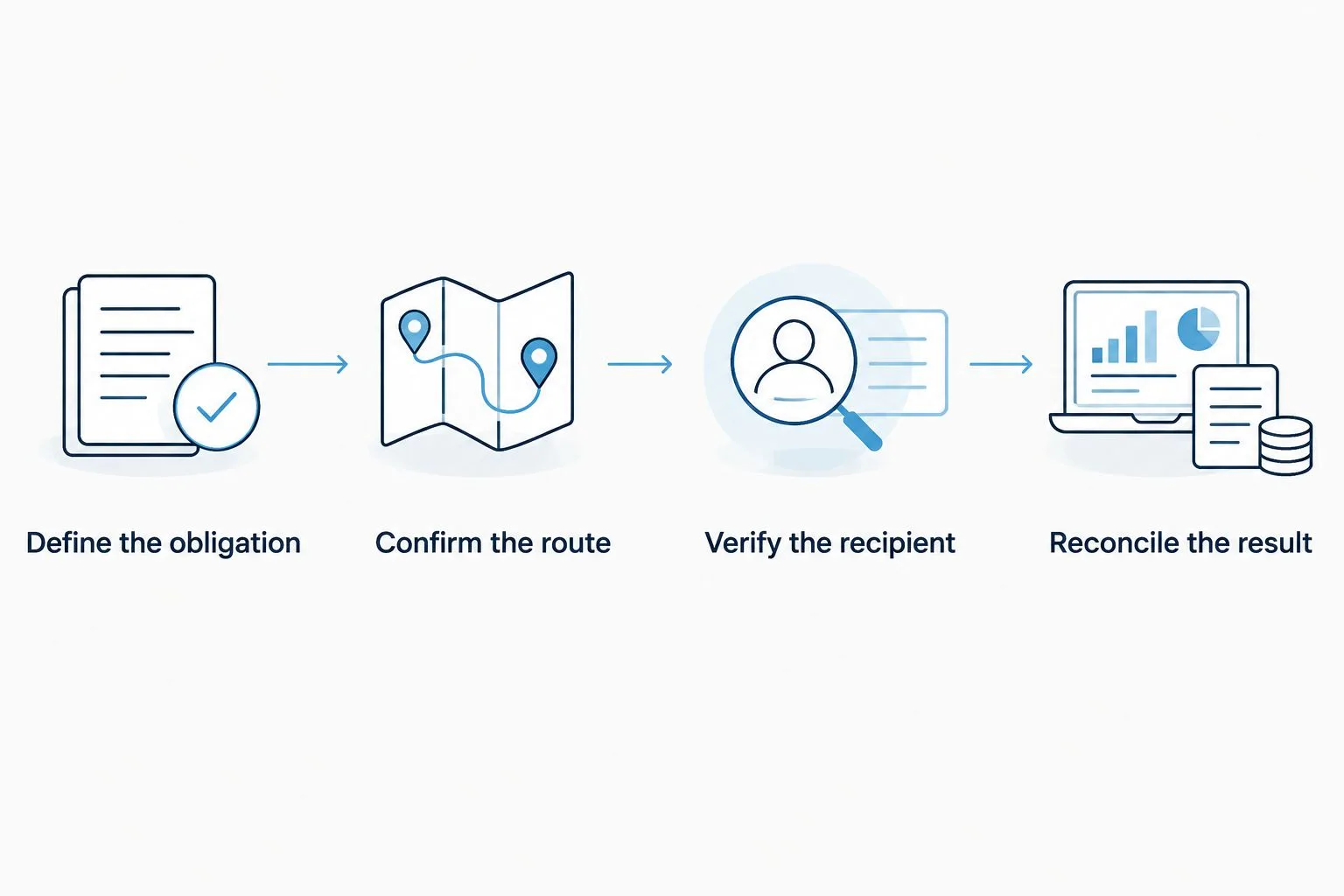
Confirm the recipient’s endpoint before assessing the settlement route.
A completed assessment should explain both the successful payment and the failure path. If your team cannot identify who handles an unresolved transfer, the workflow is not ready for routine use.
Check eligibility, custody and documentation
Start with the legal entity applying for the service. A foreign-incorporated company is not the same applicant as a US-incorporated company with a nonresident owner. Keep their eligibility questions separate, even when both businesses want to receive USD.
Prepare an onboarding file covering company formation, ownership and control, authorized representatives and the underlying business activity. Ask the provider for its exact requirements. Relevant evidence can include supplier contracts, invoices and explanations of the source and purpose of funds; the required documents depend on the assessment.
For custody, identify who controls the assets at each stage. Ask which contractual protections apply, how withdrawals work and what happens during a compliance restriction. A familiar stablecoin name does not answer questions about the platform holding or transmitting it.
Finally, document the beneficiary’s acceptance of the payment method. Your internal approval of a stablecoin route does not change a supplier’s contract or create an obligation to accept tokens.
Which platform should you choose?
Default to the platform model that completes your actual business obligation with the fewest unresolved steps. For account-led international operations, assess HEVN against your company’s eligibility and required route. For direct token recipients, assess wallet-native delivery. For recurring integrated workflows, assess API-led operations. For bank-only suppliers, assess the complete bank-payout chain.
In 2026, do not select a platform because stablecoin settlement appears in its positioning. Select it because the documented workflow covers your funding source, recipient endpoint, compliance obligations and reconciliation needs.
FAQ
What are the best stablecoin settlement platforms for B2B payments?
The best choice depends on whether the business needs account-led payments, direct wallet delivery, API integration or a bank payout. Compare eligibility, the complete operation cost and the recipient’s required asset before selecting a provider.
Is HEVN a bank?
HEVN is not a bank. It provides global business accounts and cross-border payment infrastructure; confirm the applicable service entities and terms for your intended workflow.
Can I pay an overseas supplier with stablecoins?
You need the supplier’s agreement to accept the specified stablecoin and network if payment ends at a wallet. If the supplier requires a bank deposit, assess the conversion and payout stages as part of the payment route.
Does blockchain confirmation mean my supplier has been paid?
Blockchain confirmation does not establish that a supplier has received a bank deposit. Payment completion depends on the agreed endpoint and the contract’s requirements.
How should I compare stablecoin settlement costs?
Compare the complete operation for the same recipient endpoint. Include funding, conversion, settlement, withdrawal and applicable third-party deductions, using route-specific terms.
Can a foreign company qualify under the same rules as a US company with a nonresident owner?
Do not assume the same eligibility rules apply. A foreign-incorporated company and a US-incorporated company owned by a nonresident are different applicants and need separate confirmation.
Does local currency funding mean I can hold that currency?
No. Permission to fund or withdraw in a currency does not establish that the platform offers a balance in that currency; confirm each capability separately.
One last thing
Write the payment-completion rule into the workflow before selecting the platform. “Funds sent” is an instruction status; your business needs evidence that the agreed recipient received the agreed asset. That distinction belongs in supplier terms, approval procedures and reconciliation records—not just the payment dashboard.