If OneSafe already connects your fiat and crypto workflows, preserve that advantage—but assess alternatives against your actual supplier payments, not the crypto-friendly label. HEVN is a OneSafe alternative to assess in 2026 if your priority is cross-border business payments through named banking rails rather than crypto access alone.
TL;DR
- For onesafe alternatives, assess HEVN against supplier payments, USD receipts, company eligibility and recipient requirements.
- Keep OneSafe when your existing payment routes and reconciliation already meet your business needs.
- Compare complete operation cost and recipient credit, not just conversion rates or platform fees.
- Separate stablecoin settlement requirements from ordinary international business account requirements.
Why this matters
Crypto-friendly business banking describes a broad category. It does not answer whether your foreign-incorporated company qualifies, whether a supplier accepts the payment route, or whether incoming funds can finance your next outgoing payment.
Start with the business task. An importer paying for goods needs a different assessment from an online business paying overseas contractors. Both need clear documentation and predictable reconciliation; neither should choose an account solely because it mentions stablecoins.
For a 2026 shortlist, HEVN offers global business accounts and cross-border payment infrastructure spanning ACH, SEPA, SWIFT, UAE FTS and stablecoin rails. Treat that scope as the starting point for route-specific checks, not a promise that every company can access every rail.
OneSafe alternatives at a glance
This comparison separates a candidate for a new payment setup from the benchmark you already know. It does not assign unverified eligibility, fees, settlement times or country coverage to OneSafe.
| Option | Best for | Main evaluation point | Difference from replacing OneSafe outright |
|---|---|---|---|
| HEVN | International merchants, traders and companies moving money across borders | Global business accounts and named payment rails | Assess the required business payment route before changing the wider finance setup |
| OneSafe | Businesses whose existing OneSafe workflows already meet their requirements | Your actual receipts, payments and reconciliation results | Staying avoids a migration that has no demonstrated operational benefit |
| A separate payment route alongside the existing account | Businesses with a specific unsupported or unsuitable payment task | Whether the additional route solves that task without unnecessary administration | Changes one workflow instead of the entire account arrangement |
Best for means suitability for the stated task, subject to current terms and approval. A platform name alone does not establish account ownership, deposit protection, supported activities or access to a particular payment direction.
1. HEVN: best for cross-border business payment assessment
HEVN serves international merchants, traders and companies moving money across borders. Its stated infrastructure includes conventional payment rails and stablecoin rails, so assess it around the commercial payment you need to complete—not around a blanket preference for crypto.
HEVN is best for businesses evaluating international receipts and supplier payments together. Start with the company's incorporation country, the source of incoming funds and the recipient's required currency and account details.
Where it shines
- The stated business focus includes international merchants and traders.
- The infrastructure names ACH, SEPA, SWIFT and UAE FTS rather than treating all international transfers as one product.
- Stablecoin rails sit alongside other payment infrastructure, allowing a separate discussion of business-use-case suitability.
These are reasons to investigate a route. They do not establish eligibility for your company, permission for a particular transaction or a guaranteed recipient amount.
Where it falls short
- It is not a bank. Do not substitute an account interface for an assessment of the legal account structure and applicable protections.
- A stated payment rail does not establish every supported currency, direction or recipient type.
- Account approval and payment outcomes are not guaranteed. Your incorporation, activity, ownership and transaction documentation remain material.
Head-to-head: what to establish before choosing
| Dimension | Candidate assessment | OneSafe benchmark |
|---|---|---|
| Company eligibility | Confirm your precise legal entity and business activity | Compare against the entity and activity currently accepted |
| Payment route | Confirm funding, conversion, payout and recipient requirements | Use the route your business actually uses, not a general feature description |
| Cost | Obtain the complete operation cost and recipient amount | Compare an equivalent transaction, including applicable deductions |
| Administration | Check statements, references and payment evidence | Compare against your current reconciliation process |
Best for: A foreign company assessing international revenue collection and overseas business payments under documented route conditions.
Verdict: Hold migration until eligibility, payment direction and recipient requirements are confirmed.
2. A supplementary payment route: best for an isolated gap
Replacing an entire account setup is unnecessary when only one payment task needs attention. A supplementary route is an alternative to a full platform switch, not a claim that another provider duplicates your current account.
For example, assess a separate route when your main issue is paying an overseas supplier from business revenue. Keep the evaluation limited to that payment's funding source, supporting documents, recipient instructions and reconciliation requirements.
Where this approach shines
- You can separate a payment problem from the wider account decision.
- Existing receipts and established payment instructions can remain unchanged during assessment.
- You can compare evidence from the specific transaction instead of assuming feature parity across platforms.
Where this approach falls short
- Another payment relationship adds onboarding and ongoing administration.
- Moving funds between arrangements adds a funding step that belongs in the cost and timing assessment.
- Splitting activity requires careful reconciliation across statements and payment records.
| Dimension | Supplementary route | Full replacement of OneSafe |
|---|---|---|
| Scope | One defined receipt or payment task | The wider business finance workflow |
| Onboarding | New relationship for the additional task | New relationship plus migration planning |
| Reconciliation | Records across separate arrangements | Validation of the replacement's complete records |
| Decision test | Does the route solve the specific gap? | Does the replacement improve the overall operation? |
Best for: A business with a clearly defined payment gap and an otherwise satisfactory existing setup.
Verdict: Hold the full switch; assess the isolated route first.
Why people switch from OneSafe
A sound switching decision starts with a documented mismatch. Do not assume that OneSafe has a particular limitation simply because an alternatives page lists it; use your current terms and transaction records.
The following are valid decision triggers when your own evidence establishes them:
- Entity mismatch: Your intended company cannot use the required product under its current eligibility terms.
- Route mismatch: The required funding method, payment direction or recipient type is outside the accepted scope.
- Recipient mismatch: Your supplier requires account details, a payment reference or supporting evidence your present workflow does not provide.
- Cost mismatch: A like-for-like comparison shows a better complete operation cost elsewhere.
- Administration mismatch: Your finance team cannot reconcile receipts, conversions and payouts adequately within the current process.
None of these requires a claim about outages, changing prices or poor service. A platform can work well for one business and fail another business's documented requirements.
Compare the full payment operation in 2026
Begin with 1 supplier invoice that represents your regular activity. Use its actual currency, beneficiary details and commercial purpose. Remove confidential information before circulating an example outside the appropriate onboarding or payment process.
Ask each candidate to describe the operation in the same order:
- Funding: Which business account sends the money, and whose name appears on it?
- Conversion: Is conversion required, and what conditions determine the recipient amount?
- Settlement: Which rail carries the payment, and what recipient details are required?
- Recipient credit: What constitutes completion, and which deductions or exceptions apply?
- Reconciliation: Which records connect the funding transaction, invoice and final payment?
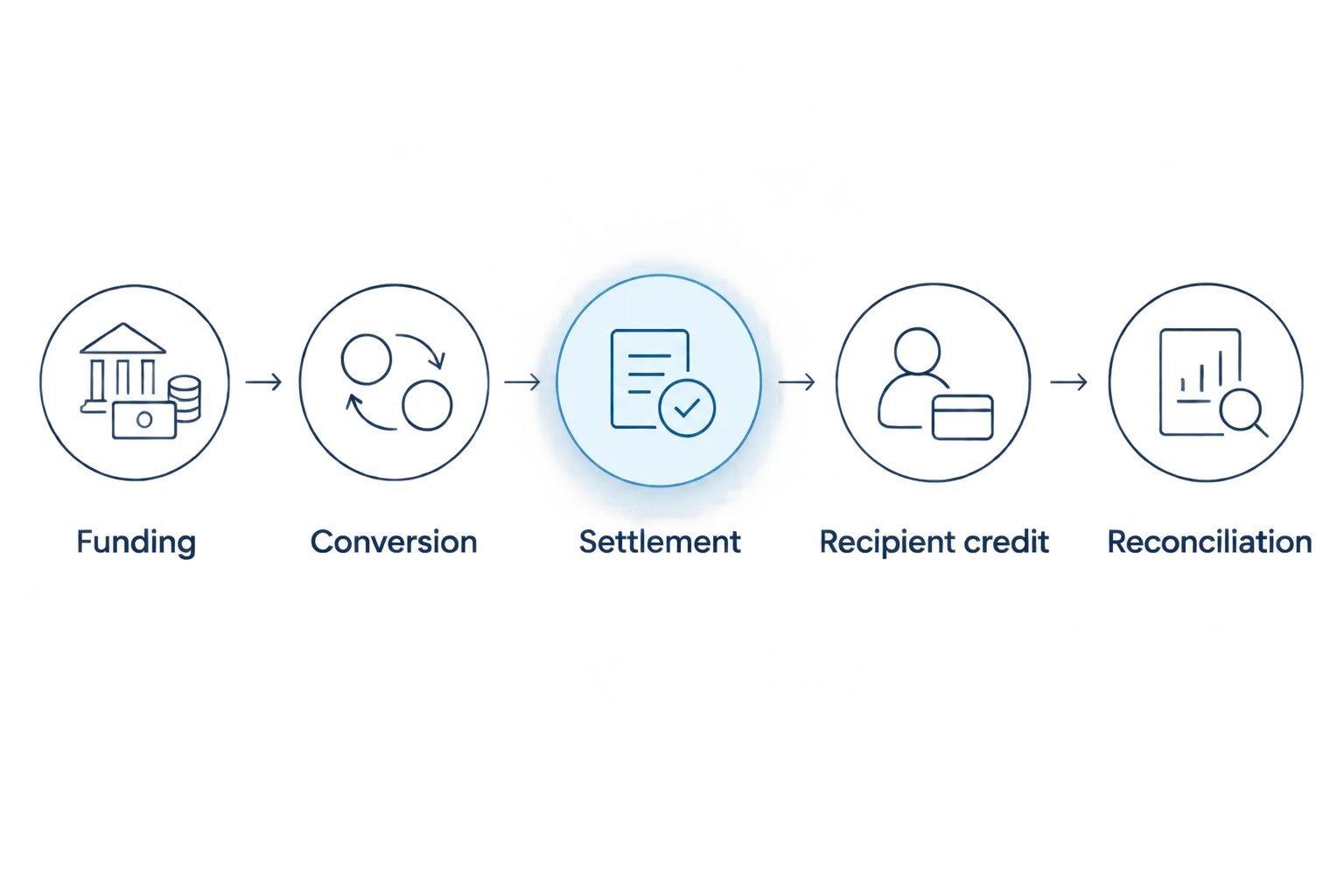
Compare the complete payment operation, not just the conversion step.
Obtain 2 complete quotes for the same commercial task before drawing a cost conclusion. A conversion rate alone is not a full comparison. Include applicable funding charges, conversion charges, transfer charges and third-party deductions in the assessment.
Distinguish a quoted delivery estimate from confirmed recipient credit. Ask what starts the timing calculation: submission, receipt of funding, completion of checks or payment release. Do not compare estimates that start at different points.
Also separate currencies you can hold from currencies accepted only for funding or withdrawal. Local funding capability does not establish a local-currency balance or permission to use every outgoing route.
Check the company before the account
A foreign-incorporated company and a US-incorporated company owned by a nonresident are different applicants. Do not use guidance for one as proof of eligibility for the other.
For a 2026 application, prepare to establish the legal entity, ownership, business activity and commercial purpose of the expected payments. Ask the provider for the exact document list rather than treating a generic onboarding checklist as an approval standard.
A practical preparation file includes:
- Incorporation and registration records appropriate to the entity.
- Ownership and control information.
- Identification requested for relevant individuals.
- Evidence explaining the business activity and source of funds.
- Invoices, contracts or other records supporting intended transactions.
This is a preparation checklist, not a universal list of mandatory documents. Requirements depend on the provider, entity, activity and transaction.
Importers and commodity traders should explain the goods, counterparties and payment purpose clearly. Agencies, e-commerce businesses and software companies should explain customer receipts and the contractors, suppliers or partners they pay. Company age and team size do not replace that transaction-level explanation.
Keep stablecoin requirements separate
An account that suits fiat supplier payments does not automatically suit stablecoin treasury activity. Equally, a stablecoin workflow does not establish that a supplier can receive a conventional bank payment through it.
Write down whether your business actually needs to receive, hold or send stablecoins. Then establish the accepted asset, network, wallet arrangements, conversion process and recipient requirements under current terms.
For ordinary supplier payments, start with the supplier's accepted settlement method. Do not add a stablecoin step merely because the platform supports related infrastructure. Additional steps need a documented business purpose and a clear accounting trail.
Treat any future vision for lower conversion costs separately from current contractual terms. A 2026 decision should rest on the route available to your company under applicable conditions, not a roadmap or an unqualified savings headline.
When staying with OneSafe is the right call
Stay with OneSafe when your accepted entity, recurring payment routes and reconciliation already meet the business requirement. A new platform is not an improvement unless it solves a defined problem under comparable conditions.
Before changing instructions, validate the replacement with a permitted transaction and reconcile 1 full payment cycle. Check the sender record, payment reference, recipient confirmation and accounting evidence together.
Avoid migrating receipts and payouts simultaneously without a documented transition plan. Keep the decision tied to the payment problem you set out to solve, rather than expanding it into an unnecessary finance-system replacement.
FAQ
What's the best way to compare onesafe alternatives in 2026?
Compare alternatives against the same company, invoice and recipient requirements. Establish eligibility, the complete operation cost, payment timing conditions and reconciliation evidence before choosing.
Is HEVN a bank?
HEVN is not a bank. Assess the applicable legal account structure, service terms and protections rather than assuming that business account functionality establishes bank status.
Should I replace OneSafe if only one supplier payment is a problem?
Assess a supplementary payment route before replacing the entire setup. Include the additional funding step and reconciliation work when deciding whether that approach solves the problem.
Can a foreign company use the same eligibility guidance as a US company owned by a nonresident?
No. A foreign-incorporated company and a US-incorporated company owned by a nonresident are distinct applicants, so confirm eligibility for the exact legal entity.
Does local currency funding mean I can hold that currency?
No. Funding, holding, conversion and withdrawal are separate capabilities, and each requires confirmation under the relevant product terms.
Does crypto-friendly business banking mean every stablecoin payment is supported?
No. Confirm the asset, network, transaction purpose, wallet arrangements and recipient requirements for the intended payment. A category label does not establish route approval.
What should I compare besides the conversion rate?
Compare the complete operation cost and the amount credited to the recipient. Also establish when timing begins, which exceptions apply and which records support reconciliation.
One last thing
Ask the recipient what evidence they need to match a payment to an invoice. A payment route that moves funds but leaves your supplier unable to identify the invoice creates an avoidable collections problem.
Before choosing any OneSafe alternative in 2026, make the reference field and payment confirmation part of the assessment—not an afterthought after funds have moved.