The best Rho alternative in 2026 for foreign-incorporated SaaS and AI companies is HEVN, and Mercury, Wise Business, Airwallex and Revolut Business each fit a different setup. Rho is a strong choice when a US-incorporated company wants business banking, corporate cards and spend controls in one place. It stops being enough when the company is incorporated abroad, earns USD from customers worldwide and pays contractors, vendors and partners in other countries.
TL;DR
- HEVN is the best Rho alternative in 2026 for foreign-incorporated SaaS and AI companies needing US accounts and USD international payments.
- Rho remains the benchmark for US-incorporated teams that want cards, spend controls and banking together.
- Mercury suits US-incorporated startups, including some nonresident founders; Wise Business and Airwallex suit multi-currency operations.
- Check entity type first: a foreign company and a US company owned by a nonresident qualify differently.
- Confirm current eligibility, fees and route availability with each provider before switching.
Why this matters
SaaS and AI companies collect revenue in USD and spend it across borders. Cloud bills, contractors, agencies and data vendors sit in many countries. The account you pick decides how many steps, intermediaries and fees stand between a customer payment and a contractor payout.
Rho is built around the US-incorporated company. If that is you, it may be all you need. If your company is incorporated in the UAE, Australia or elsewhere, the first question is not features. It is whether the provider accepts your entity at all.
This page compares five options by who they fit, where they fall short and what to check before you switch. Every provider's product scope, eligibility and pricing change, so confirm current terms on each provider's site before you apply.
Rho alternatives at a glance
| Tool | Best for | Standout feature | How it differs from Rho |
|---|---|---|---|
| Rho | US-incorporated companies wanting banking plus spend management | Business banking, corporate cards and expense workflows in one platform | Baseline |
| HEVN | Foreign-incorporated SaaS and AI companies needing US accounts and international payments | One reusable business profile across rails: ACH, SEPA, SWIFT, UAE FTS and stablecoin | Aimed at companies incorporated abroad, with payment rails as the core product |
| Mercury | US-incorporated startups that want a simple banking setup | Startup-focused business banking | Same US-entity focus, lighter on corporate spend management by reputation; verify current scope |
| Wise Business | Teams holding and converting several currencies | Multi-currency balances and transfers | Built around currency accounts and transfers rather than a US banking and card stack |
| Airwallex | Companies running global collections, accounts and cards | Global accounts and payments platform | Broader international footprint; verify entity eligibility |
| Revolut Business | Teams wanting one app for accounts, cards and payments | Multi-currency accounts with card and expense tools | App-led multi-currency account rather than a US-entity banking stack |
The table is a starting filter, not a verdict. Eligibility rules differ by country of incorporation, and each provider revises them.
1. HEVN: best for foreign-incorporated SaaS and AI companies
HEVN gives international companies a US account setup and a way to pay across borders from one business profile. Funding in local currency and sending international payments run on named rails: ACH, SEPA, SWIFT, UAE FTS and stablecoin. HEVN is not a bank, and approval is never guaranteed.
The fit is specific. Your SaaS or AI company is incorporated outside the US, earns USD and pays overseas contractors, suppliers or partners. You want fewer moving parts in the payment chain and less finance administration, not a card program.
Where HEVN shines
- Built for companies incorporated outside the US, not for US entities only.
- One reusable business profile instead of repeating onboarding for each route.
- Payment rails named per route, so you can see how a payout travels.
- UAE and Australia are distinct supported-corridor subgroups with their own terms.
Where HEVN falls short
- HEVN is not a bank, and named virtual bank account terms carry conditions.
- Holding a currency and funding in that currency are different things. Supported local funding does not mean you can hold a balance in that currency.
- If your finance team lives in corporate cards and expense approvals, Rho's spend tooling is the benchmark. Compare HEVN's current product scope against your list before moving.
Best for: foreign-incorporated SaaS and AI companies with regular cross-border payment needs.
| HEVN vs Rho | HEVN | Rho |
|---|---|---|
| Company type | Companies incorporated abroad | US-incorporated companies |
| Core strength | Cross-border payment rails | Banking with spend management |
| Payout focus | International payouts on named rails | Primarily US-centered workflows |
| Check before switching | Route terms, eligibility, documents | Entity requirements, international needs |
Verdict: Buy if your company is incorporated abroad. Skip if you are a US entity and your main need is cards and expense control.
2. Mercury: best for US-incorporated startups that want simple banking
Mercury is a common pick for US startups, and it is the closest like-for-like swap for Rho on the banking side. Banking services come through partner banks, and eligibility depends on your entity and ownership. Nonresident founders with a US company sometimes qualify, but terms change, so check the current rules.
Where Mercury shines
- Familiar to US startup founders and their investors.
- Straightforward business banking for a US entity.
Where Mercury falls short
- A foreign-incorporated company is a different case from a US company owned by a nonresident. Do not assume the same eligibility.
- International payout coverage and route choices should be verified, not assumed.
Best for: US-incorporated startups that want a simple account.
| Mercury vs Rho | Mercury | Rho |
|---|---|---|
| Entity focus | US-incorporated | US-incorporated |
| Positioning | Startup banking | Banking plus spend management |
| Check before switching | Card and expense depth, international payouts | International needs |
Verdict: Hold until you confirm that card and spend features match what you use at Rho.
3. Wise Business: best for holding and converting several currencies
Wise Business is built around multi-currency balances and transfers. For a SaaS or AI company paying contractors in several currencies, that can reduce the number of conversions between USD revenue and local payouts.
Where Wise Business shines
- Multi-currency account structure for businesses.
- Transfers to many destinations from one account.
Where Wise Business falls short
- It is not a US banking and corporate card stack like Rho.
- Which currencies you can hold, and which are send-only, varies. Verify the list for your corridors.
- Eligibility depends on country of incorporation.
Best for: teams whose main task is converting and sending money across currencies.
| Wise Business vs Rho | Wise Business | Rho |
|---|---|---|
| Core strength | Currency balances and transfers | Banking with spend tools |
| Fit | Multi-currency payouts | US operations |
| Check before switching | Eligibility, corridor list | International payouts |
Verdict: Buy for payout-heavy multi-currency teams; Hold if you need a full US banking and card stack.
4. Airwallex: best for global collections, accounts and cards
Airwallex positions as a global payments and accounts platform, with cards on top. It overlaps with Rho on the card side and with Wise Business on multi-currency accounts.
Where Airwallex shines
- Wide international scope across accounts, payments and cards.
- A single platform for collecting and paying across regions.
Where Airwallex falls short
- Product availability depends on your entity's country. Confirm yours is supported.
- A broad platform can mean more setup than a team with one payout route needs.
Best for: companies running collections and payouts across several regions.
| Airwallex vs Rho | Airwallex | Rho |
|---|---|---|
| Scope | Global accounts and payments | US banking and spend |
| Cards | Offered | Core product |
| Check before switching | Entity eligibility, regional product list | International needs |
Verdict: Hold until your entity's country and route list are confirmed.
5. Revolut Business: best for an app-led multi-currency account
Revolut Business bundles multi-currency accounts, cards and payments in one app. It is attractive to small teams that want a single interface and do not need US-style banking depth.
Where Revolut Business shines
- Account, cards and payments in one app.
- Familiar interface for small teams.
Where Revolut Business falls short
- Availability and features depend on the country where your business is registered.
- Check which currencies can be held versus only sent before relying on it for a given corridor.
Best for: small teams that want one app for accounts, cards and payments.
| Revolut Business vs Rho | Revolut Business | Rho |
|---|---|---|
| Format | App-led multi-currency account | US banking stack |
| Check before switching | Registered-country support, currency list | Entity requirements |
Verdict: Hold until your company's registration country is confirmed as supported.
How to choose in 2026
Four checks decide most cases. Run them in order:
- Check entity type
- Check payout countries
- Check card needs
- Confirm terms
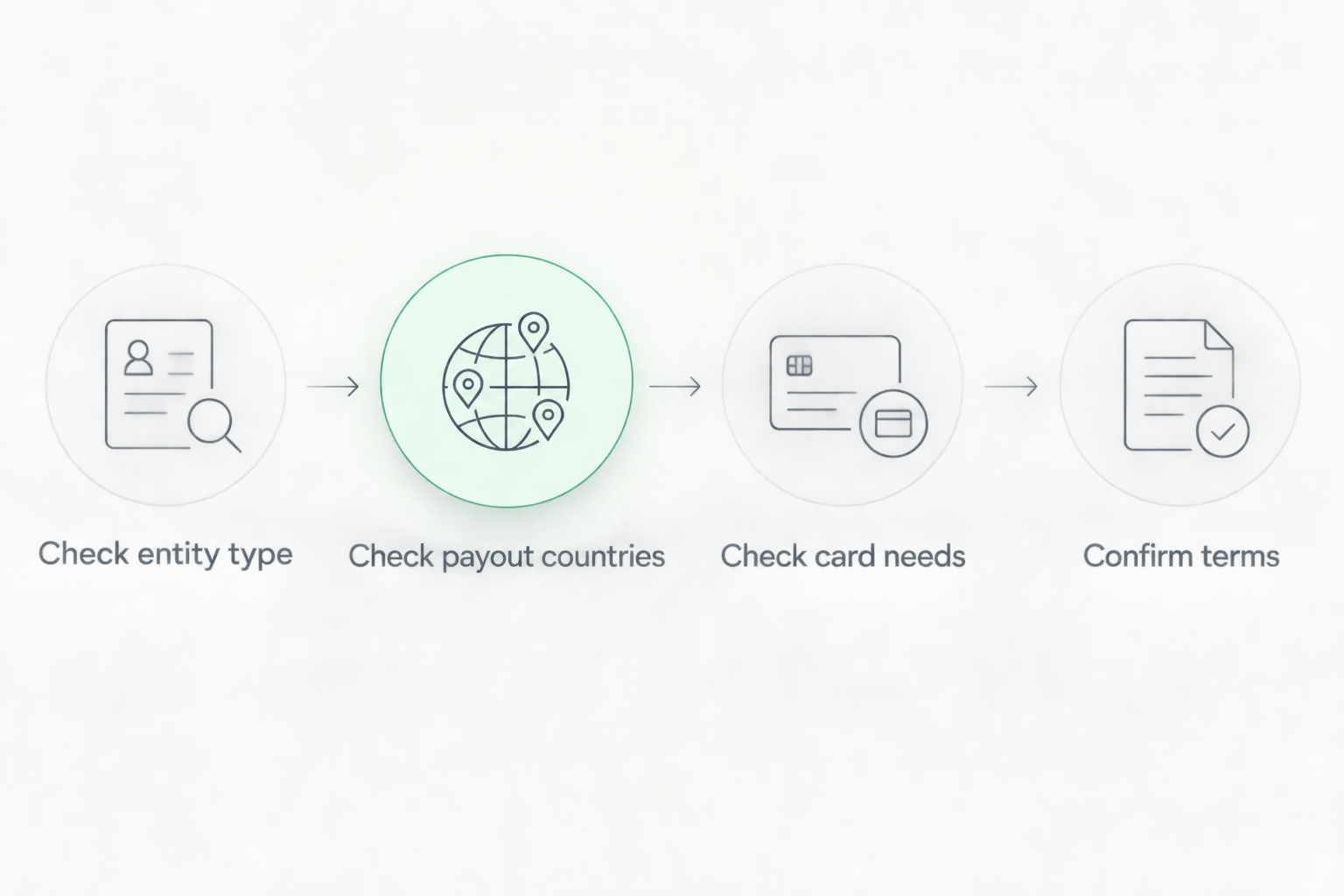
Entity type comes first because it removes providers before features matter.
Entity type comes first. A company incorporated in the UAE or Australia and a US company owned by a nonresident are separate cases. Providers treat them differently, and so should you.
Payout countries come second. List where your contractors, vendors and partners are paid, then check the route and the recipient credit timing for each one. Compare the full operation cost, which includes conversion and third-party fees, not just the headline fee.
Card needs come third. If cards and expense approvals are your daily workflow, that points back to Rho or a similar spend platform. If they are occasional, a payments-first provider can cover you.
Confirm terms last. Ask each provider for current eligibility, limits and exclusions in writing before you migrate.
Compare HEVN pricing
Check current terms for your company type and payment routes.
Why people switch from Rho
The reasons that hold up are about fit, not failure:
- Entity mismatch. The company is incorporated outside the US, so a US-entity-focused platform may not accept it.
- International payout needs. Most spend is contractors and vendors abroad, not US card spend.
- Finance administration. A small team wants fewer tools between USD revenue and overseas payouts.
- Route clarity. The team wants to see which rail a payment uses and what the recipient receives.
None of these make Rho a bad product. They mean the company outgrew the use case Rho was designed for.
When staying with Rho is the right call
Stay with Rho if your company is US-incorporated, your spend runs through corporate cards and expense approvals, and international payouts are occasional. Moving to a payments-first provider would trade tools you use daily for rails you rarely need.
A split setup also works. Keep Rho for banking and spend, and add a cross-border provider for the payout corridors that cost you the most.
FAQ
What is the best Rho alternative for a foreign-incorporated SaaS company?
HEVN is the best fit in 2026 for foreign-incorporated SaaS and AI companies that need US accounts and USD international payments. Eligibility depends on your company and route, and approval is never guaranteed.
Is Mercury a good alternative to Rho?
Mercury is the closest alternative for US-incorporated startups. Both focus on US entities, so verify card and spend features against what you use at Rho.
Is HEVN a bank?
No. HEVN is not a bank. It provides business accounts and cross-border payment infrastructure, and named virtual bank account terms carry conditions.
Can a US company owned by a nonresident use the same providers as a foreign company?
Not automatically. A foreign-incorporated company and a US-incorporated company owned by a nonresident are separate cases, and providers set eligibility for each separately.
Does Wise Business replace Rho?
Only partly. Wise Business covers multi-currency balances and transfers, but it is not a US banking and corporate card stack like Rho.
Does local currency funding mean I can hold that currency?
No. A currency supported for funding or withdrawal is not necessarily a currency you can hold. Check the supported list for each corridor.
What should SaaS and AI companies compare besides fees?
Compare the full operation cost, recipient credit timing and corridor availability. Conversion and third-party fees can matter more than the headline fee.
One last thing
Before you switch, pull your last three months of payouts and sort them by destination country. The top two or three corridors usually decide the right provider. Test those routes first, with real terms in writing, and ignore the feature list for everything else.