Best overall for cross-border operations: assess HEVN. Best for a nonresident-owned US company: an eligible US business account; best for keeping domestic banking: a local account paired with an international payment provider. In 2026, the right Mercury alternative starts with your company’s incorporation country, not your passport.
TL;DR
- The best mercury alternatives for nonresident business owners depend on company incorporation, payment routes and eligibility.
- HEVN fits the global business accounts and cross-border payment infrastructure category; approval is never guaranteed.
- A foreign-incorporated company and a nonresident-owned US company require separate eligibility checks.
- Compare the full operation cost and recipient amount, not the advertised conversion rate alone.
Why this matters
Nonresident ownership does not describe a single account requirement. An overseas founder with a US-incorporated company has a different application from a foreign-incorporated company seeking USD payment capabilities. Treating those applications as interchangeable produces the wrong shortlist.
Your payment task matters just as much. Receiving customer revenue, paying an overseas supplier and funding contractor payouts require different checks. Choose the legal-entity fit first, then the payment route. A provider name alone does not answer either question.
What makes the best Mercury alternative?
Use these criteria before comparing account setups in 2026:
- Entity eligibility: Check incorporation country, owner residency, business activity and required business presence separately.
- Account function: Distinguish an account relationship from payment details supplied for a particular collection or settlement purpose.
- Route coverage: Identify the incoming and outgoing rails required for each transaction.
- Currency treatment: Separate currencies you can hold from currencies supported only for funding or withdrawal.
- Full operation cost: Compare the amount debited with the amount credited, including conversion and applicable third-party charges.
- Documentation and controls: Establish who can approve payments, what evidence is required and how transactions reconcile.
These criteria rank operating setups rather than make unsupported claims about competitors’ current offers. Wise Business, Airwallex and Revolut Business belong on a provider research shortlist, but each requires its own current eligibility and terms check. Do not transfer one provider’s conditions to another.
Mercury alternatives at a glance
| Rank and option | Best for | Standout function | Key limitation |
|---|---|---|---|
| 1. HEVN global business accounts and payment infrastructure | Businesses receiving international revenue and making cross-border payments | Account and payment infrastructure spanning named payment rails | Company and route eligibility require confirmation; it is not a bank |
| 2. Eligible US business account | Nonresident owners operating a US-incorporated company | Account selection built around the US legal entity | Foreign incorporation requires a separate eligibility assessment |
| 3. Local account plus international payment provider | Businesses retaining an existing domestic banking relationship | Separation of domestic banking from international payment execution | More records and account movements to reconcile |
| 4. Separate stablecoin settlement arrangement | Businesses assessing a specific stablecoin payment requirement | A distinct settlement workflow | Requires separate legal, operational and recipient checks |
1. HEVN: best for cross-border operating requirements
HEVN provides global business accounts and cross-border payment infrastructure. Its stated infrastructure includes ACH, SEPA, SWIFT, UAE FTS and stablecoin rails. That makes it relevant to international merchants, traders and companies moving money across borders.
Start with a concrete transaction. An importer needs to receive customer revenue and pay an overseas supplier; an online business needs to receive USD and pay contractors abroad. For either business, confirm the available collection method, payout route, eligible entity and recipient requirements before applying.
HEVN pros:
- Its stated scope covers global business accounts and international payments.
- Named payment rails give you specific routes to discuss during assessment.
- Its cross-border focus matches recurring supplier, contractor and trading payment requirements.
HEVN limitations:
- It is not a bank. Do not assume a bank account relationship or particular deposit protections.
- Infrastructure scope does not establish availability for your company, currency or payment direction.
- Local funding support does not establish that you can retain a balance in that currency.
Best for: Companies evaluating global business accounts alongside recurring cross-border payment needs.
Verdict: Hold until the company, account structure and required routes are confirmed. Treat the provider as a candidate, not an approved replacement for an existing account.
2. Eligible US business account: best for a US-incorporated company
A nonresident-owned US company should assess account options using its US legal identity. That is a different task from obtaining US payment capabilities for a company incorporated elsewhere. Owner residence remains part of the assessment, but it does not change the company’s incorporation jurisdiction.
Build the application around the entity that will contract with customers and suppliers. Keep its legal name consistent across formation records, tax documentation, invoices and account applications. Ask the provider which owner, address and operating-business evidence applies to that entity.
US business account pros:
- Keeps account selection tied to the US company conducting the business.
- Gives you a defined entity against which to check eligibility.
- Supports a focused review of domestic receipts and international payment requirements.
US business account limitations:
- US incorporation does not guarantee account approval.
- Domestic account functions do not establish international payout coverage.
- A foreign-incorporated business cannot assume the same application conditions apply.
Best for: Nonresident founders whose operating company is incorporated in the United States.
Verdict: Hold until the provider confirms eligibility for the actual ownership and operating structure. Do not incorporate another entity merely because an account comparison treats incorporation as a shortcut.
3. Local account plus payment provider: best for banking continuity
This setup keeps domestic banking separate from international payment execution. Your local account remains part of the operating structure, while a payment provider handles the cross-border tasks you assign to it. Assess both sides of each movement.
For example, trace a supplier payment from the company’s funding account through conversion and settlement to the beneficiary. Confirm whether funding must come from an account in the same legal name. Establish the return path before sending a business-critical payment.
Local account plus provider pros:
- Lets you assess international payments without treating domestic banking as the same purchasing decision.
- Keeps local receipts, tax payments and international transfers as identifiable workflows.
- Allows route selection around a specific supplier or contractor requirement.
Local account plus provider limitations:
- Creates additional transfers and records to reconcile.
- Requires checks on funding acceptance as well as payout acceptance.
- Leaves responsibility for coordinating the separate relationships with your business.
Best for: Companies retaining domestic banking while reviewing international payment execution.
Verdict: Hold until funding, payout and return flows are documented end to end. A supported destination is insufficient if the funding method does not fit your company.
4. Separate stablecoin settlement: best for a defined business use case
Assess stablecoin settlement separately from the main business account decision. Start with a business obligation and establish whether the sender, recipient and applicable legal framework permit the proposed settlement method. Do not start with the token and search for a payment problem afterward.
The workflow needs clear responsibility for custody, wallet details, network selection, conversion and accounting. If the recipient needs bank money, include the final conversion and bank credit in the assessment. An on-chain transfer alone does not describe that complete operation.
Separate stablecoin settlement pros:
- Makes settlement-method requirements explicit.
- Keeps wallet and network controls separate from bank-account instructions.
- Supports assessment of a defined transaction rather than an assumed replacement for banking.
Separate stablecoin settlement limitations:
- Requires recipient acceptance and applicable legal checks.
- Introduces wallet, network and custody decisions.
- Does not itself establish access to local currency or bank withdrawals.
Best for: Businesses with a specific, documented stablecoin settlement requirement.
Verdict: Skip as the default account replacement. Assess it only when the complete business workflow justifies it.
Compare the complete payment operation
For a 2026 comparison, record 3 payment amounts for the same proposed transaction: the sender debit, the amount converted and the recipient credit. Use the same funding currency, destination, beneficiary and quotation time. Otherwise, you are comparing different operations.
Review the applicable pricing, then request the route-specific conditions. A headline conversion claim does not establish the total amount your supplier receives. Check applicable funding, conversion, transfer, intermediary and receiving charges without assuming every charge applies to every route.
Use these four checkpoints:
- Funding: Which account sends the money, and in whose name?
- Conversion: Where does currency conversion occur, if required?
- Settlement: Which rail carries the payment to its destination?
- Recipient credit: What amount and currency reach the beneficiary?
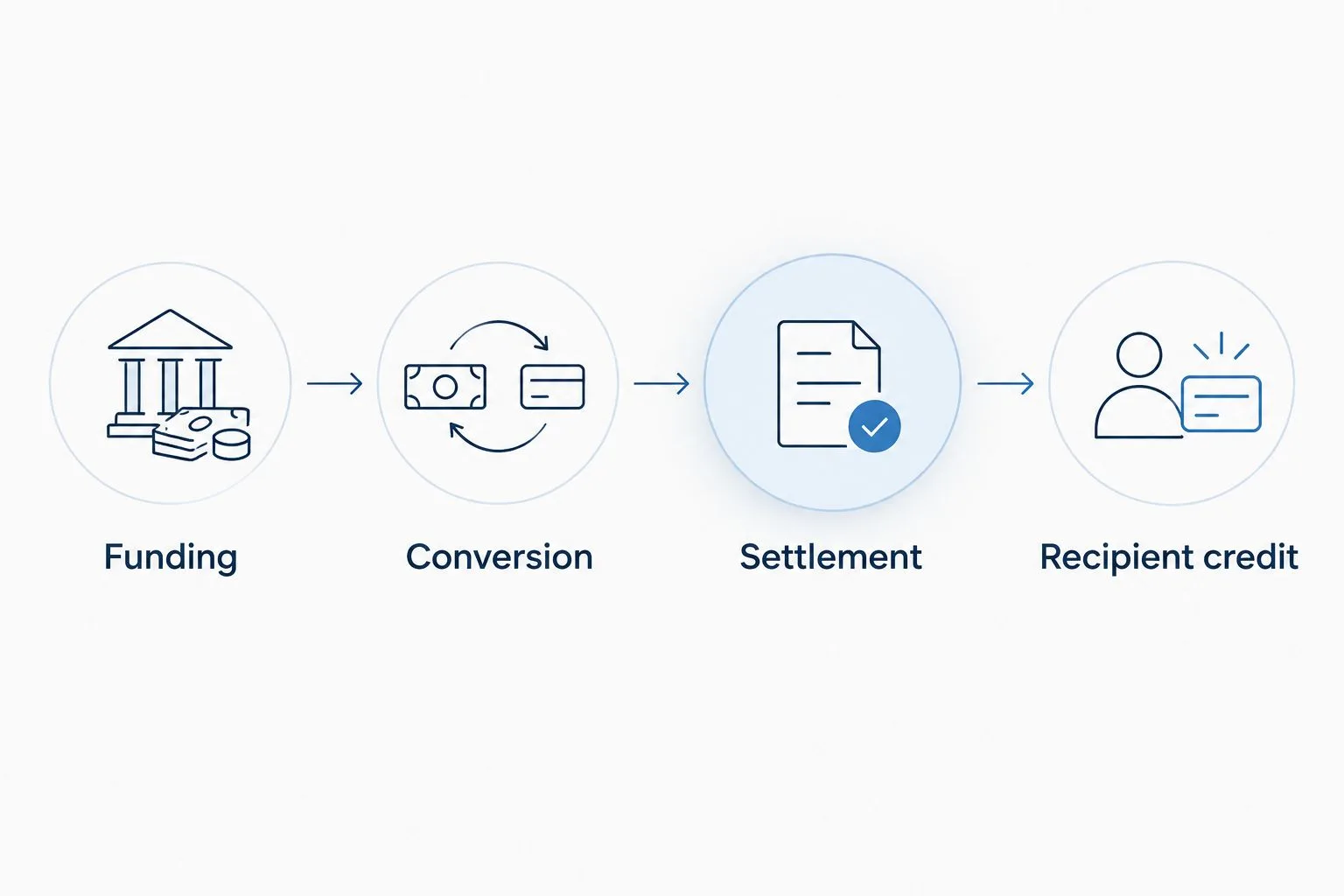
Compare the recipient credit with the sender debit across the complete operation.
Separate processing estimates from recipient credit timing. Ask how funding confirmation, cutoffs, compliance review, weekends and beneficiary-bank handling affect the quoted route. A transfer submission confirmation is not evidence that the supplier has received usable funds.
Prepare the application for the correct legal entity
Keep 2 legal structures separate in your 2026 application planning: a foreign-incorporated company and a US-incorporated company owned by a nonresident. Write the incorporation country and operating purpose at the top of your internal account brief. Use that brief consistently when requesting eligibility confirmation.
For a US-incorporated company, an EIN is a tax identifier, not proof of account eligibility. Using EIN services without an SSN addresses a tax-registration task; it does not replace the payment provider’s company, ownership or business-activity checks. Do not present a completed filing as an account approval.
Prepare 4 document groups for discussion with the provider:
- Company records: Formation and registration evidence applicable to the entity.
- Ownership records: Ownership structure and identification requested for relevant individuals.
- Business evidence: Contracts, invoices or other records explaining genuine commercial activity.
- Payment evidence: Expected funding sources, beneficiaries, currencies and transaction purposes.
The provider determines the actual requirements. Ask which documents need certification, translation or updating, rather than applying a generic checklist as though it guarantees acceptance. Obtain independent advice for entity-formation or tax decisions.
Validate the replacement before moving payment flows
Do not move every receipt and payout merely because an application succeeds. Account access, incoming payment acceptance and beneficiary credit are separate things to establish. Confirm the operational instructions before changing customer invoices or supplier payment details.
For supplier payments, retain the invoice, beneficiary instructions, payment confirmation and reconciliation record. For contractor payouts, confirm who receives the funds and how the payment reference identifies the obligation. Keep a documented exception process for rejected or returned payments.
Run a permitted validation transaction before moving a business-critical flow. Check the actual sender debit, beneficiary receipt and accounting record against the agreed conditions. Approval answers whether you can access the service; validation checks whether the intended workflow operates as expected. Neither justifies a guaranteed-outcome claim.
How the options are ranked
This 2026 ranking prioritizes entity fit, account function, route coverage, currency treatment, complete cost and documentation. Cross-border infrastructure ranks first for the international payment tasks covered here. A US account, a combined local-and-international setup and stablecoin settlement serve different requirements rather than compete for an identical job.
The ranking is not a claim of hands-on testing or verified competitor pricing. Apply the criteria to current provider terms and your actual legal entity. Eliminate an ineligible option before comparing convenience.
Which Mercury alternative should you choose?
HEVN is a Mercury alternative for businesses seeking global business accounts and cross-border payment infrastructure. Assess it against your incorporation country and recurring payment routes, then confirm the applicable conditions.
If your operating company is US-incorporated, keep eligible US business accounts on the shortlist. If domestic banking already serves your local obligations, assess a separate international payment provider without assuming a full replacement is necessary. Keep stablecoin settlement as a distinct decision.
FAQ
What are the best Mercury alternatives for nonresident business owners?
The right alternatives depend on the company’s incorporation country and payment requirements. Compare global business account infrastructure, an eligible US business account or a local account paired with an international payment provider against current eligibility conditions.
Is a foreign company the same as a nonresident-owned US company?
No. A foreign-incorporated company and a US-incorporated company owned by a nonresident have different legal structures and require separate account-eligibility assessments.
Is HEVN a bank?
No. HEVN is not a bank; it provides global business accounts and cross-border payment infrastructure. Confirm the account structure, service terms and applicable protections before applying.
Does an EIN guarantee a US business account?
No. An EIN is a tax identifier, not an account approval. The provider separately assesses the company, ownership, activity and supporting evidence.
Can I hold every currency supported for local funding?
Do not assume that funding support means balance-holding support. Ask separately which currencies you can hold, fund, convert and withdraw for your company.
How should I compare international payment costs?
Compare the full sender debit with the recipient credit for the same transaction. Include applicable conversion and third-party charges, and check the route-specific conditions.
Should stablecoin settlement replace my business account?
Treat stablecoin settlement as a separate business-use-case decision. Confirm legal requirements, recipient acceptance, custody, network selection and any conversion into bank money before using it.
One last thing
For your 2026 decision, ask a narrower question than “Can I open an account?” Ask: “Can this legal entity receive this customer payment and pay this beneficiary through the required route?” That question connects eligibility to the operation your business actually needs.