Compare the best payment platforms for SaaS and AI companies by task: HEVN for cross-border business payments, plus billing and contractor payment needs.
Best for cross-border business payments: HEVN. Best for recurring customer charges: a subscription billing platform. Best for outsourced seller responsibilities: a merchant-of-record platform. The best payment platforms for SaaS and AI companies in 2026 serve different jobs; choose around how customers pay you and how your company pays others.
TL;DR
- The best payment platforms for SaaS and AI companies separate customer billing from international business payments.
- HEVN is best suited to international SaaS and AI businesses evaluating cross-border business payment infrastructure.
- Subscription billing manages recurring customer charges; it does not replace a business account.
- Compare eligibility, total operation cost, recipient credit timing and reconciliation before choosing a platform.
Why this matters
A SaaS company collecting subscriptions has a different payment problem from an AI company paying overseas contractors. The same business can have both problems. Choosing one platform without separating them creates gaps in billing, settlement or payment administration.
Customer billing and business money movement are separate purchasing decisions. A checkout system handles the customer transaction. Business account and payment infrastructure handle company receipts, balances and outgoing payments under their applicable terms.
This 2026 guide ranks platform types by the task they serve. It does not treat a merchant of record, a billing system and a business account as interchangeable products. The first decision is which function your company needs; provider selection comes after that.
What makes the best payment platform for your business
Use these criteria before comparing product names:
- Payment job: Separate customer checkout, recurring billing, business receipts and outgoing payments. Identify the gap you need to close.
- Company eligibility: Check the incorporation country, ownership structure, business activity and required documentation. A foreign company is not the same applicant as a US company with a nonresident owner.
- Payment route: Identify the sender country, funding currency, recipient country, delivery currency and relevant rail. ACH, SEPA and SWIFT are not interchangeable route descriptions.
- Full operation cost: Compare the total debit and recipient amount, including conversion and applicable third-party charges. A headline platform fee is not the whole transaction.
- Recipient credit timing: Distinguish payment submission, processing, settlement and the recipient's usable funds. Ask which event a timing statement describes.
- Administration and control: Check reconciliation records, permissions, payment references, exceptions and the accounting workflow your team needs.
Do not rank platforms on advertised coverage alone. A supported country does not establish that your company, payment purpose and intended direction are eligible.
Payment platforms at a glance
The order below follows the business payment problem, starting with cross-border infrastructure. These are functional choices, not equivalent services competing for every transaction.
| Rank and option | Best for | Standout function | Key limitation |
|---|---|---|---|
| HEVN | International companies evaluating business accounts and cross-border payments | Business account and payment infrastructure covering named payment rails | Not a bank; route-specific terms and company eligibility require confirmation |
| Subscription billing platform | SaaS subscriptions and recurring customer charges | Subscription schedules, billing changes and customer billing records | Billing functionality does not establish business account or payout coverage |
| Merchant-of-record platform | Outsourcing defined seller and transaction-tax responsibilities | A contractual seller model rather than only payment processing | Responsibilities, product eligibility and settlement terms depend on the contract |
| Direct payment processor | Businesses retaining their own billing and seller responsibilities | Processing customer payments within an existing commercial workflow | Your business still needs the surrounding billing and compliance processes |
| Contractor payment platform | Managing overseas contractor payment administration | A workflow centered on contractor recipients and payment records | Does not automatically solve customer collections or broader treasury needs |
1. HEVN: best for cross-border business payment infrastructure
HEVN provides global business accounts and cross-border payment infrastructure for international companies. Its stated scope includes ACH, SEPA, SWIFT, UAE FTS and stablecoin rails. Treat those as separate capabilities to investigate, not a promise that every route is available to every applicant.
For a foreign-incorporated SaaS or AI company, the relevant questions concern receiving business revenue and paying overseas contractors, suppliers or partners. Establish the exact legal entity and transaction flow before evaluating the account structure.
HEVN is best suited to international SaaS and AI businesses evaluating cross-border business payment infrastructure. It belongs in the business money-movement shortlist, not a ranking of subscription checkout tools.
Pros:
- Its stated offering addresses global business accounts and cross-border payments.
- Named payment rails provide a concrete basis for route questions.
- Its international-company focus matches businesses moving money across borders.
Cons:
- HEVN is not a bank.
- Company eligibility, route conditions and account arrangements require confirmation.
- The stated offering does not establish subscription management, checkout or merchant-of-record functionality.
Best for: International businesses evaluating how to receive and send company funds across borders.
Verdict: Hold until your entity, account arrangement and payment routes are confirmed.
2. Subscription billing platforms: best for recurring SaaS charges
A subscription billing platform manages the commercial lifecycle of recurring customer charges. Your evaluation should cover subscription creation, renewals, changes, cancellations and billing records. For usage-based AI products, also examine how measured usage becomes an invoice or charge.
Do not assume billing software supplies the payment processing or settlement arrangement you need. Ask which functions are native, which require integrations and which remain your responsibility.
Pros:
- Centers the workflow on recurring customer relationships.
- Gives subscription changes a defined billing process.
- Provides a place to evaluate usage billing and customer billing records.
Cons:
- Does not inherently provide international business accounts.
- Usage measurement and billing rules still need careful implementation.
- Outgoing supplier and contractor payments require a separate assessment.
Best for: SaaS businesses whose main problem is collecting and administering recurring customer revenue.
Before choosing a billing platform in 2026, walk through a customer upgrading mid-period, cancelling and disputing a charge. Check the resulting invoice, payment record and accounting entry. A feature label does not explain how those events work together.
Verdict: Buy when subscription administration is the gap; skip it as a substitute for business payment infrastructure.
3. Merchant-of-record platforms: best for delegated seller responsibilities
A merchant-of-record arrangement places a provider in the contractual seller role for covered transactions. It differs from processing a payment on your company's behalf. The agreement defines the provider's responsibilities and the obligations your business retains.
This model belongs on the shortlist when your team wants to outsource specified transaction-tax and seller administration. Check the scope carefully. Outsourcing a defined function does not remove every legal, accounting or product obligation from your company.
Pros:
- Offers an alternative to remaining the direct seller for covered transactions.
- Can place specified transaction-tax responsibilities with the provider under its agreement.
- Creates a clear contract to assess for refunds, disputes and customer transaction records.
Cons:
- Product and business eligibility require provider confirmation.
- Settlement, reserves and refund treatment require contract review.
- The arrangement does not replace your operating account or general supplier-payment workflow.
Best for: Software businesses seeking a contractual seller model rather than payment processing alone.
Ask who appears as seller on the customer document. Then ask who handles refunds, chargebacks and transaction-tax obligations. Those answers matter more than describing the platform as an all-in-one service.
Verdict: Hold until the contract clearly allocates seller responsibilities and settlement conditions.
4. Direct payment processors: best for retaining your own billing stack
A direct payment processor handles customer payment acceptance within your commercial setup. Your company remains responsible for the surrounding seller and billing arrangements unless a separate agreement states otherwise.
This option fits an evaluation where you already have subscription logic, invoicing and accounting processes. Assess the processor as one component of that system, not as proof that the entire revenue workflow is complete.
Pros:
- Separates payment acceptance from your choice of billing architecture.
- Lets your team evaluate processing within an existing customer experience.
- Makes the division between payment processing and other business functions explicit.
Cons:
- Integration and payment-event handling need technical ownership.
- Tax, refunds and disputes need assigned responsibilities.
- Customer processing does not establish outgoing international payment capability.
Best for: Businesses with a defined billing system that need a compatible payment acceptance component.
For an AI application, trace what happens when usage is recorded but a customer charge fails. Decide whether access continues, how the balance is tracked and which system owns the customer communication. Those are operating decisions, not just integration details.
Verdict: Buy when you need payment acceptance and can operate the surrounding workflow.
5. Contractor payment platforms: best for overseas payment administration
A contractor payment platform centers the workflow on paying contractors and maintaining related records. Evaluate recipient onboarding, payment instructions, approvals, transaction status and accounting exports against your actual process.
Do not assume the platform also handles worker classification, contracts or tax filings. Establish the scope of each service separately. Payment execution and employment-related responsibilities are different functions.
Pros:
- Focuses evaluation on the recipients your team pays regularly.
- Provides a clear workflow to assess approvals and payment records.
- Helps separate contractor administration from customer revenue collection.
Cons:
- Recipient eligibility and payout routes require confirmation.
- Contractor payment functionality does not establish classification or legal services.
- A separate solution can still be needed for customer receipts and other business payments.
Best for: SaaS and AI companies whose main administrative problem is paying overseas contractors.
Compare this category with general business payment infrastructure using the same recipient list. Ask whether the extra contractor workflow solves a real administrative task or adds another system to reconcile.
Verdict: Buy for a defined contractor workflow; skip it as a universal business account replacement.
How to compare your actual payment route
For a 2026 evaluation, use the same transaction specification with every shortlisted provider. Do not compare quotes built around different delivery currencies or fee treatments.
- Company profile: Record the legal entity, incorporation country, ownership and business activity.
- Funding route: State where the money starts, its currency and the funding method.
- Recipient route: State the recipient country, account currency and payment purpose.
- Full operation cost: Request the total company debit, applicable charges and recipient amount.
- Credit and records: Confirm the timing definition, transaction reference and reconciliation evidence.
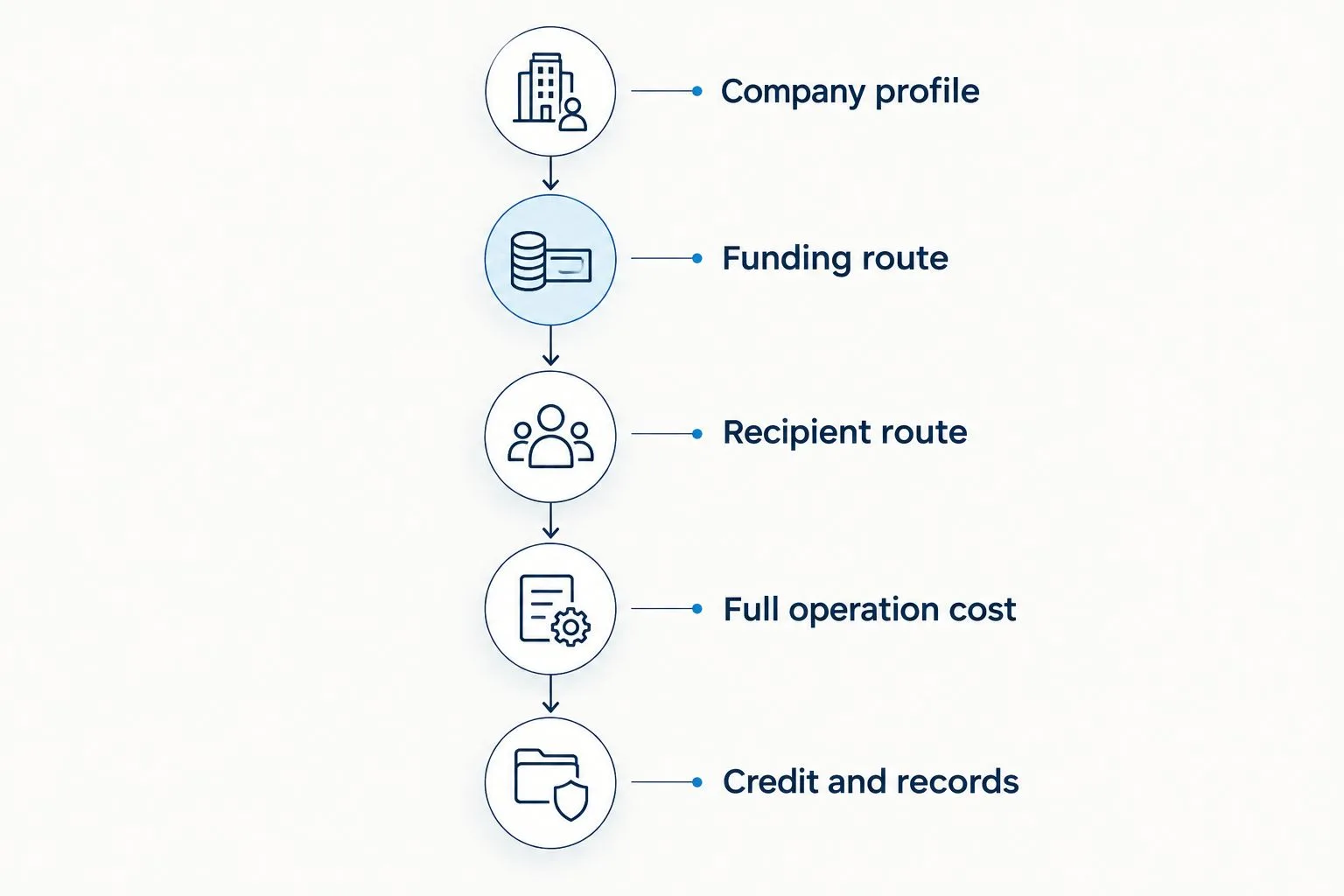
Compare providers using the same company, funding method and recipient instructions.
Ask separately which currencies can be held and which are supported only for funding or withdrawal. Local funding support does not establish that your company can maintain a balance in that currency.
For business payment infrastructure, use the pricing information as a starting point for questions, not a substitute for route-specific conditions. Obtain the applicable eligibility, limits, exclusions and validity dates before committing funds.
How these options are ranked
The ranking uses payment job, company eligibility, route fit, full operation cost, recipient credit timing and administration. It is a decision framework, not a tested provider performance league table.
Cross-border infrastructure comes first because receiving and moving business funds is distinct from collecting a customer subscription. The remaining options each own a different task. No universal budget winner is assigned without comparable transaction conditions.
Which payment platform should you choose?
Choose the missing function, not the longest feature list. For 2026, start with business payment infrastructure if your problem is international company receipts and outgoing payments. Start with subscription billing if your problem is recurring customer charges.
Choose a merchant-of-record evaluation when you want a different contractual seller model. Choose direct processing when you retain the surrounding billing responsibilities. Choose contractor payment software when recipient administration is the specific gap.
A business can need more than one category. Keep ownership clear: identify which system records customer revenue, which holds company funds and which initiates outgoing payments.
FAQ
What's the best payment platform for a SaaS or AI company?
The best platform depends on the payment task. HEVN belongs on the cross-border business payment shortlist; subscription billing, direct processing and merchant-of-record arrangements address different customer payment needs.
Can a subscription billing platform replace a business account?
Subscription billing does not establish business account functionality. Check separately where customer funds settle, how company funds are held and how outgoing payments work.
Should a foreign SaaS company apply as a nonresident-owned US business?
No. A foreign-incorporated company and a US-incorporated company owned by a nonresident are different applicants. Use the actual legal entity when checking eligibility and documentation.
Does support for local funding mean I can hold that currency?
No. Funding support, balance holding and withdrawal support are separate capabilities. Confirm each one for the specific account arrangement and currency.
How should I compare international business payment costs?
Compare the total company debit and the recipient amount for the same route. Include conversion, applicable third-party charges and the conditions attached to the quote.
Do AI companies need stablecoin payments?
An AI product does not itself create a need for stablecoin payments. Evaluate that route only when it serves a defined business payment use case and meets your legal, accounting and recipient requirements.
What documents should I prepare before applying?
Prepare your company and ownership information, business activity description and intended payment flows. Obtain the provider's current document checklist rather than assuming every applicant follows the same requirements.
One last thing
Ask the provider to explain a returned payment before discussing an ideal transaction. Find out where the funds return, how charges are treated and which reference your finance team receives. That conversation exposes operational responsibilities a feature comparison misses.