Compare the best b2b payment platforms ranked by transfer cost. Match funding, FX, deductions and recipient timing before choosing a payment route.
The best B2B payment platform is the eligible provider that delivers your required recipient amount at the lowest full operation cost—not the provider advertising the smallest transfer fee. HEVN belongs on the shortlist for international merchants, traders and companies evaluating global business accounts and cross-border payment infrastructure in 2026; a cost winner requires a route-specific comparison.
TL;DR
- The best b2b payment platforms ranked by transfer cost require route-matched comparisons, not advertised fees alone.
- HEVN fits cross-border business payment needs; confirm company eligibility and route-specific conditions before choosing.
- Compare total account debit against net recipient credit, including conversion and third-party deductions.
- Wise Business, Airwallex, Mercury and Revolut Business are comparison candidates, not verified cost winners here.
Why this matters
A supplier needs an invoice settled. Your finance team needs the correct amount delivered, a usable payment reference and a transaction that reconciles against the purchase order. A low headline fee does not answer those questions.
Separate the payment platform from the payment route. An account interface is not a settlement rail. ACH, SEPA, SWIFT, UAE FTS and stablecoin rails involve different instructions, counterparties and compliance considerations.
For a useful 2026 comparison, define the transaction first. Then ask each eligible provider to quote the same funding method, destination, recipient currency and required recipient amount.
What makes the best B2B payment platform?
Use these criteria before assigning a cost rank:
- Full operation cost: Include funding charges, conversion, transfer charges, applicable third-party deductions and attributable account costs.
- Recipient amount: Compare what reaches the beneficiary, not just what leaves your account.
- Company eligibility: Check incorporation jurisdiction, ownership, business activity and the exact account service requested.
- Route suitability: Confirm the funding rail, settlement route and recipient account requirements for the specific transaction.
- Recipient credit timing: Distinguish payment submission, processing, settlement and usable funds in the beneficiary account.
- Operational workload: Assess beneficiary setup, supporting documents, approval controls and reconciliation records.
Reject any cost comparison that changes the recipient amount or funding method between providers. You would be comparing different transactions.
B2B payment platforms at a glance
The order below is an evaluation sequence, not a verified cheapest-to-most-expensive ranking. Each platform has a distinct assessment scenario. Confirm current eligibility, product scope and transaction conditions before treating any candidate as suitable.
| Platform | Best for: assessment scenario | Standout assessment question | Key limitation of the comparison |
|---|---|---|---|
| HEVN | International merchants and traders assessing cross-border infrastructure | Does the proposed account-and-rail combination fit the actual payment flow? | Suitability and full operation cost require route-specific confirmation |
| Wise Business | A baseline comparison for a defined supplier payment | What account debit delivers the required invoice amount? | A quote for one route does not establish the cheapest platform overall |
| Airwallex | Businesses assessing several recurring international payment flows | What is the combined operational cost across the required workflows? | Relevant account, currency and payment functions require current verification |
| Mercury | Businesses separating company eligibility from payment cost | Is this particular legal entity eligible for the required services? | Foreign incorporation and nonresident ownership are different eligibility cases |
| Revolut Business | Businesses assessing account costs alongside transfers | How do applicable account terms change the cost of recurring payments? | Entity eligibility, service scope and transaction conditions require verification |
No starting-price column belongs in this comparison. An account subscription or advertised transfer charge does not establish the cost of completing your business payment.
1. HEVN: assess for cross-border trade payment infrastructure
HEVN provides global business accounts and cross-border payment infrastructure for international merchants, traders and companies moving money across borders. The stated infrastructure includes ACH, SEPA, SWIFT, UAE FTS and stablecoin rails. That does not establish that every rail is available to every company or transaction.
HEVN is a fit for international merchants and traders evaluating cross-border payment infrastructure. Start with your revenue collection and supplier payment flows, then confirm the applicable account and route conditions.
Pros of this shortlist fit:
- The stated business focus matches international commercial payments.
- Named payment rails provide a concrete basis for route questions.
- The account-and-payment scope supports evaluating the full transaction rather than conversion alone.
Cons and boundaries:
- HEVN is not a bank.
- Account approval and payment outcomes are not guaranteed.
- Funding support must not be treated as proof that a currency balance can be held.
Best for: International merchants and traders assessing an account-and-payment arrangement around their actual commercial flows.
Review the pricing information, then request the conditions applicable to your company and route. Verdict: Hold the cost ranking until the complete transaction terms are confirmed.
2. Wise Business: assess as a supplier-payment baseline
Use Wise Business as a comparison candidate for a tightly specified supplier payment. The task is to obtain a current quote for your legal entity and compare the resulting account debit with the required beneficiary credit.
Do not turn a favorable result on a single route into a platform-wide cost claim. Repeat the comparison when the funding method, destination or recipient currency changes.
Wise Business assessment pros:
- A defined supplier invoice gives the comparison a clear endpoint.
- A matched recipient amount makes different fee structures comparable.
- A transaction-specific assessment avoids unrelated account features.
Wise Business assessment cons:
- The comparison does not establish current company eligibility.
- A quoted payment does not establish suitability for other routes.
Best for: A business building a baseline quote for a specific overseas supplier invoice.
Verdict: Hold until current eligibility, the complete debit and recipient credit are confirmed.
3. Airwallex: assess for recurring payment workflows
Include Airwallex when your evaluation covers several business payment flows rather than an isolated transfer. Ask which relevant account, collection, conversion and payout functions are currently available to your entity; do not assume the answer from the platform name.
Build the assessment around real operational tasks. Your comparison should show how funds enter, where conversion occurs, how recipients are paid and what records return to your accounting process.
Airwallex assessment pros:
- A workflow assessment includes administration alongside transfer execution.
- Mapping funds from receipt to payout exposes extra transaction steps.
- Recurring-payment scenarios give account-level conditions proper attention.
Airwallex assessment cons:
- Broader workflow scope makes a headline-fee comparison inadequate.
- Every required function needs current entity-specific verification.
Best for: A business assessing the combined operation of recurring international collections and payments.
Verdict: Hold until the required functions and full workflow cost are confirmed.
4. Mercury: assess eligibility before transfer economics
Put Mercury through an entity-eligibility check before spending time on payment comparisons. A foreign-incorporated company is not the same applicant as a US-incorporated company owned by a nonresident.
Record the company's jurisdiction, ownership and activity accurately. Ask for confirmation of the services available to that exact entity before evaluating any international payment route.
Mercury assessment pros:
- Eligibility-first screening prevents an unusable quote from influencing the shortlist.
- Separating ownership from incorporation keeps the application question precise.
- Account suitability and payment economics remain separate decisions.
Mercury assessment cons:
- Ownership alone does not establish eligibility.
- Account eligibility does not establish support for the required payment route.
Best for: Founders who need to resolve their company's eligibility category before comparing transfer costs.
Verdict: Hold until both entity eligibility and the required payment services are confirmed.
5. Revolut Business: assess account terms with recurring payments
Include Revolut Business when evaluating how account conditions affect a recurring payment pattern. Request current terms for your entity, intended services and expected transactions before making a cost comparison.
Keep the same payment basket across candidates. Changing the transaction mix while comparing account arrangements produces an unreliable ranking.
Revolut Business assessment pros:
- A recurring-payment basket includes account conditions in the decision.
- Consistent transaction assumptions make comparisons easier to audit.
- Separating account terms from route charges exposes different cost sources.
Revolut Business assessment cons:
- An account-level comparison does not prove a particular route is cheapest.
- Eligibility and relevant service scope require current confirmation.
Best for: A business assessing account-level conditions together with recurring international transfers.
Verdict: Hold until current account terms and route-specific transaction costs are confirmed.
How to rank transfer cost for your business
A defensible 2026 ranking starts with a payment specification, not a provider leaderboard. Use the following sequence for each candidate.
Define the payment
Record the sending legal entity, funding currency, funding method, beneficiary country, recipient currency and invoice amount. State whether the supplier must receive the invoice amount without deductions.
Keep commercial purpose explicit. Supplier payments, contractor payments and transfers between your own accounts are different business scenarios; do not assume identical requirements.
Confirm eligibility
Ask whether the provider supports your entity and the proposed transaction. Keep the answer tied to the incorporation jurisdiction, business activity, ownership and destination.
Prepare the documents requested for that assessment. These can include incorporation records, ownership information and commercial evidence such as the relevant invoice or contract.
Compare full debit
Request the total amount leaving your business, including applicable funding, conversion and transfer charges. Include attributable account costs when comparing recurring use.
Use a consistent exchange-rate reference and quote timestamp. Comparing quotes from different moments mixes provider costs with currency movement.
Confirm recipient credit
Ask what the beneficiary receives after applicable deductions. Where the final amount is not fixed, establish which deductions remain uncertain and who bears them.
Confirm recipient credit timing separately. A payment marked submitted or processed is not the same as funds credited to the supplier.
Save the evidence
Retain the quote, its conditions, the payment confirmation and the recipient credit record. Reconcile the completed transaction against the original expectation.
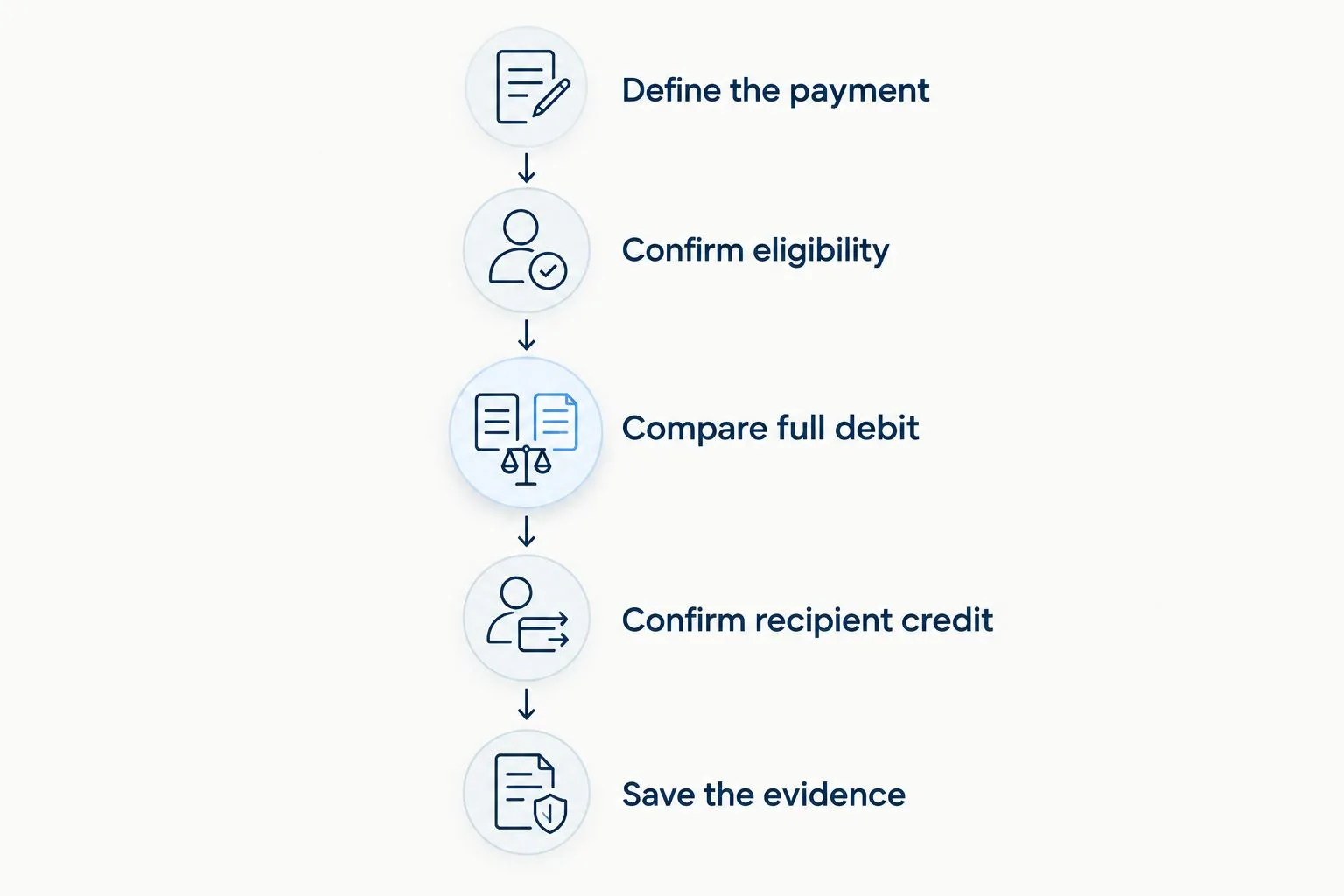
Rank the completed payment, not the advertised transfer fee.
Repeat this process for each material payment route in your 2026 payment plan. A result for an overseas supplier does not establish the right choice for contractor payouts or revenue collection.
How this shortlist is ordered
The shortlist starts with the stated cross-border infrastructure fit, then separates supplier-payment benchmarking, recurring workflows, entity eligibility and account-level economics. These are assessment priorities, not measured provider advantages.
A numerical cost ranking requires comparable current quotes and applicable conditions. Without that common basis, naming a cheapest provider would turn an editorial position into an unsupported financial claim.
Which B2B payment platform should you choose?
Choose the eligible platform that meets the recipient requirement at the lowest confirmed full operation cost. Reject a cheaper-looking option if it cannot support the company, commercial purpose or required recipient credit.
For recurring payments, assess administration as well. Beneficiary maintenance, document requests and reconciliation affect the work required to complete each payment, even when they do not appear as transfer charges.
For your 2026 decision, keep a route-level shortlist. Do not force every supplier, contractor and collection flow through the same provider merely to maintain a single platform relationship.
FAQ
What's the best B2B payment platform ranked by transfer cost?
The best platform is the eligible provider with the lowest confirmed full operation cost for your specific payment. Compare the same funding method and required recipient amount across current quotes.
Is HEVN a bank?
HEVN is not a bank. It provides global business accounts and cross-border payment infrastructure; confirm the applicable service terms and route conditions before applying or transferring funds.
Is the lowest transfer fee always the cheapest option?
No. Conversion, funding charges, applicable third-party deductions and attributable account costs affect the full operation cost.
Can a foreign company use the same comparison as a US company with a nonresident owner?
No. A foreign-incorporated company and a US-incorporated company owned by a nonresident have different eligibility questions. Confirm the exact legal entity before comparing available services.
Does support for local funding mean I can hold that currency?
No. Funding support does not establish that a balance can be held in that currency. Confirm holding, conversion and withdrawal capabilities separately.
How do I compare payment speed correctly?
Compare when the recipient can use the funds, not just when the payment is submitted. Confirm route conditions, processing requirements and the meaning of each status.
Are stablecoin payments automatically cheaper for suppliers?
No. Compare the complete operation, including any required conversion, settlement and withdrawal steps. Confirm that the proposed arrangement fits the supplier's receiving requirements and applicable compliance conditions.
One last thing
Ask your supplier to confirm the amount actually credited after the first completed payment. Reconcile that amount against the quote and your account debit before increasing payment volume.
The decisive cost record is the completed transaction: what your business paid and what the supplier received. Keep that evidence with the invoice.