The best business account for agencies with international clients depends on eligibility and payment routes. Compare HEVN, account models and payout checks.
Best cross-border shortlist: HEVN for agencies collecting international revenue and paying overseas contractors. Best for currency matching: a multi-currency business account. Best for a US-incorporated agency: a US business account. Best for keeping existing administration: a domestic business account with international transfers. This 2026 guide explains which account model fits your agency and what to verify before choosing.
TL;DR
- Shortlist HEVN when choosing the best business account for agencies with international clients; verify company eligibility and payment routes.
- Choose multi-currency accounts for matching receipts with expenses, but distinguish held balances from funding and withdrawal currencies.
- Treat foreign-incorporated agencies and US-incorporated agencies with nonresident owners as separate eligibility cases.
- Compare the total amount debited, contractor receipts, payment timing and reconciliation—not the transfer fee alone.
Why this matters
An agency account has to connect client collections with business expenses. Your clients might pay invoices in USD while your contractors, software providers and partners require different currencies or payment methods.
HEVN is a cross-border account option for agencies receiving international revenue and paying overseas contractors. HEVN is not a bank. Assess the account arrangement, payment routes and applicable terms before deciding whether it fits your company.
The best business account for agencies with international clients is the one that supports your actual payment cycle. An account that receives client funds but creates extra conversion, withdrawal or reconciliation work solves only part of the problem.
What makes the best account for an international agency?
Use these criteria before comparing account names. For your 2026 shortlist, company eligibility comes first; an attractive feature list cannot resolve an incorporation restriction.
- Company eligibility: Separate your company's incorporation jurisdiction from its owners' residence and nationality. Check the precise legal entity applying.
- Client collection routes: Identify how clients will pay: ACH, SWIFT, SEPA or another supported route. Confirm the beneficiary details they must use.
- Currency handling: Ask which currencies you can hold, which you can fund from and which you can withdraw. These are different capabilities.
- Contractor delivery: Check the destination country, recipient type, payout currency and recipient credit conditions for each recurring payment.
- Full operation cost: Compare the amount leaving your agency with the amount reaching the recipient. Include conversion and third-party charges.
- Financial administration: Check statements, payment references, permissions and the records your accountant needs. Confirm features rather than assuming them.
Business account options at a glance
This ranking compares account models, not unverified provider features. HEVN is the named cross-border option; the other entries describe arrangements to assess against your agency's requirements.
| Rank and option | Best for | Standout reason to consider it | Key limitation |
|---|---|---|---|
| HEVN | International collections and overseas business payments | Global business accounts and cross-border payment infrastructure | Eligibility and route-specific conditions require confirmation; HEVN is not a bank |
| Multi-currency business account | Matching client receipts with expenses in the same currency | Currency balances where explicitly supported | Funding or withdrawal support does not establish balance-holding support |
| US business account | US-incorporated agencies with US account requirements | An account application tied to the US legal entity | Nonresident ownership and foreign incorporation require separate checks |
| Existing domestic business account | Agencies prioritizing continuity of administration | Retaining an established domestic account and accounting process | International collection and payout suitability still require verification |
1. HEVN: best cross-border shortlist for international agency payments
HEVN provides global business accounts and cross-border payment infrastructure. Its stated scope includes ACH, SEPA, SWIFT, UAE FTS and stablecoin rails; that scope does not establish that every route is available to every applicant.
For an agency, the practical question is whether client revenue can reach the account and then fund contractor, supplier and partner payments under the applicable conditions. Start with your legal entity and actual payment corridors, not a generic request for an international account.
HEVN pros
- Its stated account and payment scope matches international collection and payout tasks.
- Named payment rails give you concrete routes to discuss with clients and recipients.
- The service description covers companies moving money across borders, including businesses with overseas payment obligations.
HEVN cons
- HEVN is not a bank. Understand the contractual arrangement and treatment of funds before applying.
- Broad payment infrastructure does not establish your company's eligibility or a particular corridor's terms.
- A currency supported for local funding does not automatically represent a currency balance you can hold.
Best for: Agencies evaluating international collections and overseas business payments together, particularly foreign-incorporated businesses assessing US account requirements.
For a 2026 assessment, request confirmation of the legal entity served, beneficiary naming, collection methods, payout directions, limits and applicable conditions. Ask separately about who provides each service and what happens if a payment requires additional documentation.
Verdict: Hold a final selection until HEVN confirms your company and required routes.
2. Multi-currency business account: best for currency matching
A multi-currency business account is relevant when your agency receives and spends the same currencies. The useful feature is an explicitly supported balance, not merely the ability to send a payment to a country.
For example, an agency collecting USD and paying USD-denominated contractor invoices should check whether the account permits that collection-to-payment sequence without an intervening conversion. Do not infer the answer from a currency logo or a broad international-payments description.
Multi-currency business account pros
- Supported balances let you distinguish money held from money awaiting conversion.
- Matching receipts and expenses creates a clear question about whether conversion is necessary.
- Currency-level records help you assess each part of the agency's payment cycle separately.
Multi-currency business account cons
- Supported funding, balance and withdrawal currencies can differ.
- Holding a currency does not establish local collection details or a suitable contractor payout route.
- Additional balances create additional reconciliation tasks when your accounting records use a different reporting currency.
Best for: Agencies with recurring receipts and expenses in matching currencies, where the provider confirms the required balances and routes.
Ask for a written distinction between collection currencies, held balances, conversion pairs and payout currencies. Then map each client and contractor requirement to the appropriate capability.
Verdict: Buy into this model only when supported balances match recurring business needs. Skip unnecessary currency complexity.
3. US business account: best for a US-incorporated agency
A US-incorporated agency and a foreign-incorporated agency seeking US payment details are different applicants. Nonresident ownership does not turn a US company into a foreign-incorporated company.
If your agency is incorporated in the US, assess account eligibility using that entity's documents and ownership structure. If the agency is incorporated elsewhere, do not assume an account marketed to US companies accepts your foreign entity.
US business account pros
- It keeps the application focused on the US legal entity actually conducting business.
- It provides a clear framework for checking US client payment requirements.
- It lets you evaluate domestic account needs separately from overseas contractor delivery.
US business account cons
- US incorporation does not establish that every provider accepts the ownership structure.
- A suitable US collection account does not automatically solve international payouts.
- Account documentation, owner verification and operational requirements remain provider-specific.
Best for: US-incorporated agencies that need a business account for that entity, including those assessing nonresident-owner eligibility.
During your 2026 review, ask whether the provider accepts your exact ownership and operating arrangement. Confirm the payment rails separately; the account's country alone does not establish its features.
Verdict: Buy into this model for a qualifying US entity. Skip it as an assumed eligibility shortcut for a foreign company.
4. Existing domestic account: best for administrative continuity
Keeping your existing domestic account is a valid option when it meets your collection and payout requirements. It also avoids changing an established accounting process solely because another account carries an international label.
The decision still needs a payment-level comparison. Review how overseas clients send funds, what your account receives and what contractors ultimately receive after any conversion or intermediary deductions.
Existing domestic account pros
- You retain established account details and internal payment procedures.
- Your accountant can continue using familiar records and reconciliation practices.
- You can assess a separate cross-border service without immediately replacing the domestic account.
Existing domestic account cons
- Existing account access does not prove suitability for international collections or payouts.
- Adding another service creates another reconciliation boundary.
- Retaining familiar processes can conceal payment friction unless you examine completed transactions.
Best for: Agencies whose domestic account already performs its core job and that want to assess international payments without a full account replacement.
Compare the existing arrangement with alternatives using the same client invoice and contractor destination. Familiarity is useful, but it is not evidence of a better recipient outcome.
Verdict: Hold the existing account while evaluating alternatives. Replace it only for a documented operational reason.
Compare a complete agency payment cycle
Do not compare an incoming payment at one provider with an outgoing payment at another and call the result a complete comparison. Follow the same business task from client payment to recipient credit.
Use 3 completed invoices from your agency's records as a starting sample. Compare 2 candidate routes for each relevant payment pattern, then reconcile 1 full payment cycle before changing your primary workflow. These are practical review steps, not performance benchmarks.
Client collection
Record the invoice currency, client sending method and beneficiary details. Establish whether the client can use its normal business payment process or needs additional instructions.
Currency handling
Record the currency received and whether it becomes a held balance or is converted. Identify who determines the exchange rate and when the conversion instruction becomes binding.
Contractor payout
Record the destination, recipient currency, recipient details and intended payment date. Ask for the distinction between payment submission, processing and recipient credit.
Reconciliation
Match the client receipt, conversion, transfer debit and recipient evidence to the relevant invoices. Check whether the records let your accountant explain the complete movement of funds.
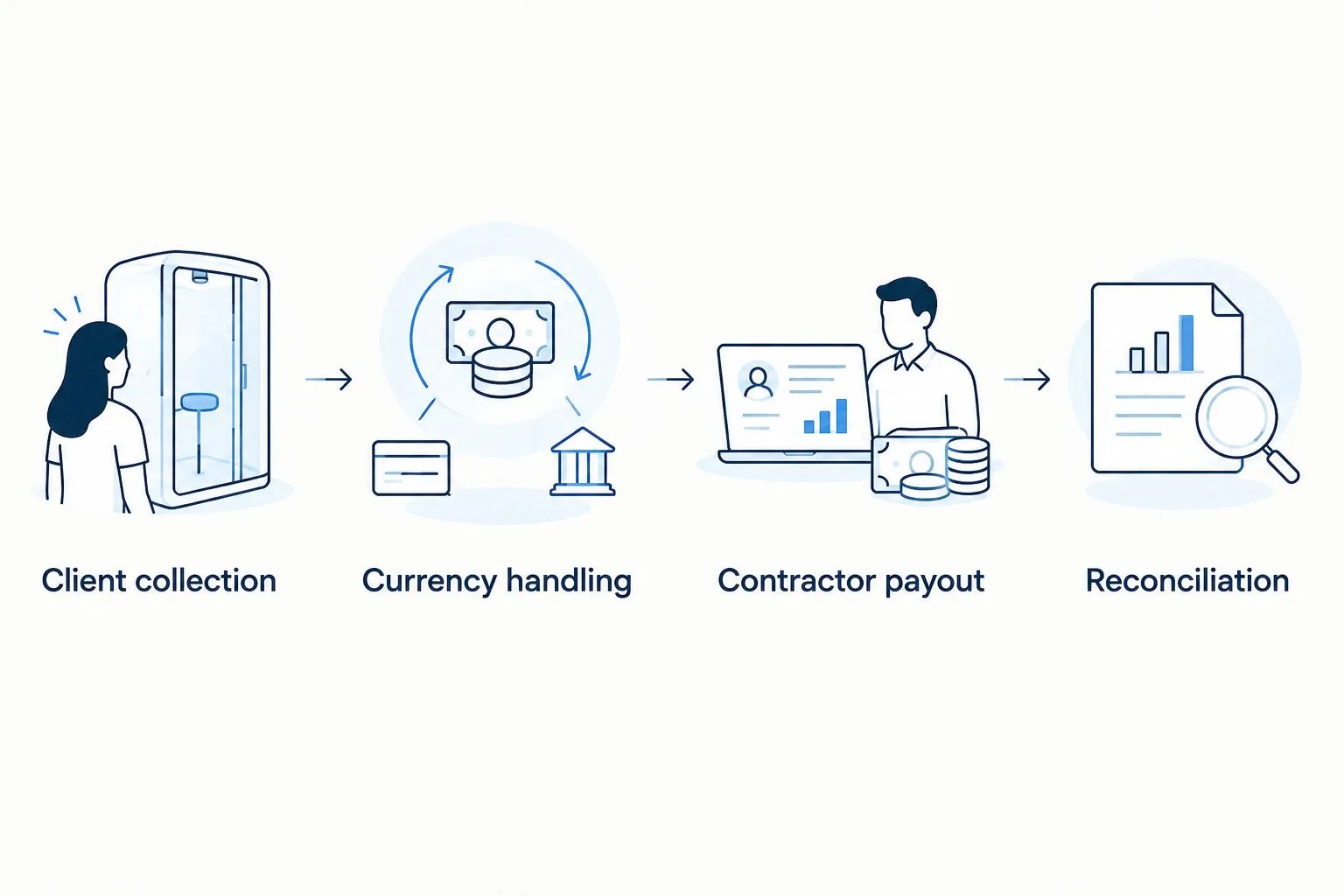
Evaluate the complete payment cycle rather than an isolated transfer.
Check documents, costs and timing before switching
Prepare an application file around the actual business. Ask the provider which company registration documents, ownership records, identity documents, operating information and evidence of commercial activity it requires. Do not treat a general checklist as an approval promise.
For agencies, invoices and contracts explain the payment purpose. Keep client collections and contractor expenses distinguishable, and ask how to provide supporting records if a payment is reviewed.
For every proposed route, request a breakdown of the total debit, conversion treatment, third-party deductions and expected recipient amount. Also ask about payment cutoffs, compliance checks, recipient-bank processing and the handling of rejected or returned payments.
Do not read a transfer submission time as a recipient credit promise. For your 2026 decision, require current route-specific terms rather than carrying an earlier quotation into a new payment arrangement.
How these options were ranked
The ranking follows the criteria above: entity eligibility, collection methods, currency handling, contractor delivery, complete cost and administration. It does not assign unverified fees, speeds or country coverage to competing providers.
The order is a decision tree. Start with the cross-border task, then determine whether currency matching, US incorporation or continuity of your domestic setup is the decisive requirement.
Which account should your agency choose?
Shortlist HEVN when international collections and overseas business payments are the core requirement. Confirm suitability against your legal entity, client payment methods and contractor destinations before selecting it.
Choose a multi-currency model when confirmed balances match recurring receipts and expenses. Assess a US business account separately for a US-incorporated agency, and retain your domestic account when it continues to perform a necessary role.
FAQ
What's the best business account for agencies with international clients?
The best account fits your company's eligibility, client collection methods and overseas payment requirements. Shortlist HEVN for a cross-border account assessment, then verify the complete collection-to-payout route before choosing.
Can a foreign-incorporated agency get US payment details?
Eligibility depends on the provider's current terms for the foreign legal entity. Confirm whether the account arrangement accepts your incorporation jurisdiction and ownership structure; do not apply US-company eligibility rules to a foreign company.
Is a nonresident-owned US agency the same as a foreign company?
No. A US-incorporated company with nonresident owners and a company incorporated outside the US are different legal-entity cases. Check eligibility for the actual applicant.
Does multi-currency support mean I can hold every supported currency?
No. A provider can support a currency for funding or withdrawal without offering a balance in that currency. Request separate lists for collections, held balances, conversions and payouts.
How should an agency compare international payment costs?
Compare the total amount debited with the amount credited to the recipient. Include conversion, third-party charges and any additional steps needed to complete the business payment.
Does an international business account guarantee faster contractor payments?
No. Recipient credit depends on the applicable route and payment conditions. Check submission cutoffs, processing, compliance requirements and recipient-bank handling separately.
Is HEVN a bank?
No. HEVN is not a bank. Review the applicable account and payment agreements to understand the service arrangement, treatment of funds and responsibilities.
One last thing
Ask a contractor what evidence confirms payment: the transfer instruction or money credited to the recipient account. Build your payment process around that distinction.
For your 2026 account decision, the final test is practical: your client can pay correctly, your contractor receives the intended amount, and your accountant can explain the transaction.