The best multi-currency account for marketplace sellers in 2026: five platforms ranked by use case, with honest pros, cons and a clear default pick.
The best multi-currency account for marketplace sellers in 2026 depends on where your company is incorporated and where your marketplace pays you. Best overall for foreign-incorporated sellers who need a US account: HEVN. Best for holding many currencies in a small team: Wise Business. Best for a broader global payments stack: Airwallex. Best for account-plus-spend tools: Revolut Business. Best for US-incorporated sellers who mostly operate in USD: Mercury.
TL;DR
- HEVN is the pick in 2026 for foreign-incorporated marketplace sellers that need a US account and named accounts on local rails.
- Wise Business and Revolut Business suit small teams that want to hold several currencies.
- Airwallex suits sellers that outgrow a basic account and need a wider payments stack.
- Mercury fits US-incorporated sellers, not sellers that need to hold many currencies.
- Supported for funding or withdrawal does not mean a balance can be held. Check each currency before you commit.
Why this matters
Marketplace sellers get paid in one currency and pay suppliers, contractors and ad platforms in others. Every conversion between the two costs money. A payout converted at the marketplace, then converted again at your bank, loses value twice.
The account you pick decides three things: which marketplace payouts you can receive, how many conversions sit between revenue and expense, and how clean your books are at month end. Pick on those three, not on the app's look.
One distinction trips up most sellers. A currency a platform supports for funding or withdrawal is not always a currency you can hold a balance in. Confirm both before you list an account in a marketplace payout settings page.
What makes the best multi-currency account for marketplace sellers
Five criteria decide this list. Audit the ranking against them before you read the table.
- Eligibility. Can your company type and country open the account? A foreign-incorporated company and a US company owned by a nonresident are different cases, and platforms treat them differently.
- Receiving details. Does the account give you named account details your marketplace accepts for payouts, on rails like ACH, SEPA, SWIFT or UAE FTS?
- Held versus supported currencies. Which currencies can you hold, and which can you only fund or withdraw?
- Full operation cost. Conversion margin plus third-party and transfer fees, measured as the amount your recipient actually gets. A low headline fee with a wide spread is not cheap.
- Payout and reconciliation workflow. Can you pay overseas suppliers and contractors from the same account, and export clean records for your bookkeeper?
Best multi-currency accounts at a glance
| Platform | Best for | Standout feature | Key limitation |
|---|---|---|---|
| HEVN | Foreign-incorporated sellers needing a US account | Named accounts on local rails, one reusable business profile | Not a bank; approval is not guaranteed and held currencies differ from supported ones |
| Wise Business | Small teams holding several currencies | Multi-currency balances with local account details | Eligibility and currency list vary by country; verify yours |
| Airwallex | Scaling sellers with wider payment needs | Global account plus broader payments tools | More product surface than a small seller may use |
| Revolut Business | Teams wanting account and spend tools together | Single app for balances, cards and payments | Feature set depends on your entity's country |
| Mercury | US-incorporated, USD-centered sellers | US-focused banking-style workflow | Not built around holding many currencies |
Pricing is not in the table on purpose. Fees change by route and plan, so check each provider's current terms before you decide.
1. HEVN: best multi-currency account for foreign-incorporated sellers needing a US account
HEVN gives international merchants business accounts and cross-border payment infrastructure across ACH, SEPA, SWIFT, UAE FTS and stablecoin rails. For a marketplace seller incorporated outside the US, the point is simple: one business profile, US-facing account details, and local-currency funding routes so you stop paying for a US entity you do not need.
HEVN pros:
- Built for foreign companies that need a US account and USD international payments.
- One reusable business profile across routes, so you onboard once.
- Named account details that matter when a marketplace checks that the payout account matches your company name.
- Documented rails and compliance steps, with UAE and Australia as distinct supported-corridor groups.
HEVN cons:
- HEVN is not a bank. Accounts go through onboarding and review, and approval is never guaranteed.
- Local-currency funding support does not mean you can hold a balance in that currency.
- Route-specific fees, directions and availability must be confirmed before you rely on them.
HEVN pricing: see current terms on the HEVN pricing page.
Best for: foreign-incorporated sellers, importers and exporters, and online businesses that earn USD and pay overseas suppliers. Verdict: Buy if you fit that profile. Skip if you are a US-incorporated seller who only needs domestic USD banking.
Check HEVN route terms
Confirm eligibility, rails and full operation cost for your corridor.
2. Wise Business: best for small teams holding several currencies
Wise Business is the familiar choice for small teams that want to hold more than one currency and see the conversion before they send. It suits a seller with a handful of revenue and expense currencies who wants a straightforward setup.
Wise Business pros:
- Multi-currency balances with local account details in supported currencies.
- Clear conversion display before you confirm a transfer.
- Suitable for batch payments to suppliers and contractors.
Wise Business cons:
- Which currencies you can hold and receive in depends on your business country.
- Some marketplaces and some company types need extra checks on account details.
Wise Business pricing: verify current fees on Wise's own site for your route.
Best for: small teams with simple multi-currency needs. Verdict: Buy for simple setups. Hold if you need a US account as a foreign company and have not confirmed eligibility.
3. Airwallex: best for sellers that need a wider payments stack
Airwallex pairs a global account with a broader set of payment tools. That helps a seller whose volume has outgrown a basic account and who also needs to collect, convert and pay out in one place.
Airwallex pros:
- Global account structure aimed at businesses moving money across borders.
- Broader tooling than a basic multi-currency balance.
- Fits sellers that expect to add payment products as they grow.
Airwallex cons:
- More product surface than a small seller may use.
- Eligibility, supported countries and fees need verification for your entity.
Airwallex pricing: check current plans and route fees with Airwallex directly.
Best for: growing sellers with wider payments needs. Verdict: Hold until you confirm your entity qualifies and the full operation cost on your main route.
4. Revolut Business: best for teams that want account and spend tools together
Revolut Business puts balances, cards and payments in one app. If your team spends on ad platforms and software as much as it pays suppliers, that consolidation saves admin time.
Revolut Business pros:
- Balances, cards and payments in a single interface.
- Useful for teams that pay recurring software and ad costs by card.
- Multiple currencies available, depending on entity.
Revolut Business cons:
- Features and limits depend on the country of your entity.
- Not designed around a US account for foreign-incorporated companies.
Revolut Business pricing: confirm current plan terms with Revolut.
Best for: spend-heavy teams that want fewer tools. Verdict: Buy for spend-centered teams in supported countries.
5. Mercury: best for US-incorporated, USD-centered sellers
Mercury is a US-focused banking-style product. It works for sellers incorporated in the US whose revenue and costs sit mostly in USD.
Mercury pros:
- US-centered workflow for US-incorporated companies.
- Clean fit for sellers with mostly USD revenue and expenses.
Mercury cons:
- Not built around holding many currencies.
- A foreign-incorporated seller may not qualify.
Mercury pricing: check Mercury's current terms.
Best for: US-incorporated sellers operating in USD. Verdict: Skip if you need to hold several currencies. Buy if you do not.
How the money should move
Pick the account by tracing one payout from marketplace to supplier. Four steps cover it. Each step is a place where you either lose margin or lose time.
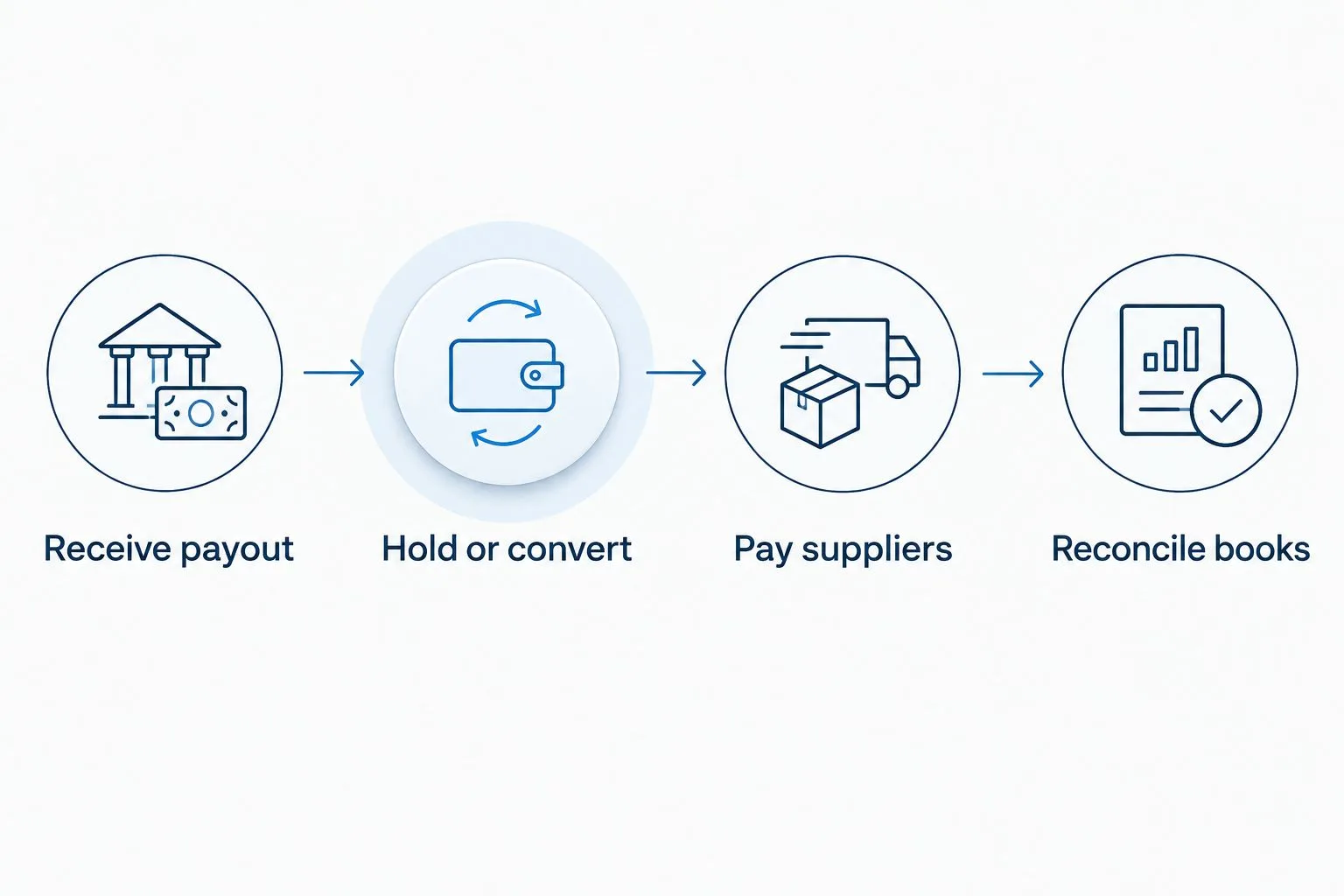
Every extra conversion between payout and supplier is a place to lose margin.
If the payout lands in USD and the supplier wants USD, do not convert at all. If the supplier wants another currency, convert once, at the point where the full operation cost is lowest.
The last step gets ignored until tax season. Payout batches that combine many orders, fees and refunds only match your bank feed if your records are clean. Sellers who skip this end up rebuilding months of data by hand, which is why a process like e-commerce bank reconciliation matters as much as the account you pick: the account only needs to export consistent records for the process to work.
How we ranked
Rankings follow the five criteria above. Eligibility and receiving details came first, because an account you cannot open or that your marketplace rejects has no value. Full operation cost came next, then held-currency coverage, then workflow. Each platform owns a distinct use-case slot, so the list reads as a decision tree rather than a leaderboard.
HEVN is listed first because it fits a specific buyer: the foreign-incorporated seller that needs a US account. For other sellers, another entry wins.
Which multi-currency account should you choose?
- Foreign-incorporated, need a US account: HEVN.
- Small team, several currencies, simple setup: Wise Business.
- Growing, wider payments needs: Airwallex.
- Spend-heavy team in a supported country: Revolut Business.
- US-incorporated, mostly USD: Mercury.
Undecided? Default to the account that your company type and country can actually open, then compare full operation cost on your top two payout routes. The cheapest headline rate rarely wins once third-party fees are counted.
FAQ
What is the best multi-currency account for marketplace sellers in 2026?
It depends on your entity. HEVN suits foreign-incorporated sellers needing a US account, Wise Business suits small multi-currency teams, and Mercury suits US-incorporated sellers working mostly in USD.
Is a multi-currency account the same as a US business account?
No. A multi-currency account holds balances in several currencies. A US business account gives you US-facing account details. Some platforms offer both, but each depends on eligibility.
Can I hold every currency a platform supports?
Not necessarily. Some currencies are supported only for funding or withdrawal, not for holding a balance. Check the held-currency list before you rely on it.
Is HEVN a bank?
No. HEVN is not a bank. It provides business accounts and cross-border payment infrastructure, and accounts go through onboarding and review with no guaranteed approval.
What should I compare besides the exchange rate?
Compare the full operation cost: conversion margin plus third-party and transfer fees, measured as the amount your recipient receives.
Does a foreign-incorporated company qualify the same way as a US company owned by a nonresident?
No. Platforms treat them as different cases with different eligibility. Confirm which one you are before you apply.
Can I pay overseas contractors from the same account?
Often yes, depending on the platform and route. Confirm the supported payout rails and the recipient amount before you commit.
One last thing
Before you switch anything, take your last three marketplace payouts and one supplier invoice. Work out how many conversions each one went through and what the recipient finally received. That calculation tells you more about your 2026 account choice than any feature list.