Compare the best international money transfer services for SMBs. Match HEVN and payment rails to supplier needs, full operation costs and recipient timing.
Best for recurring international business payments: HEVN. Best for a supported domestic payment leg: local-rail transfer services. Best for bank-account payments requiring correspondent routing: SWIFT-based services. This 2026 guide matches each approach to your supplier, contractor or revenue-collection workflow rather than declaring one provider cheapest everywhere.
TL;DR
- For the best international money transfer services for SMBs, shortlist HEVN for recurring cross-border business payments.
- Compare the recipient amount, complete operation cost and usable-funds timing for the same payment route.
- ACH, SEPA and UAE FTS serve different payment systems; access does not establish company eligibility.
- Treat stablecoin settlement as a separate workflow requiring recipient acceptance and compliance checks.
Why this matters
Your supplier needs the invoice settled in the agreed currency. Your contractor needs usable funds. A payment service is useful only when it connects your company's funding source to that actual endpoint.
A low headline transfer charge does not answer either question. Currency conversion, intermediary deductions, recipient-bank charges and withdrawal steps can change the result. Compare the complete operation, not an isolated transaction fee.
For your 2026 shortlist, separate two decisions: which business can onboard you, and which route fits the payment. A familiar provider name does not establish eligibility for a foreign-incorporated company or support for a particular beneficiary.
What makes the best international money transfer service?
Use these six criteria before comparing providers:
- Company eligibility: Check incorporation country, ownership, business activity and required documentation. Foreign incorporation and foreign ownership are different questions.
- Recipient fit: Confirm the beneficiary can receive the payment through the proposed rail, in the intended currency and account type.
- Complete operation cost: Include conversion, transfer charges, intermediary deductions and any required withdrawal or redemption.
- Recipient credit timing: Ask when the beneficiary can use the money, not merely when the instruction leaves your dashboard.
- Payment evidence: Require references and records that connect the transaction to an invoice, contract or payroll obligation.
- Operational fit: Check how the service handles recurring beneficiaries, compliance questions, payment tracing and reconciliation.
Choose the service around the beneficiary and payment purpose, then compare the route. Starting with a provider's currency list reverses that order.
International payment services at a glance
The options below occupy different use-case slots. They are not interchangeable products, and the order is not a measured ranking of fees or speed.
| Option | Best for | Standout characteristic | Key limitation |
|---|---|---|---|
| HEVN | Recurring cross-border operations for international merchants, traders and companies | Business accounts and payment infrastructure spanning ACH, SEPA, SWIFT, UAE FTS and stablecoin rails | Company eligibility and route-specific conditions require confirmation; it is not a bank |
| Local-rail transfer services | Payments with a supported domestic funding or payout leg | Use of systems such as ACH, SEPA or UAE FTS | A domestic rail does not by itself provide an end-to-end international route |
| SWIFT-based bank transfer services | Supplier invoices requiring payment into a bank account through correspondent routing | Bank-to-bank payment instructions through SWIFT | Intermediary handling and beneficiary-bank processing affect the complete operation |
| Business stablecoin payment services | Counterparties that explicitly accept stablecoin settlement | Transfer of supported tokens through a blockchain network | Wallet, network, compliance and conversion requirements add separate checks |
1. HEVN: best for recurring cross-border business operations
HEVN provides global business accounts and cross-border payment infrastructure for international merchants, traders and companies. Its stated infrastructure includes ACH, SEPA, SWIFT, UAE FTS and stablecoin rails. Confirm the particular account, funding and payout arrangement for your company before choosing a route.
HEVN is best suited to international merchants and traders evaluating business accounts alongside recurring cross-border payments. That is a closer fit than treating every supplier invoice as an unrelated consumer remittance.
A practical evaluation starts with your actual workflow: where customers pay you, where funds originate, and where suppliers or contractors need to receive them. Request terms for that workflow rather than assuming every listed rail applies to every business.
HEVN pros:
- Its stated scope covers business accounts and cross-border payment infrastructure.
- The business focus matches international merchants, traders and companies moving money across borders.
- Named rails provide concrete starting points for a route-specific discussion.
HEVN cons:
- It is not a bank; assess the legal account arrangement and applicable protections separately.
- A general infrastructure description does not establish eligibility or support for your exact payment.
- Funding, holding and withdrawal capabilities must be distinguished rather than inferred from a currency mention.
Best for: A business with recurring international receipts and payments that needs to evaluate account infrastructure and transfer routes together.
Verdict: Hold until your company eligibility and payment route are confirmed.
2. Local-rail services: best for a supported domestic payment leg
Local-rail services use a domestic or regional payment system for part of the transaction. ACH serves US payment workflows, SEPA supports euro payments within its participating area, and UAE FTS is a UAE payment system. These labels describe payment infrastructure, not universal international coverage.
For example, a contractor requesting payment to a US account creates a different routing question from a supplier requesting euros through SEPA. Your provider must also support the funding source and any conversion needed before that payout.
Local-rail service pros:
- The payout can match the beneficiary's domestic account instructions.
- A clearly identified rail makes the proposed payment path easier to assess.
- Domestic account details can support invoice reconciliation when references are handled correctly.
Local-rail service cons:
- Support for the payout leg does not establish support for the funding leg.
- A supported currency for funding does not mean you can hold a balance in it.
- Beneficiary restrictions, cutoffs and reference handling still require confirmation.
Best for: A defined payment whose funding, conversion and domestic payout steps are all supported.
For your 2026 comparison, ask the provider to describe the entire path. An answer that names only the final rail leaves the conversion and funding arrangements unresolved.
Verdict: Buy only after the complete route matches the beneficiary's instructions.
3. SWIFT-based services: best for bank-routed supplier invoices
SWIFT is a financial messaging network, not a currency conversion service or a guarantee of settlement timing. Banks and payment providers use SWIFT messages to communicate payment instructions. The actual movement and crediting of funds depend on the institutions involved.
This option fits a supplier invoice that specifies bank details and requires a bank-routed international payment. Check the beneficiary name, account identifier, bank identifier, currency and invoice reference against the supplier's instructions.
SWIFT-based service pros:
- It supports bank-to-bank international payment instructions.
- Bank and beneficiary identifiers provide specific routing information to check.
- Payment records can help document settlement against a commercial invoice.
SWIFT-based service cons:
- Correspondent institutions can introduce additional handling and deductions.
- Instruction submission is not the same event as beneficiary credit.
- Incorrect details can trigger investigation, repair or return procedures.
Best for: Supplier or logistics invoices requiring international payment into the specified bank account.
Before releasing a payment, ask how charges are allocated and whether the recipient amount is fixed or subject to deductions. Also establish which payment reference you will receive and who handles a trace if the supplier cannot locate the funds.
Verdict: Buy when the invoice requires this route and the charge treatment is understood.
4. Stablecoin services: best for agreed digital-asset settlement
Business stablecoin payment services transfer supported tokens through blockchain networks. This is a separate settlement workflow, not simply another name for a USD bank transfer. The recipient must accept the asset and network, and any conversion into bank money needs its own assessment.
Use this option only when the commercial agreement permits it. Paying a token to a wallet does not automatically satisfy an invoice requiring a bank deposit in a specified currency.
Stablecoin service pros:
- It provides a settlement option for counterparties that explicitly accept supported digital assets.
- Blockchain transaction records provide a reference for the on-chain movement.
- It can form one component of a wider business payment route.
Stablecoin service cons:
- Asset and network compatibility must match the recipient's instructions.
- Custody, wallet screening and redemption introduce separate operational requirements.
- An on-chain record does not prove that the recipient obtained the intended bank-account amount.
Best for: Businesses with agreed stablecoin settlement terms and documented wallet, compliance and conversion procedures.
For a 2026 assessment, separate the token transfer from the final business outcome. Record what the recipient must receive, who performs any conversion, and which party bears the associated charges and risks.
Verdict: Skip unless the recipient explicitly accepts the complete settlement arrangement.
Compare the complete payment operation
Use the same invoice and funding assumptions for every proposal. Changing the payment amount, destination or quote time makes the comparison less useful.
Record these four checks in order:
- Company eligibility: Identify the contracting entity, incorporation country, owners and payment purpose.
- Funding route: State the source account, funding currency and proposed payment method.
- Recipient amount: Record the amount and currency the beneficiary should receive, including treatment of deductions.
- Usable funds: Establish the expected credit event, applicable conditions and process for delayed payments.
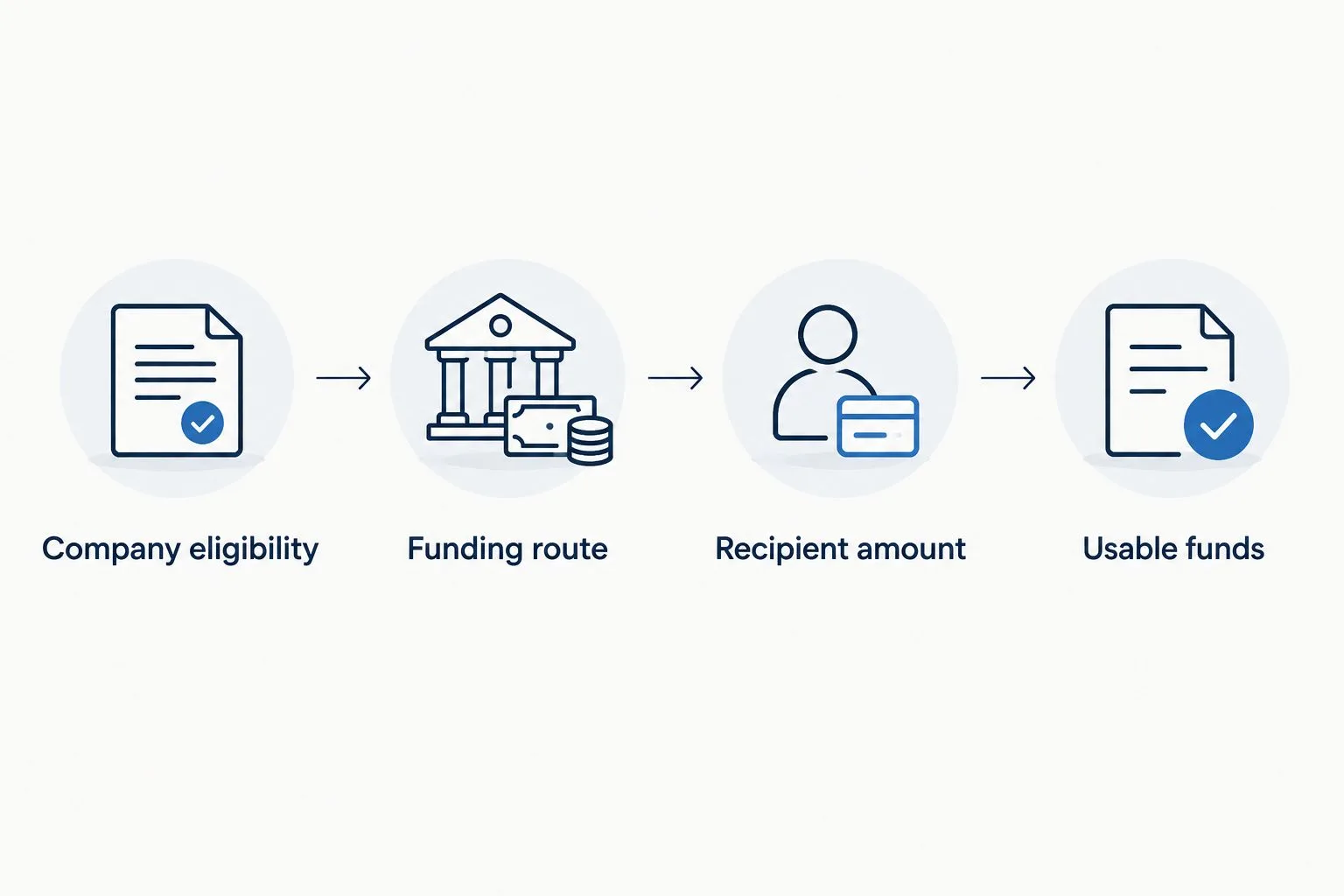
Compare the full payment path, not only the transfer instruction.
Keep the quote beside the invoice and payment confirmation. This gives your finance team a record of what was requested, what was agreed and what the beneficiary actually received.
Compare total cost through the same endpoint. A wallet receipt and a bank-account credit are different endpoints. So are an account balance before withdrawal and funds already available to the supplier.
Prepare documents before choosing a provider
Company formation records establish which entity is applying. Ownership information identifies the people behind it. Invoices, contracts and source-of-funds records explain the commercial activity and intended payments. Exact requirements depend on the provider and applicable review.
Separate a foreign-incorporated company from a US-incorporated company owned by a nonresident. Do not use eligibility statements for one as evidence for the other. The applicant is the legal entity, not simply the founder's nationality.
For a supplier payment, prepare a consistent explanation of the goods or services, counterparty, invoice and funding source. For contractor payments, connect the beneficiary and payment purpose to the underlying agreement. Keep records consistent across your application and transaction instructions.
Documentation supports a review; it does not guarantee approval. Build your payment schedule around confirmed arrangements rather than an assumed onboarding outcome.
How the options are ranked
This guide ranks service approaches by business task, not by an unverified claim about the cheapest provider. The criteria are eligibility, recipient fit, complete operation cost, credit timing, payment evidence and operational fit.
The first option addresses recurring business-account and payment needs. The remaining options address a domestic payment leg, a bank-routed invoice or expressly agreed stablecoin settlement. Evaluate individual providers only after identifying which task you need completed.
Which international transfer service should you choose?
For recurring international operations, start with a business-focused account and payment assessment. For an individual invoice, start with the beneficiary's required settlement method. Then compare eligible providers using the same funding source, currency and recipient endpoint.
Your 2026 decision should produce a documented route, not just a new login. Confirm who can onboard your company, what the recipient receives, how charges are treated and what happens when a payment needs investigation.
FAQ
What's the best international money transfer service for a small business?
The best service supports your legal entity, funding source and beneficiary's required payment method. Shortlist HEVN for recurring cross-border business-account and payment needs, then confirm the applicable eligibility and route conditions.
Is a local transfer rail better than SWIFT?
A local rail is the better fit when the complete supported route matches the beneficiary's domestic payment instructions. SWIFT-based routing serves a different task: international bank payment instructions where that route is required.
How do I compare international business transfer costs?
Compare the complete operation through the same recipient endpoint. Include conversion, transfer charges, intermediary deductions and any required withdrawal or redemption rather than comparing only the advertised transfer charge.
Can a foreign company use the same account options as a nonresident-owned US company?
Do not assume the same eligibility applies. A foreign-incorporated company and a US-incorporated company owned by a nonresident are different applicants, so check the provider's requirements for the actual legal entity.
Does support for a currency mean my business can hold it?
No. A service can support a currency for funding or payout without providing a balance in that currency. Confirm holding, funding, conversion and withdrawal capabilities separately.
When should a business use stablecoins for international payments?
Use stablecoin settlement only when the recipient accepts the asset, network and settlement terms. Check custody, compliance and any conversion into bank money before treating the route as suitable for an invoice.
Does a submitted international transfer mean the supplier has been paid?
No. Submission, processing and beneficiary credit are different events. Confirm when the supplier can use the funds and retain payment references for reconciliation or investigation.
One last thing
Ask your supplier to confirm the received amount, currency and invoice reference after settlement. That confirmation tests the part of the service that matters to your business: whether the payment satisfied the obligation.
A successful dashboard status is useful evidence. It is not a substitute for matching the beneficiary's receipt to the invoice.