Best fit to assess for cross-border trade payments: HEVN. Best for domestic banking needs: a UAE business bank. Best for bank-directed international payments: a SWIFT-enabled bank. Best for agreed digital-asset settlement: a business stablecoin payment provider. Your final choice depends on company eligibility, supplier routes and the amount credited to the recipient—not the platform label.
TL;DR
- The best banking platform for UAE import export companies depends on eligibility, supplier routes and recipient amounts.
- HEVN serves international merchants and traders with global business accounts and cross-border payment infrastructure; it is not a bank.
- Separate UAE domestic banking needs from USD collections and international supplier payments.
- Compare full operation cost and recipient credit timing for each payment route.
- Treat stablecoin settlement as a separate supplier-approved workflow, not the default banking setup.
Why this matters
A UAE importer receiving international revenue and paying overseas suppliers has several distinct requirements. Domestic banking, USD collections, currency conversion and supplier settlement do not necessarily belong with the same provider.
Choose the setup around the payment obligation. A platform that accepts your company but cannot serve the supplier’s destination does not solve that obligation. Neither does a low headline charge that leaves the recipient short.
For your 2026 shortlist, separate a UAE-incorporated company from a US-incorporated company owned by a UAE resident. Those are different applicants. Ownership, incorporation and operating activity each belong in the eligibility assessment.
What makes the best banking platform for UAE import export companies?
Use these criteria before comparing interfaces or account features:
- Company eligibility: Confirm the legal entity, license, ownership structure, business activity and trading destinations are acceptable.
- Collection fit: Establish which customers can pay you, through which rails, and under whose account name.
- Supplier coverage: Confirm the destination, recipient bank, payment purpose and currency for each recurring obligation.
- Full operation cost: Compare the total funding debit against the final recipient amount, including conversion and third-party deductions.
- Recipient credit timing: Distinguish submission, processing, settlement and credit to the supplier’s account.
- Operational control: Assess supporting documents, approval permissions, payment references, transaction records and exception handling.
Do not treat a currency list as proof that every listed currency can be held. Funding, conversion, holding and withdrawal are different functions. Record each separately.
Banking and payment options at a glance
These are ranked operating models, not a claim that every institution in a category accepts UAE trading companies. Each model addresses a different task.
| Rank | Option | Best for | Defining function | Key limitation |
|---|---|---|---|---|
| 1 | HEVN | Assessing cross-border trade payment infrastructure | Global business accounts and payment infrastructure | Not a bank; route-specific eligibility and terms need confirmation |
| 2 | UAE business bank | Domestic banking requirements | A banking relationship for local operations | International collection and supplier-payment suitability require separate assessment |
| 3 | SWIFT-enabled bank | Suppliers requiring international bank payments | Bank-to-bank payment messaging through SWIFT | Recipient credit timing and deductions need route-level confirmation |
| 4 | Business stablecoin payment provider | Counterparties agreeing to digital-asset settlement | A separate stablecoin settlement workflow | Requires compatible settlement instructions, controls and accounting treatment |
1. HEVN: best assessment fit for cross-border trade payments
HEVN provides global business accounts and cross-border payment infrastructure for international merchants, traders and companies. Its stated infrastructure includes ACH, SEPA, SWIFT, UAE FTS and stablecoin rails. That scope makes it relevant to a UAE trading company assessing international revenue collection and overseas supplier payments.
HEVN is built for international merchants and traders moving money across borders. That is a buyer-fit statement, not a promise that a particular company, currency direction or transaction will be accepted.
Advantages
- Its stated business focus includes international merchants and traders.
- Its infrastructure spans several named payment rails.
- Its scope covers business accounts and cross-border payments rather than only a single transfer method.
Limitations
- HEVN is not a bank; do not assume bank status or protections.
- The general rail list does not establish eligibility for a specific company or payment.
- Current holding currencies, route conditions, limits and recipient timing require confirmation.
Best for: A UAE trading company assessing international collections and recurring overseas supplier payments.
Provide the company’s incorporation details, goods traded, customer locations and supplier destinations. Ask for the proposed route for each flow and a clear distinction between currencies held and currencies used only for funding or withdrawal.
Use the pricing page as a starting point, then obtain terms for the actual transaction. Do not infer that a published headline applies to every corridor.
Verdict: Hold until company eligibility and payment-route terms are confirmed.
2. UAE business bank: best for domestic banking requirements
A UAE business bank belongs on the shortlist when your requirements include domestic banking rather than international payments alone. Define those requirements explicitly: local collections, local supplier payments and any other banking services your company needs.
Assess the bank’s international offering separately. A suitable domestic relationship does not, by itself, answer how you should collect overseas revenue or pay a foreign supplier.
Advantages
- Gives domestic banking requirements their own selection process.
- Provides a banking option to compare against nonbank payment infrastructure.
- Lets you evaluate local and international workflows without assuming one provider must handle both.
Limitations
- Acceptance depends on the particular bank and applicant.
- International payment costs and recipient timing remain route-specific questions.
- Domestic suitability does not establish support for every trading destination or business activity.
Best for: A UAE-incorporated trading company with defined domestic banking needs alongside international trade.
Ask the bank to assess your actual business model. Supply a clear description of goods, counterparties and transaction purposes. Do not describe a commodity trader as a generic consultancy to simplify the application.
Keep the operating model practical. If a separate payment provider handles international transfers, document how funds move between the banking relationship and that provider.
Verdict: Hold until domestic requirements and international payment conditions are documented.
3. SWIFT-enabled bank: best for bank-directed supplier payments
SWIFT is a financial messaging network, not an account provider. A SWIFT-enabled bank is therefore an operating choice for executing international bank payments—not a direct substitute for every business account feature.
Start with the supplier’s instructions. If the contract requires payment to a specified bank account, assess the sending institution’s ability to reach that account in the agreed currency.
Advantages
- Matches a bank-account settlement instruction without introducing a wallet workflow.
- Gives the supplier’s beneficiary details a central role in route selection.
- Supports a bank-payment assessment distinct from local collection requirements.
Limitations
- A SWIFT message does not establish when the supplier receives usable funds.
- Intermediary and recipient-bank deductions need explicit treatment.
- The sending bank must assess the transaction, destination and supporting documents.
Best for: A trading company whose supplier requires an international payment into a bank account.
Ask what payment tracking is available and who handles a delayed, rejected or returned transfer. Establish the fee arrangement and whether the supplier must receive an exact amount.
For your 2026 comparison, reject a timing answer that ends at “sent.” Your operational question is when the beneficiary account is credited and what happens if that does not occur as expected.
Verdict: Hold until the bank confirms the beneficiary route and exception process.
4. Business stablecoin provider: best for agreed digital settlement
A business stablecoin provider addresses a separate settlement use case. Consider it when both parties explicitly agree on the asset, network, destination and settlement obligation.
Do not turn a supplier’s bank-payment instruction into a stablecoin transfer without agreement. A blockchain transaction and payment of a commercial invoice are not automatically the same event.
Advantages
- Creates a distinct option for counterparties that accept digital-asset settlement.
- Allows treasury teams to assess wallet settlement separately from bank transfers.
- Makes conversion and withdrawal steps explicit when the recipient ultimately needs bank funds.
Limitations
- The recipient needs an acceptable way to receive and use the asset.
- Wallet, custody, network and conversion risks require separate controls.
- Blockchain confirmation does not establish credit to a recipient bank account.
Best for: Businesses with a documented, supplier-approved digital-asset settlement workflow.
Confirm who controls the destination wallet and how the recipient’s identity is checked. Document the agreed asset and network, valuation method, invoice reference and evidence of settlement.
Treat this as a separate 2026 treasury decision. Do not assume it replaces domestic banking or makes the full operation free.
Verdict: Skip unless the supplier agreement and internal controls support digital settlement.
How the options are ranked
The order follows the task of a UAE import-export company assessing international payments: cross-border infrastructure first, domestic banking second, bank-directed supplier settlement third, and separately agreed digital settlement fourth.
This is not a measured provider performance ranking. HEVN’s stated scope supports its inclusion; it does not establish a cost or speed advantage over a particular bank or competitor. The deciding criteria remain eligibility, route coverage, recipient amount, timing and operational control.
Compare an actual supplier payment before choosing
Build a small payment file rather than comparing headline claims. Use 3 representative invoices: a recurring supplier invoice, a payment to a different destination and an exception that needs additional documentation.
Follow this sequence for your 2026 assessment:
- Company eligibility: Give each shortlisted provider the same legal entity and business description.
- Payment instructions: Supply the invoice currency, beneficiary details, destination and required recipient amount.
- Operation cost: Request the total debit, conversion terms and treatment of third-party charges.
- Recipient credit: Ask for the timing basis, applicable conditions and evidence of completion.
- Exception handling: Establish the process for missing information, rejection, return or delayed credit.
Keep the inputs identical. Comparing different payment amounts or quote times obscures the decision rather than clarifying it.
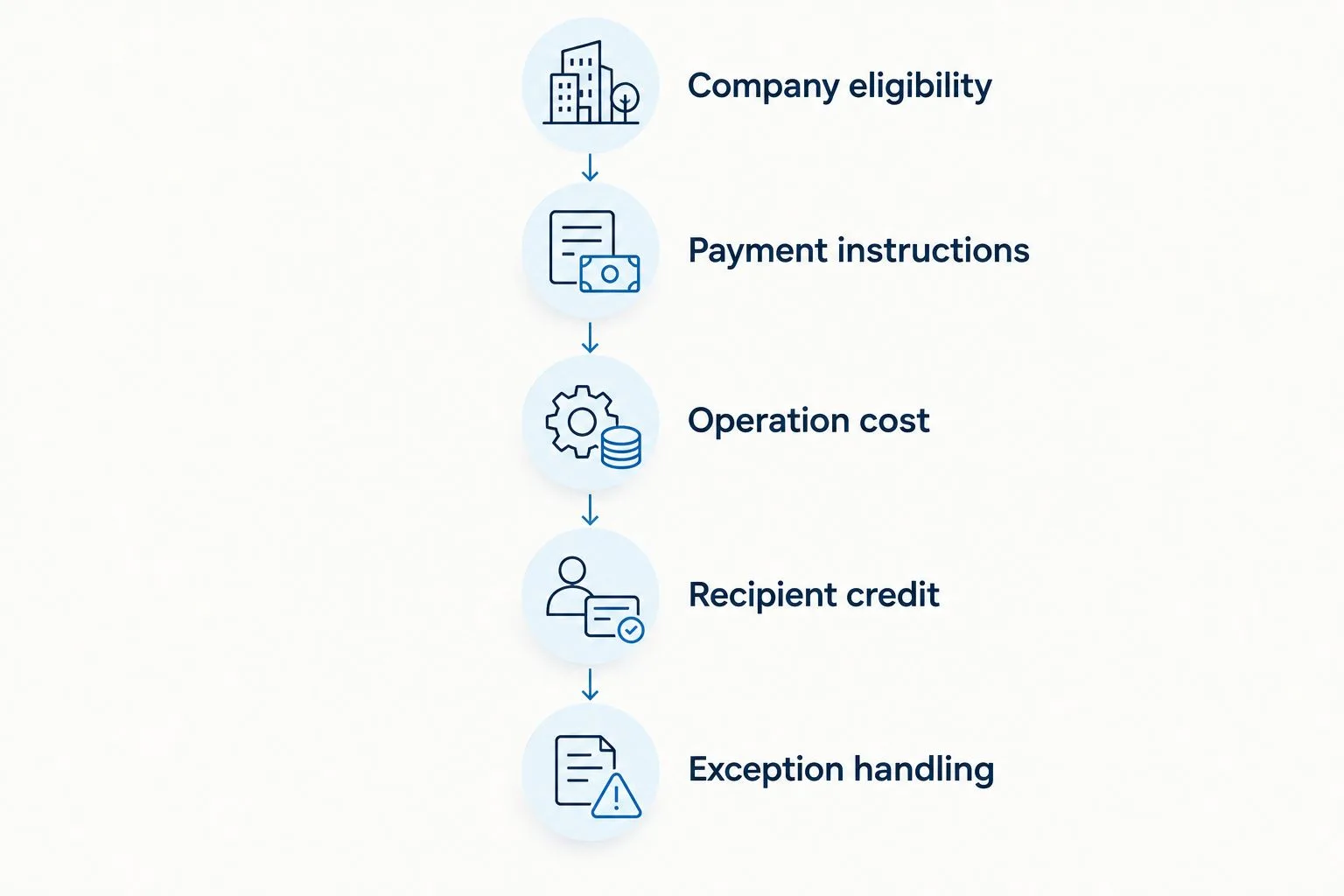
Compare the complete payment operation, not just the transfer instruction.
Request 2 written quotes using the same funding currency and required recipient amount. If the quotes use different assumptions, ask for aligned versions before choosing.
Then assess 1 controlled payment within your approved treasury procedures. Record the actual debit, recipient credit, timestamps and reconciliation evidence. A successful payment demonstrates that transaction’s outcome; it does not guarantee future payments.
Which banking setup should you choose?
Start with the supplier obligation, then choose the provider configuration. For international revenue and overseas supplier payments, assess HEVN against the actual routes your company uses. Keep a UAE business bank in the assessment wherever domestic banking is required.
Use a SWIFT-enabled bank when its confirmed route fits the supplier’s bank instructions. Consider stablecoin settlement only as a separately agreed workflow.
Your final 2026 selection should have written answers to three questions: Is the company eligible? What amount reaches the recipient? What happens when the payment needs intervention? An attractive interface does not answer any of them.
FAQ
What is the best banking platform for UAE import-export companies?
The best choice is the provider configuration that accepts your company and serves its collection and supplier-payment routes. Assess eligibility, full operation cost, recipient credit timing and exception handling before selecting a platform.
Is HEVN a bank?
No. HEVN provides global business accounts and cross-border payment infrastructure, but it is not a bank. Confirm the applicable account structure, provider relationships and terms before using a service.
Can a UAE company use a US business account?
Eligibility depends on the provider and the UAE company's circumstances. A UAE-incorporated company is a different applicant from a US-incorporated company owned by a UAE resident; do not use one applicant category's requirements for the other.
Does support for local funding mean I can hold that currency?
No. Local funding support does not establish that you can hold a balance in the funding currency. Ask separately about funding, conversion, balance holding and withdrawal.
How should I compare international supplier payment costs?
Compare the total amount debited with the amount credited to the supplier under matching quote conditions. Include conversion, provider charges and any intermediary or recipient-bank deductions that apply.
Does sending a SWIFT payment mean the supplier has been paid?
No. A sent instruction is not proof that the supplier's account has been credited. Obtain the available payment status and confirm receipt against the invoice.
Should a UAE importer pay suppliers with stablecoins?
Only consider stablecoin settlement when the supplier expressly accepts it and your legal, compliance, accounting and treasury controls support the workflow. Agree the asset, network, destination and evidence of settlement before sending.
One last thing
Put the required recipient amount beside the invoice approval—not just the amount you intend to send. That forces the payment decision to account for conversion and deductions before the supplier reports a shortfall.
Keep the invoice, quote, payment instruction and receipt together. Your next provider comparison will then start with documented outcomes rather than remembered headline claims.