Best overall: a global business account for centralized funding and cross-border payouts. Best for US recipients: an ACH-enabled business account. Best for euro-area recipients: a SEPA-enabled business account. Best for destinations outside suitable local routes: a SWIFT-enabled business account. The best business account for recurring international payroll matches your company's eligibility, recipient destinations and payroll obligations—not just the currencies shown on a website.
TL;DR
- The best business account for recurring international payroll matches company eligibility, payment rails and recipient requirements.
- Consider HEVN for cross-border payment infrastructure, not as a substitute for employee payroll processing.
- Use ACH, SEPA or SWIFT according to the recipient account and the supported payment purpose.
- Separate employee payroll obligations from contractor invoice payments before choosing an account.
Why this matters
Recurring international payroll combines two separate jobs: calculating what people must receive and delivering the money. A business account handles the payment layer. It does not, by itself, establish employment compliance, calculate withholding or produce legally required payroll records.
HEVN provides global business accounts and cross-border payment infrastructure for businesses moving money internationally. HEVN is a candidate for businesses evaluating cross-border payment infrastructure; employee payroll requires a separate assessment. HEVN is not a bank.
For your 2026 selection, start with the legal employer and recipient type. An overseas employee, an independent contractor and a local payroll provider need different documentation and payment instructions. Do not treat them as interchangeable beneficiaries.
What makes the best account for recurring international payroll
Evaluate these six criteria before comparing account setups:
- Company eligibility: Confirm the incorporation jurisdiction, ownership structure, business activity and permitted payment purposes.
- Recipient coverage: Check the actual destination account, receiving currency and supported route—not merely a country list.
- Full operation cost: Compare funding, conversion, transfer and third-party deductions against the amount the recipient receives.
- Recipient credit timing: Distinguish payment submission, processing, settlement and final credit to the beneficiary.
- Repeat-payment controls: Check beneficiary management, authorization, scheduling, duplicate prevention and failed-payment handling.
- Reconciliation: Require records that connect each payment to the payroll run or contractor invoice it settles.
A foreign-incorporated company is not the same applicant as a US-incorporated company with nonresident owners. Check the relevant eligibility rules before moving to feature comparisons.
Account setups at a glance
These are ranked account configurations, not a claim that any provider supports every payroll workflow. Select the configuration first. Then verify the provider's current terms for your company and recipients.
| Rank and account setup | Best for | Standout function | Key limitation |
|---|---|---|---|
| 1. Global business account | Centralized funding across several destinations | Connects international receipts with cross-border disbursements | Each route and payment purpose needs confirmation |
| 2. ACH-enabled business account | US recipients with eligible US account details | Uses a US domestic payment rail | Does not solve overseas local-currency delivery |
| 3. SEPA-enabled business account | Eligible euro payments within SEPA | Uses a common euro payment framework | Does not cover every European currency or destination |
| 4. SWIFT-enabled business account | Bank transfers without a suitable local route | Supports cross-border bank payment instructions | Intermediary handling complicates cost and timing estimates |
1. Global business account: best for centralized funding
A global business account is the default configuration when your company receives international revenue and pays people in several destinations. It gives you a central point for organizing funding and outgoing payments, subject to the provider's actual account structure.
HEVN offers global business accounts and cross-border payment infrastructure involving ACH, SEPA, SWIFT, UAE FTS and stablecoin rails. That scope does not establish that every rail accepts salary payments, supports scheduled payroll or serves every company jurisdiction. Confirm the specific workflow before committing payroll funds.
Global business account pros:
- Connects international revenue collection with an organized payout process.
- Lets you assess different routes against the same recipient requirements.
- Provides a framework for consolidating payment records across destinations.
Global business account cons:
- Centralized funding does not remove destination-specific payroll obligations.
- A currency supported for funding or withdrawal is not necessarily a currency you can hold.
- Dependence on one provider creates an operational concentration to address in your continuity plan.
Best for: A foreign-incorporated business evaluating centralized USD receipts and recurring overseas disbursements.
Before choosing HEVN for recurring international payroll funding, obtain confirmation of company eligibility, permitted payment purposes, beneficiary requirements and available controls. Evaluate stablecoin settlement separately rather than making it the default payroll method.
Verdict: Hold until the exact funding and payout workflow is confirmed.
2. ACH-enabled business account: best for US recipients
ACH is a US payment network. An ACH-enabled business account is a relevant configuration when your recipients have eligible US accounts and the provider permits your intended payment type.
This setup fits a US-recipient payment requirement, not an entire international payroll operation. Your company still needs the correct payroll calculations and records, and the account provider still needs to accept your company and transaction purpose.
ACH-enabled business account pros:
- Matches payments to recipients using eligible US banking details.
- Keeps the US delivery leg within a domestic payment framework.
- Offers a clear route to assess when your business already receives USD.
ACH-enabled business account cons:
- ACH alone does not deliver local currency to an overseas bank account.
- Returns, submission cutoffs and provider restrictions require operational planning.
- ACH access does not establish eligibility for payroll origination or automated scheduling.
Best for: A business making recurring payments to US-based recipient accounts, with the relevant payment purpose approved.
For a 2026 account review, ask whether the service supports your company structure and outgoing payment type. Also ask how returns are reported and what evidence confirms the beneficiary received the payment.
Verdict: Buy only after US recipient details and permitted use are confirmed.
3. SEPA-enabled business account: best for euro recipients
SEPA provides a framework for euro payments across participating countries. A SEPA-enabled business account is a relevant choice when recipients need euros in eligible accounts and your provider supports the intended transfers.
Do not use “Europe” as a substitute for route verification. A recipient's location, account details, currency and the provider's participation determine whether the proposed payment works.
SEPA-enabled business account pros:
- Aligns euro-denominated obligations with a euro payment route.
- Provides a consistent framework for assessing eligible euro beneficiaries.
- Separates euro delivery requirements from unrelated currency-conversion decisions.
SEPA-enabled business account cons:
- SEPA is not a payment route for every European currency.
- Standard and instant transfer capabilities are not interchangeable.
- Access to euro payouts does not establish that your business can hold a euro balance.
Best for: A business paying euro-denominated obligations to eligible SEPA recipient accounts.
Ask whether the provider supports the required transfer type, payment reference and beneficiary checks. For employee salaries, confirm the local payroll requirements separately. A technically successful transfer does not demonstrate that withholding or reporting obligations were met.
Verdict: Buy for verified euro payment requirements; skip for non-euro delivery needs.
4. SWIFT-enabled business account: best for bank-only destinations
SWIFT is a financial messaging network, not a universal guarantee of settlement speed or recipient amount. A SWIFT-enabled business account is relevant when your recipient requires a bank transfer and a suitable local route is not available through your provider.
Assess the full payment chain. The sending institution, intermediaries and receiving institution can affect processing and deductions, subject to the route and agreed terms.
SWIFT-enabled business account pros:
- Provides a route to assess for cross-border bank payments.
- Supports bank-to-bank payment instructions and associated references.
- Offers an alternative when an appropriate domestic payout route is unavailable.
SWIFT-enabled business account cons:
- Intermediary deductions complicate recipient-amount planning.
- Payment release does not establish final beneficiary credit.
- Investigations and returned payments need a defined support process.
Best for: Businesses paying recipients whose bank requirements cannot be met through an approved local route.
Before authorizing a recurring payment, confirm charge allocation, required beneficiary information and the process for tracing an unresolved transfer. For salary obligations, arrange funding around the contractual due date rather than treating a dispatch notification as completion.
Verdict: Hold until deductions, tracing and recipient-credit expectations are documented.
How the account setups are ranked
The ranking prioritizes operational fit: company eligibility, recipient coverage, full operation cost, credit timing, repeat-payment controls and reconciliation. A global account comes first for centralized cross-border funding. ACH, SEPA and SWIFT follow as distinct delivery configurations.
This is not a performance ranking of providers. Your 2026 shortlist should advance only after the provider confirms the actual company, route and payment purpose.
Build the recurring payment workflow before moving funds
Use this sequence to turn an account shortlist into an operating process. Assign an owner to each step, including someone responsible for exceptions.
Classify recipients
Separate employees, contractors and payroll service providers. Record the contracting entity and payment obligation. Do not classify someone as a contractor merely because an international transfer is easier to arrange than local payroll.
Confirm eligibility
Give the provider an accurate company profile. Prepare incorporation records, ownership information, authorized-person identification and evidence supporting the business activity and payment purpose. The precise documents depend on the provider's requirements.
Confirm the route
Document the funding currency, conversion step, payout rail and recipient currency. Ask which currencies can be held and which are supported only for funding or withdrawal. Record any restrictions on salary or contractor payments.
Approve payments
Separate payment preparation from release where your team's controls permit it. Verify changed bank details through an established channel. A recurring beneficiary is not a reason to bypass authorization.
Reconcile receipt
Link the outgoing payment to the obligation it settles. Preserve the amount sent, deductions reported, payment reference and available recipient-credit evidence. Keep unresolved items open until they are investigated.
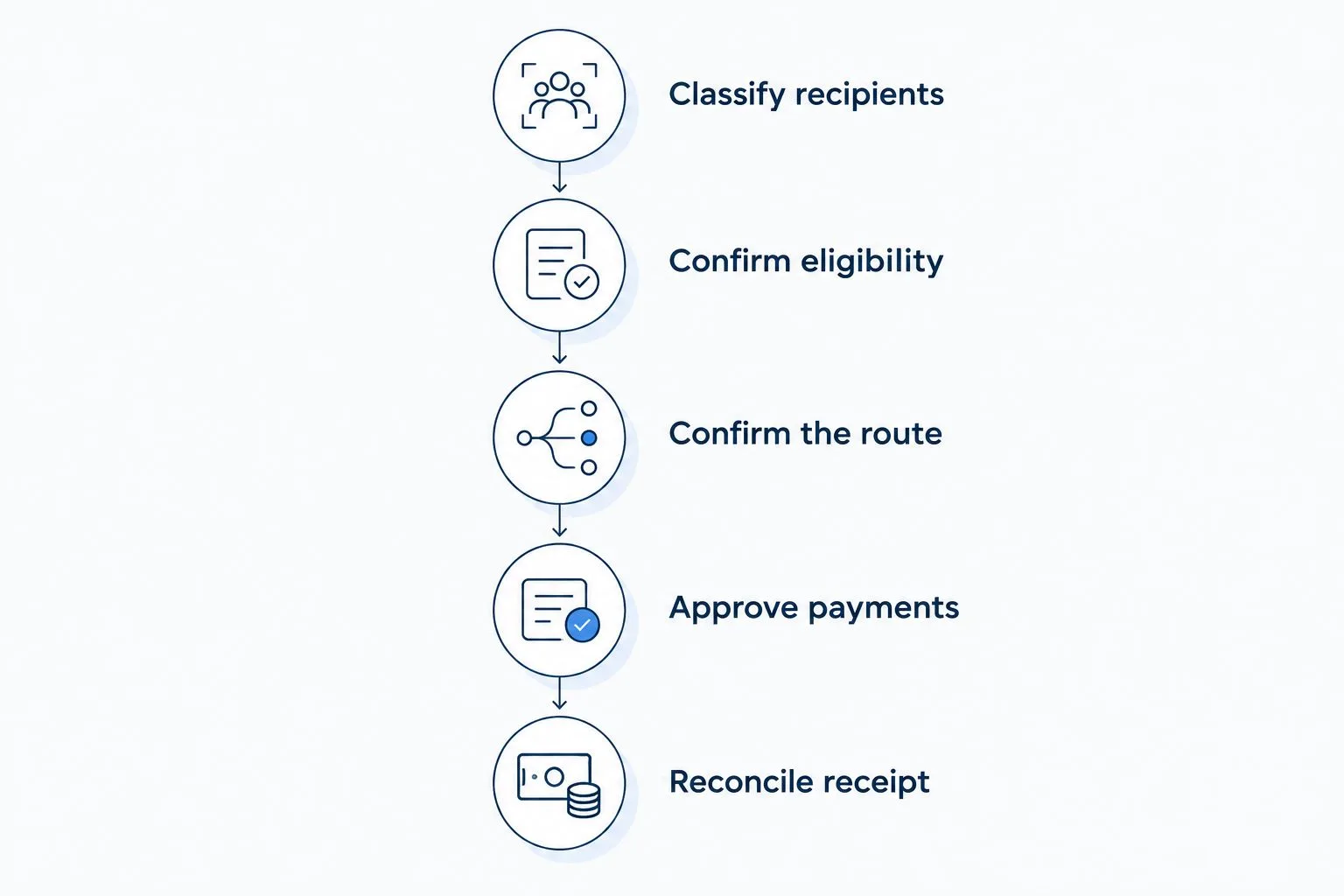
Choose the payment route after confirming the recipient type and company eligibility.
Before your first production run, agree on how rejected instructions, returned funds and beneficiary changes will be handled. Keep an alternative funding process documented. An account is only one component of a repeatable payroll operation.
Compare the full operation, not the advertised transfer fee
For each proposed route, request a written explanation of funding charges, conversion methodology, transfer charges and possible third-party deductions. Ask how long the quote remains valid and whether the recipient amount is fixed or indicative.
Separate timing into funding readiness, provider processing and recipient credit. Ask which cutoffs and calendars apply. Do not convert an estimated processing window into a promise about payday.
For a 2026 procurement review, retain the applicable conditions with the decision record. Reconfirm them when your destinations, company structure or payment volumes change.
Which account should you choose?
Choose a global business account as the default funding configuration when your business receives internationally and pays across several destinations. Use ACH for confirmed US account requirements, SEPA for eligible euro payments and SWIFT when the recipient needs a bank route that suitable local options cannot serve.
Keep employee payroll calculation and compliance separate from account selection. For contractors, connect each payment to an approved invoice or contractual obligation. Neither task is solved by adding more currency balances.
FAQ
What's the best business account for recurring international payroll?
The best business account matches your company's eligibility, recipient accounts and required payment routes. A global business account is a useful default funding configuration, but employee payroll still requires the correct calculation, withholding and reporting process.
Can HEVN replace an international payroll provider?
Do not treat HEVN as a replacement for a payroll provider. HEVN provides global business accounts and cross-border payment infrastructure; confirm any proposed salary-payment workflow separately from employment compliance and payroll calculation.
Is paying international contractors the same as running payroll?
No. Contractor payments settle contractual obligations, while employee payroll involves employment-related requirements. Confirm worker classification before choosing the payment workflow.
Should I use ACH, SEPA or SWIFT for recurring payments?
Choose the rail that fits the eligible recipient account, currency and permitted payment purpose. Assess ACH for US accounts, SEPA for eligible euro payments and SWIFT for cross-border bank instructions where an appropriate local route is unavailable.
Can a foreign company use the same account as a US company with a nonresident owner?
Do not assume the same eligibility rules apply. A foreign-incorporated company and a US-incorporated company with nonresident owners are different applicants, even when their owners or recipients overlap.
Does support for a currency mean I can hold that currency?
No. A provider can support a currency for funding or withdrawal without offering a balance in that currency. Confirm holding, funding, conversion and payout capabilities separately.
What should I verify before choosing an account in 2026?
Verify company eligibility, permitted payment purposes, recipient coverage, full operation cost, credit timing and payment controls. Obtain current route-specific conditions rather than applying one example to every destination.
One last thing
A payment marked sent is not the same as a salary received. Build your 2026 reconciliation around beneficiary credit and the underlying payment obligation—not just a successful submission screen. That distinction belongs in your operating procedure before the first recurring run.