Best fit to assess for foreign-company US accounts and international payments: HEVN. Best for an established banking relationship: your bank’s international payment service. Best for a specific domestic payout requirement: a local-rail provider. Best for a business-approved digital-asset workflow: a stablecoin settlement provider. This 2026 guide ranks those approaches by business task, not by an unsupported claim of universal MENA coverage.
TL;DR
- The best MENA cross-border payment platforms for B2B match company eligibility, supplier requirements, and the exact payment route.
- HEVN is a fit to assess for foreign companies seeking US accounts and cross-border payments.
- Compare international supplier payments by total debit, recipient credit, and documented timing—not the advertised transfer fee.
- Treat stablecoin settlement as a separate workflow requiring counterparty agreement and compliance checks.
Why this matters
MENA is a region, not a single payment network or company-eligibility category. A platform’s regional positioning does not establish whether it accepts your legal entity, handles your business activity, or pays your supplier through the required route.
Start with the transaction. An importer paying an overseas manufacturer has a different task from an agency receiving USD revenue and paying contractors abroad. Both need cross-border payments, but their documentation, reconciliation, and recipient requirements differ.
For your 2026 shortlist, separate the account decision from the transfer decision. An account that receives revenue does not automatically solve every outgoing payment requirement.
What makes the best MENA B2B payment platform
Apply these criteria before comparing names:
- Entity eligibility: Your incorporation country, ownership structure, business activity, and operating locations must fit the provider’s requirements.
- Route suitability: Establish the funding currency, conversion step, payment rail, destination, and recipient-account requirements.
- Recipient outcome: Compare what leaves your business with what reaches the beneficiary, including applicable deductions.
- Credit timing: Separate payment submission, processing, settlement, and credit to the beneficiary’s account.
- Operational control: Check payment permissions, supporting documents, transaction references, reconciliation, and exception handling.
- Legal clarity: Identify the contracting entity, service providers, and terms governing the account or payment service.
Use the same criteria throughout your 2026 assessment. A feature matters only when it solves a requirement in your actual payment flow.
MENA B2B payment approaches at a glance
| Ranked option | Best for | Standout role | Key limitation |
|---|---|---|---|
| HEVN | Foreign companies assessing US accounts and international payments | Business accounts and cross-border infrastructure spanning named payment rails | Eligibility and each required route need confirmation; HEVN is not a bank |
| Your bank’s international payment service | Keeping payments within an existing banking relationship | A bank-led route for international transfers | An existing account does not establish the final recipient amount or credit time |
| A local-rail payment provider | A defined domestic collection or payout requirement | Connecting a business workflow to a specific local payment system | Local funding, currency holding, and withdrawal are different capabilities |
| A stablecoin settlement provider | Businesses with an approved digital-asset settlement workflow | A separate settlement approach for agreed business transactions | Conversion, wallets, counterparty acceptance, and compliance add decision points |
The order reflects distinct use cases. It is not a measured ranking of provider performance, geographic reach, or transaction outcomes.
1. HEVN: best fit to assess for foreign-company US accounts
HEVN provides global business accounts and cross-border payment infrastructure for international merchants, traders, and companies moving money across borders. Its stated infrastructure includes ACH, SEPA, SWIFT, UAE FTS, and stablecoin rails. That scope does not establish that every rail is available to every company or transaction.
HEVN is a fit to assess for foreign companies seeking US accounts and cross-border payments. Keep this assessment separate from the needs of a US-incorporated company owned by a nonresident; the legal entities are different.
HEVN pros:
- The stated business focus includes international merchants and traders.
- The infrastructure covers named payment rails rather than an unspecified international-transfer promise.
- The account and payment scope addresses businesses receiving revenue and paying across borders.
HEVN cons:
- HEVN is not a bank; assess the applicable service structure and terms.
- Product-level scope does not establish your company’s eligibility or a particular corridor’s conditions.
- A supported funding currency must not be treated as proof that you can hold a balance in that currency.
Best for: A foreign-incorporated business assessing US-account access alongside recurring international payment needs.
Verdict: Hold selection until your entity and required routes are confirmed.
2. Your bank’s international payment service: best for continuity
Ask your existing bank to quote the same supplier payment you submit to other providers. Where the bank offers an appropriate international transfer service, this gives you a bank-led option to compare against a separate payment platform.
Do not substitute familiarity for transaction detail. Establish the outgoing route, any conversion, the charge arrangement, and the evidence available if the supplier reports a short credit.
Bank-led service pros:
- You can assess the option within your existing banking relationship.
- The comparison starts with a known business account and account agreement.
- It provides a distinct alternative to adding another payment provider.
Bank-led service cons:
- Existing account access does not establish support for the destination or business purpose.
- A transfer confirmation alone does not prove the supplier received the invoiced amount.
- Charges and beneficiary deductions still require transaction-specific review.
Best for: A business that prioritizes its existing bank relationship and can obtain clear terms for the required transfer.
Verdict: Hold until the bank documents the route and recipient outcome.
3. A local-rail payment provider: best for a defined local requirement
Use a local-rail assessment when the task is specific: collecting through a required domestic system or delivering funds to a supplier through a local payout route. Named systems such as UAE FTS, ACH, and SEPA describe different payment arrangements; they are not interchangeable labels for worldwide coverage.
Ask where the local payment begins and ends. A local payout can sit at the end of a wider cross-border transaction involving funding and conversion elsewhere.
Local-rail provider pros:
- The assessment focuses on the recipient’s actual payment requirement.
- You can distinguish the domestic payment leg from the wider transaction.
- Rail-specific instructions give your finance team concrete details to validate.
Local-rail provider cons:
- A local route does not establish account availability for your company.
- Currency support for funding does not establish currency-holding capability.
- Collection coverage does not establish payout coverage in the opposite direction.
Best for: A company with a documented domestic collection or beneficiary-payment requirement.
Verdict: Hold until the provider confirms the complete route, not just the local leg.
4. A stablecoin settlement provider: best for an agreed settlement workflow
Assess stablecoin settlement separately from conventional account-to-account payments. Establish whether your business is sending or receiving a digital asset, or whether a provider uses that infrastructure behind a fiat payment service.
Those are different operating models. Your supplier’s willingness to receive a bank transfer does not establish willingness to receive a stablecoin, and internal accounting approval does not replace applicable legal requirements.
Stablecoin settlement provider pros:
- It creates a separate option for businesses that have approved this settlement method.
- The assessment makes wallet ownership and conversion responsibilities explicit.
- It allows counterparties to document the settlement asset before payment.
Stablecoin settlement provider cons:
- Wallet controls, asset selection, and conversion require separate decisions.
- Counterparty acceptance must be explicit.
- A digital-asset transfer does not by itself complete a fiat supplier-payment obligation.
Best for: Businesses whose counterparties and internal policies support a documented digital-asset workflow.
Verdict: Skip when the supplier requires fiat and the conversion-to-bank-account process is unresolved.
How we ranked
This 2026 ranking orders approaches by the buyer task: foreign-company accounts, banking continuity, local payment requirements, and approved stablecoin settlement. The criteria are eligibility, route suitability, recipient outcome, timing, operational control, and legal clarity.
No option earns a universal recommendation. Use the table to choose an assessment path, then compare candidates against the same transaction specification. A shortlist is useful only when the options can serve the same legal entity and payment obligation.
Build a transaction specification before requesting quotes
Give every shortlisted provider the same payment brief. Otherwise, apparent differences can come from different assumptions rather than different service terms.
- Company profile: Incorporation country, operating locations, ownership structure, and business activity.
- Funding source: Sending account, funding currency, and how the money reaches the provider.
- Payment purpose: Supplier invoice, freight charge, contractor invoice, or another documented business obligation.
- Recipient requirements: Beneficiary jurisdiction, account details, invoice currency, and required payment reference.
- Credit evidence: The confirmation needed to reconcile the payment and resolve a discrepancy.
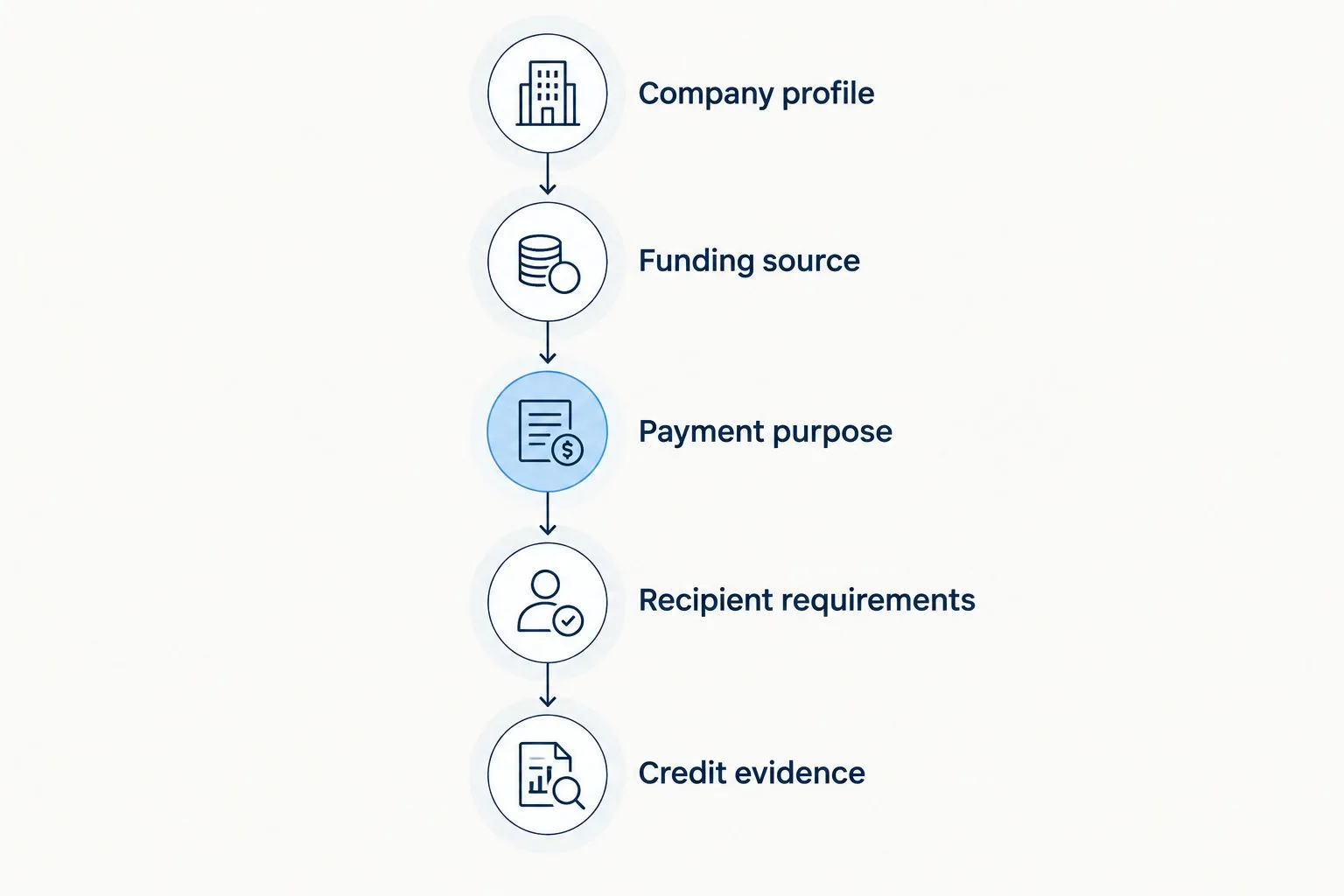
Use the same transaction specification when comparing payment providers.
Keep the brief specific to a real obligation. A general request for international payment coverage leaves too much unresolved, particularly when your company receives one currency and pays invoices in another.
For recurring supplier payments, also identify who checks beneficiary changes and who approves release. Payment-route selection does not replace your own payment controls.
Compare the full operation, not an isolated fee
A useful comparison records the total amount debited, the recipient currency, the amount credited, and the conditions attached to the quote. Ask which amounts are fixed and which depend on later conversion or third-party deductions.
Separate account-related charges from transaction-related charges in your internal assessment. Then assess conversion, transfer, intermediary, receiving, and withdrawal components wherever applicable. Do not assume every component applies to every route.
The published pricing information is a starting point for questions, not a substitute for the terms governing your specific transaction. Keep the applicable quote and conditions with the invoice approval record.
Currency labels require the same discipline. In a payment workflow, payment gateway currency support and treasury currency support answer different questions: accepting a customer payment does not establish that your business can hold that currency or use it for a supplier payout.
Compare the complete obligation from funding to recipient credit. A narrow comparison of the visible transfer charge leaves the finance team without a complete decision.
Separate transfer speed from supplier credit
Ask what each timing statement measures. Submission, provider processing, network settlement, and beneficiary-account credit describe different stages; your supplier usually cares about the last one.
Document applicable cutoffs, business-day definitions, compliance dependencies, and the process for incomplete beneficiary information. Treat timing as conditional on the stated route and transaction requirements rather than a platform-wide promise.
For goods and logistics payments, connect the payment plan to the commercial obligation. Record the invoice deadline and the evidence the supplier accepts. A payment sent before a deadline is not necessarily the same as a payment credited before that deadline.
Keep an escalation path with the transaction record. Your finance team needs to know who investigates a missing credit, what reference to provide, and how the outcome is documented.
Check eligibility before changing payment operations
A foreign-incorporated company seeking US-account access is not the same applicant as a US-incorporated company with a nonresident owner. Describe the legal entity accurately from the start.
Prepare the company registration record, ownership information, identity documents, business description, and transaction evidence requested by the provider. Requirements vary; use the actual application checklist rather than treating this list as sufficient for approval.
Ask which legal entity contracts with your business and which terms govern each service. Establish what account details represent, who provides the underlying service, and what restrictions apply to your intended activity.
Do not redirect customer receipts or supplier payments before onboarding and route checks are complete. No platform selection guarantees account approval or uninterrupted processing.
Which MENA B2B payment approach should you choose?
For 2026, choose the approach that resolves your documented business task. Start with the foreign-company account assessment when US-account access and international payments belong to the same operating need. Start with your bank when continuity is the priority and its proposed route meets the obligation.
Choose a local-rail assessment when the recipient requires a specific domestic payment method. Keep stablecoin settlement separate unless the counterparties, operating process, and applicable requirements support it.
For an undecided buyer, the next move is straightforward: prepare one real payment brief and request comparable terms. Select on confirmed eligibility and recipient outcome, not regional branding.
FAQ
What are the best MENA cross-border payment platforms for B2B companies?
The best choice is the provider that accepts your legal entity and completes your required payment route on documented terms. Compare business-account platforms, your bank, local-rail providers, and stablecoin settlement providers only where they serve the same obligation.
Is HEVN a bank?
HEVN is not a bank. Assess the applicable service structure, contracting entity, and account terms before using a service.
Can a foreign company apply for the same account as a US company with a nonresident owner?
These are different legal-entity situations and require separate eligibility checks. State the incorporation country, ownership structure, and intended activity accurately in the application.
Does local currency funding mean I can hold that currency?
No. Funding, balance holding, conversion, and withdrawal are separate capabilities that require confirmation under the applicable product terms.
How should I compare international supplier payment costs?
Compare the full amount debited with the amount credited to the supplier under the same transaction assumptions. Identify applicable conversion, transfer, intermediary, receiving, and withdrawal components.
Does a fast transfer mean my supplier receives funds immediately?
No. Submission, processing, settlement, and beneficiary credit are different stages, so ask which stage the timing statement describes and what conditions apply.
Are stablecoin payments the default choice for MENA business payments?
No. Treat stablecoin settlement as a separate workflow requiring counterparty agreement, appropriate controls, and assessment of applicable legal requirements.
One last thing
Before your next 2026 provider assessment, ask the supplier which account must receive the funds, in which currency, and which payment reference must survive. Put the answer in the payment brief. Comparing platforms before confirming the beneficiary requirement starts the decision at the wrong end.